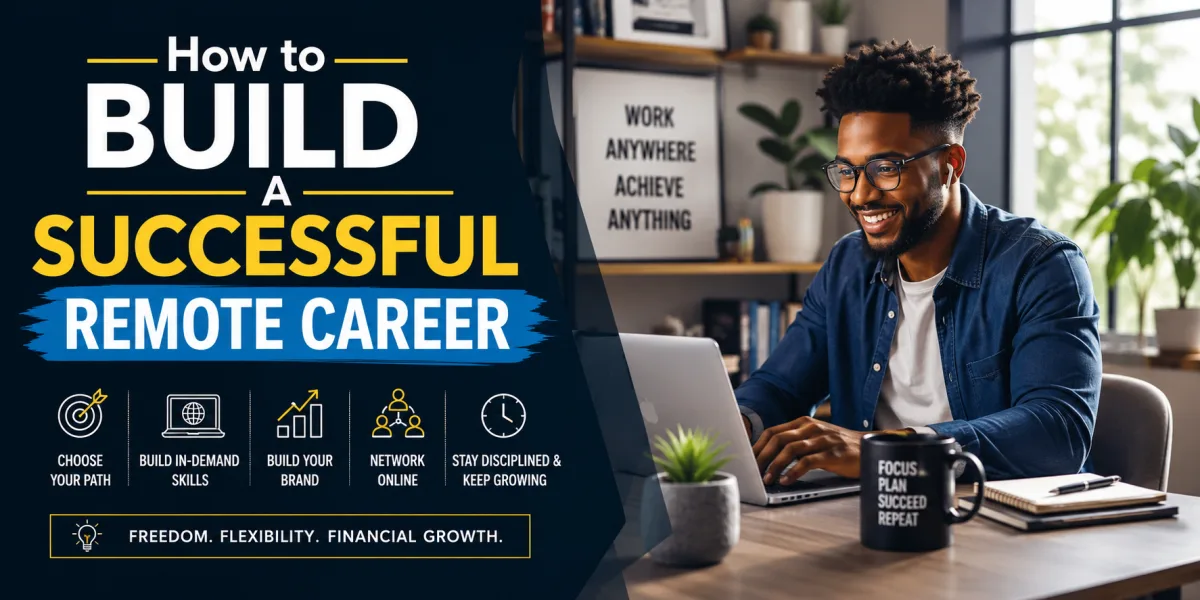
The Remote Career Advantage: How to Build a Work-From-Home Path That Actually Grows
A remote job is not the same as a remote career.
A remote job gives you permission to work away from an office. A remote career gives you a path to grow your skills, income, reputation, responsibility, and freedom over time. The difference is not location. The difference is strategy.
Many people want remote work because they want relief from commuting, office distractions, rigid schedules, or limited local opportunities. Those are legitimate reasons. Remote work can give a person more control over daily life. It can allow a parent to stay closer to home, a worker in a small town to access national employers, a caregiver to maintain income, or a professional to choose opportunity without relocating.
But remote work also creates new risks. You can become invisible. You can be excluded from informal conversations. You can work longer hours because home and work blur. You can lose momentum because nobody sees your effort directly. You can be judged by output more harshly than presence. You can miss promotions if leaders associate advancement with proximity. You can drift into isolation if every interaction becomes transactional.
A successful remote career requires more than logging in from home. It requires deliberate communication, visible contribution, digital fluency, self-management, relationship building, measurable results, and continuous skill growth.
The market makes this discipline even more important. Robert Half reported that across roles it analyzed in Q1 2026, 77% of new job postings were fully on-site, 19% were hybrid, and only 4% were fully remote. Fully remote opportunities exist, but they are scarce enough that workers must compete through skill, proof, and reliability.
Remote work can still create real upward mobility. A 2026 study using 48 million U.S. job transitions found that workers entering remote-eligible jobs experienced higher wage growth and higher rates of upward seniority mobility than comparable workers entering fully on-site roles. The effects were especially large for lower-income workers and people from regions with fewer high-skill opportunities.
That is the promise worth taking seriously. Remote work can reduce geographic barriers and expand access to opportunity. But access is only the beginning. The worker still has to build a career.
Choose a Remote-Friendly Career Path, Not Just a Remote Job
The first step is choosing work that can grow remotely. Not every job that can be done from home offers the same long-term career potential.
Some remote jobs are task-based. They pay for completing repetitive work: basic data entry, simple moderation, low-level customer responses, transcription cleanup, or microtasks. These roles can provide income, but they often have limited growth unless they lead to a higher-value skill.
Other remote roles are career-building. They develop skills that employers and clients continue to value: technical support, sales, customer success, bookkeeping, digital marketing, writing, project coordination, operations, data analysis, web development, design, product support, cybersecurity, software testing, and consulting.
The difference matters. A task-based remote job may solve an immediate income problem. A career-building remote role can increase your earning power over time.
When evaluating a remote opportunity, ask whether the role builds transferable skills. Will you learn tools used across industries? Will you work with customers, revenue, data, systems, projects, or technical problems? Will the experience qualify you for a better role later? Will you be able to show measurable results? Will the work become more valuable with experience?
A remote customer support role can become a path to customer success, product operations, technical support, quality assurance, or account management. A virtual assistant role can become operations coordination, executive assistance, project management, or business management. A social media assistant role can become digital marketing, email marketing, content strategy, or paid advertising. A data entry role can become data cleanup, reporting, analytics, or operations support.
The best remote career begins with the next role in mind. Do not only ask, “Can I do this from home?” Ask, “Where can this take me?”
Understand the Remote Career Trade-Off
Remote work offers flexibility, but it also shifts responsibility onto the worker. In an office, some visibility happens automatically. People see when you arrive, attend meetings, answer questions, help colleagues, stay late, or contribute to informal conversations. Remote workers do not receive that passive visibility.
This is not unfair; it is structural. Remote work reduces physical signals. That means results, communication, and trust become more important.
A remote worker must be clearer than an office worker. Clearer about priorities. Clearer about deadlines. Clearer about blockers. Clearer about progress. Clearer about availability. Clearer about accomplishments.
This can feel unnatural at first. Many people believe good work should speak for itself. In remote careers, good work needs documentation. Not exaggeration. Not self-promotion without substance. Documentation.
If you solve a customer problem, record it. If you improve a process, explain it. If you complete a major task, summarize the outcome. If you identify a risk, make it visible early. If you help a teammate, do not hide the contribution. Remote careers reward people who make their work easy to understand.
The trade-off is simple: remote work gives you more autonomy, but it requires more intentional professionalism.
Build Trust Before You Ask for Flexibility
Trust is the currency of remote work. Managers, clients, and teammates need to believe that you will do what you said, when you said, at the quality expected, without constant supervision.
Trust is built through repeated small signals. You respond when needed. You meet deadlines. You ask clarifying questions early. You document decisions. You admit when something is delayed. You do not disappear. You follow through. You make other people’s work easier.
Many remote workers damage trust not through major mistakes, but through ambiguity. They go silent on tasks. They miss messages without explanation. They wait too long to report blockers. They treat deadlines casually. They assume people know what they are doing.
Remote work magnifies uncertainty. If a manager cannot see you and also cannot understand your progress, confidence declines. The solution is not to be constantly online. The solution is to communicate predictably.
A simple weekly rhythm can build trust. On Monday, confirm priorities. During the week, update progress on important tasks. If blocked, explain the issue and propose next steps. On Friday, summarize what was completed, what remains, and what decisions are needed.
This rhythm reassures people without requiring surveillance. It shows ownership.
Master Written Communication
Written communication is one of the most important remote career skills. Emails, chat messages, project updates, documents, tickets, meeting notes, proposals, and status reports become the infrastructure of work.
Remote workers who write clearly move faster. They reduce confusion. They prevent unnecessary meetings. They make decisions easier. They create records. They help teams operate across time zones.
Good remote writing is concise, specific, and action-oriented. It explains context, decision, owner, deadline, and next step. It does not bury the point in long paragraphs. It does not assume everyone remembers the conversation. It does not leave people guessing.
Compare these two messages:
“Just checking on the campaign. Let me know what you think.”
“The campaign draft is ready for review. I need feedback on the subject line and offer by Thursday at 3 p.m. so we can schedule the email for Friday morning. The draft is linked here, and I added two options for the opening paragraph.”
The second message is better because it reduces work for the reader. It tells them what happened, what is needed, when it is needed, and where to look.
In remote work, clarity is generosity. It saves everyone time.
Become Visible Without Becoming Noisy
Remote workers often worry about visibility. The answer is not constant messaging, performative busyness, or attending every meeting. Visibility should come from useful contribution.
You become visible by sharing progress, solving problems, documenting improvements, asking thoughtful questions, helping teammates, presenting results, and connecting your work to business goals.
A useful visibility habit is the weekly achievement note. This can be a short update to your manager or team: what you completed, what result it produced, what you learned, what is next, and where you need input. Keep it factual. The goal is not bragging. The goal is making impact legible.
Another visibility habit is documenting decisions. After a meeting, send a brief recap: decisions made, owners, deadlines, unresolved questions. This positions you as someone who creates clarity.
You can also become visible by improving systems. Create a better onboarding checklist. Update a confusing FAQ. Build a dashboard. Write a process guide. Clean up a project board. Summarize customer feedback. Remote teams value people who reduce operational friction.
The best remote visibility is not self-centered. It makes the team better.
Protect Deep Work
Remote work can improve focus, but only if you protect it. Without boundaries, a remote day can dissolve into messages, meetings, household interruptions, notifications, and half-finished tasks.
Deep work is concentrated time spent on tasks that require thinking: writing, analysis, planning, coding, design, strategy, problem-solving, reporting, research, or complex customer issues. These tasks often create the most career value. They also suffer most from constant interruption.
Build blocks of focused time into your calendar. Turn off nonessential notifications. Use status messages to signal focus. Batch administrative tasks. Separate urgent communication from routine communication. Do not let chat become your manager.
Task management tools can help, but tools alone do not create productivity. A 2025 study of remote knowledge workers using task management tools found that digital task management applications did not significantly improve perceived productivity compared with pen and paper, emphasizing the need for better personalization rather than assuming tools solve productivity problems automatically.
The lesson is practical: choose a simple system you will actually use. A sophisticated tool ignored daily is worse than a plain checklist followed consistently.
Remote productivity is not about appearing busy. It is about completing valuable work reliably.
Learn to Manage Your Energy, Not Only Your Time
Remote workers often focus on time management, but energy management matters just as much. Working from home can blur boundaries. You may start earlier, end later, skip breaks, eat poorly, move less, and remain mentally attached to work long after the day ends.
This is not sustainable. A successful remote career is a long-term asset. It should not be built on burnout.
Create start and stop rituals. A commute used to separate work and home. Remote workers need replacements. A morning walk, planning session, desk setup, or first focused task can signal the start of work. Closing your laptop, writing tomorrow’s priorities, or taking an evening walk can signal the end.
Take movement seriously. Remote work removes natural movement: walking to meetings, commuting, going to lunch, moving between floors. Without intention, the body becomes sedentary. Short walks, stretching, standing breaks, and exercise protect energy and mental clarity.
Protect recovery. If your home is your office, you need boundaries around availability. Not every message needs an instant response. Not every task deserves evening attention. Sustainable remote workers know when to stop.
A remote career should improve life, not quietly consume it.
Build Digital Fluency
Remote careers depend on digital tools. The exact tools vary by role, but the underlying skill is the same: you must be comfortable learning software, organizing information, collaborating online, and troubleshooting basic problems.
Common remote tools include Slack, Microsoft Teams, Zoom, Google Workspace, Microsoft 365, Notion, Asana, Trello, ClickUp, Monday.com, Jira, HubSpot, Salesforce, Zendesk, Intercom, QuickBooks, Canva, Loom, Miro, Airtable, GitHub, Figma, and analytics dashboards.
You do not need to master every tool. You need confidence learning new ones. Remote teams change systems often. A worker who panics every time a tool changes becomes less adaptable. A worker who can learn, document, and teach tools becomes more valuable.
Digital fluency also includes cybersecurity habits. Use strong passwords, multi-factor authentication, secure Wi-Fi, approved devices, and safe file-sharing practices. Do not download suspicious attachments. Do not place confidential information into unauthorized AI tools. Do not treat home technology casually when it carries business data.
Remote workers are part of the security perimeter. Professionalism includes protecting information.
Develop a Reputation for Ownership
Ownership is the quality that separates average remote workers from career builders. Ownership means you do not merely complete assigned tasks. You understand the outcome, anticipate obstacles, communicate risks, and follow through until the problem is solved.
A task-oriented remote worker says, “I sent the email.”
An ownership-oriented remote worker says, “I sent the email, tracked responses, followed up with the three prospects who opened but did not reply, and updated the CRM with next steps.”
The second person is more valuable because they think in outcomes.
Remote teams need ownership because managers cannot monitor every detail. A person who can take a problem and move it forward reduces management burden. That is how remote workers earn trust, raises, promotions, better clients, and more autonomy.
Ownership does not mean doing everything alone. It means being responsible for clarity. If you need help, ask. If a deadline is unrealistic, say so early. If a decision is blocked, explain the options. If something fails, identify the lesson.
Remote career growth favors people who make uncertainty smaller.
Build Relationships Intentionally
Remote work can make relationships feel optional. They are not. Careers are built through trust, reputation, collaboration, sponsorship, mentorship, referrals, and shared problem-solving. These require relationships.
In an office, some relationships form casually. Remote workers must be more intentional. Schedule occasional one-on-one conversations with teammates. Ask about priorities. Offer help. Join relevant team discussions. Participate in virtual gatherings when useful. Use meetings not only to report work, but to understand people.
Relationship building does not require forced friendliness. It requires consistency and respect. Respond thoughtfully. Give credit. Thank people. Ask good questions. Share context. Avoid making every interaction a transaction.
Mentorship also matters. Find people who understand the career path you want. Ask how they developed skills, earned promotions, handled remote visibility, and avoided mistakes. A short, specific question is better than a vague request to “pick your brain.”
Remote careers can be lonely if you wait for connection to happen. Build it deliberately.
Understand How Promotions Work Remotely
Remote workers can be promoted, but they often need to be more deliberate about proving readiness. Promotions usually require evidence of impact, not just time served.
To prepare for advancement, understand what the next level requires. Review job descriptions for senior roles. Ask your manager what skills or outcomes would justify promotion. Identify gaps. Build a record of accomplishments. Take on visible projects. Document business impact.
Do not wait until annual review season to discuss growth. Have career conversations throughout the year. Ask: “What would make me a stronger candidate for the next level?” “Which responsibilities should I begin owning?” “What metrics matter most for this role?” “Where do you see the biggest skill gap?”
Remote workers should maintain a promotion file. Include completed projects, metrics, customer feedback, process improvements, revenue influenced, costs saved, deadlines met, leadership moments, and examples of cross-functional collaboration. This file makes performance conversations concrete.
Without documentation, remote work can disappear into the background. With documentation, it becomes evidence.
Measure Your Work in Business Terms
Career growth accelerates when you connect your work to business outcomes. Every role can do this.
Customer support can measure response time, resolution rate, customer satisfaction, ticket volume, knowledge base improvements, and churn risks identified. Sales can measure meetings booked, pipeline created, conversion rates, and revenue. Marketing can measure leads, email performance, traffic, conversion, and campaign output. Operations can measure cycle time, errors reduced, processes documented, and handoff improvements. Data analysts can measure reports delivered, decisions supported, and insights acted upon.
The point is not to reduce your entire value to numbers. The point is to help others understand impact.
Remote careers are vulnerable when work is vague. “I helped with operations” is weak. “I reduced client onboarding time from five days to two by creating a standardized checklist and automated reminders” is strong.
Business language makes remote contribution visible.
Keep Learning in Public and Private
Remote careers grow through continuous learning. The market changes quickly. Tools evolve. AI becomes more embedded. Employers expect digital adaptability. Workers who stop learning become easier to replace.
Private learning includes courses, books, certifications, practice projects, and tool training. Public learning includes sharing useful insights, documenting projects, writing posts, contributing to professional communities, or presenting internally.
You do not need to become a public influencer. But some visible learning helps. A marketer who shares a campaign breakdown, a developer who maintains a GitHub project, a designer who posts portfolio updates, a bookkeeper who writes about common small business mistakes, or a support specialist who creates helpful documentation builds reputation.
AI skills are increasingly relevant across remote roles. A 2025 study of roughly ten million online job vacancies from 2018 to 2024 found that AI-related roles were significantly more likely to offer non-monetary benefits, including remote working options, even after controlling for education, industry, and occupation type.
The lesson is not that everyone must become an AI engineer. The lesson is that workers who learn how to use emerging tools responsibly may improve their career options. Remote careers reward adaptability.
Use AI as a Career Multiplier
AI tools can help remote workers draft emails, summarize meetings, analyze documents, prepare reports, organize notes, create first drafts, generate ideas, improve presentations, and automate repetitive work. Used well, AI can increase output quality and speed.
But AI should not become a substitute for judgment. Do not paste confidential company data into unapproved tools. Do not submit AI-generated work without review. Do not rely on AI for facts without verification. Do not let your writing become generic. Do not automate communication that requires empathy.
The strongest remote professionals use AI to improve their process while keeping ownership of the outcome. A project coordinator can use AI to summarize meeting notes, then verify action items. A writer can use AI for outlines, then add original thinking. A data analyst can use AI to explain formulas, then check the numbers. A customer support worker can use AI to draft responses, then adapt them to the customer’s actual problem.
AI can help you work faster. Your career grows when you use that speed to deliver better judgment.
Protect Your Home Office as a Professional Environment
A remote career needs infrastructure. The setup does not need to be luxurious, but it should be reliable.
You need stable internet, a functional computer, a decent microphone or headset, proper lighting for video calls, a comfortable chair if possible, secure passwords, backup access plans, and a workspace that supports focus. If your work involves confidential calls, you need privacy. If your work involves customer service, you need quiet.
Small improvements can produce large benefits. A better headset reduces meeting fatigue. A second monitor can improve productivity for spreadsheets, support tickets, design, coding, or project management. A dedicated desk area helps separate work from home life. A backup internet option can protect you during outages.
Remote workers should also understand employer equipment policies. Some companies provide devices. Others require personal equipment. Contractors may need to supply their own tools. Plan for these costs when evaluating remote opportunities.
Your work environment is part of your professional credibility.
Avoid the Isolation Trap
Remote work can be freeing, but it can also become isolating. Without office interaction, workers may lose casual feedback, social connection, mentorship, and a sense of belonging.
Isolation can quietly weaken performance and career growth. You may become less informed about company priorities. You may hesitate to ask questions. You may feel disconnected from the team. You may miss opportunities because nobody knows what you want next.
Prevent this deliberately. Schedule recurring check-ins with your manager. Maintain relationships with peers. Join professional communities outside your company. Attend occasional industry events, online workshops, or local meetups if available. Build a network that is not entirely dependent on one employer.
Remote workers should also create social rhythms outside work. Exercise groups, friendships, volunteering, coworking days, community activities, or local professional meetups can protect mental health and broaden opportunity.
A successful remote career should not shrink your world. It should give you more control over how you build it.
Plan for Job Security Differently
Remote workers need a different approach to job security. Because remote roles attract wider applicant pools and companies can hire across regions, competition can be intense. Remote workers should treat employability as an ongoing project.
Keep your resume updated. Maintain a portfolio. Track accomplishments. Build savings. Maintain relationships outside your employer. Learn adjacent skills. Watch market trends in your field. Know which companies hire for your role remotely.
Do not wait until you need a job to build proof. A remote worker who has a portfolio, references, documented results, and an active network can respond faster if employment changes.
Job security no longer comes only from staying at one company. It comes from being valuable in the market.
Negotiate Remote Work Clearly
Remote arrangements should be clear. Is the role fully remote, hybrid, remote within a specific country, remote within a time zone, temporarily remote, or remote with travel? Does the company provide equipment? Are work hours fixed? Are meetings required at certain times? Can you work from another country? Are there tax or compliance restrictions?
Do not assume. Ask before accepting.
Remote work has become a point of tension as some employers change policies. A worker hired remotely may later face return-to-office pressure. This is why written terms matter. Employment agreements, offer letters, remote work policies, and manager confirmations should be reviewed carefully.
If remote work is essential to your life, treat it as a core employment term, not a casual perk.
Know When to Choose Hybrid Strategically
Fully remote work is valuable, but hybrid work may sometimes be a strategic compromise. Hybrid roles are more available than fully remote roles in many markets. Robert Half’s Q1 2026 data showed hybrid postings at 19% compared with fully remote postings at 4% among analyzed roles.
Hybrid work can offer some flexibility while preserving in-person relationship building. It may be useful for early-career workers who need mentorship, people changing fields, or professionals seeking promotion in companies that still value office presence.
The decision should be practical. If a hybrid role offers better pay, stronger learning, a reputable company, and a manageable commute, it may advance your career more than a weaker fully remote role. If the commute is costly, the office culture is poor, or the role limits your options, fully remote may be better.
The goal is not ideological purity. The goal is career growth and life fit.
Build Multiple Income Options Over Time
A successful remote career can also create side-income opportunities. Skills developed remotely often translate into freelance services, consulting, digital products, tutoring, templates, courses, or advisory work.
A remote marketer can consult for small businesses. A bookkeeper can take freelance clients. A project manager can sell templates. A technical support specialist can teach beginners. A writer can build a newsletter. A web developer can create small websites. A data analyst can sell dashboard services.
This does not mean every remote worker must become an entrepreneur. But building optional income can increase resilience. Remote work already develops digital delivery habits. Those habits can become assets.
Be careful with conflicts of interest. Review employment agreements, confidentiality rules, non-compete or non-solicitation provisions where applicable, and company policies before taking outside work. Do not use employer time, data, or equipment for personal business.
Multiple income streams should strengthen your financial position, not jeopardize your main career.
Create a Remote Career Scorecard
To manage your career, track more than salary. Build a personal scorecard.
Include income, skill growth, promotion path, manager quality, workload, flexibility, benefits, learning opportunities, visibility, network growth, portfolio value, work-life boundaries, and long-term marketability.
A job with slightly lower pay but strong skill growth may be valuable. A high-paying role with no growth and constant burnout may be costly. A flexible role that allows a side business may support wealth building. A prestigious role with poor remote culture may damage energy and confidence.
Review your scorecard every six months. Ask whether the role is still helping you grow. If not, decide whether to improve the current role, negotiate, transfer internally, learn new skills, or search externally.
Remote careers can drift because the environment feels comfortable. Comfort is not the same as progress.
A Practical 12-Month Remote Career Plan
In the first three months, focus on reliability. Learn the tools, understand expectations, document processes, communicate clearly, and build trust. Ask your manager what success looks like. Deliver consistently.
In months four through six, focus on visibility. Take ownership of a process, improve a workflow, present a result, create documentation, or help solve a recurring problem. Begin tracking accomplishments.
In months seven through nine, focus on skill expansion. Identify one skill that would increase your value: data analysis, automation, customer success, sales, writing, technical troubleshooting, project management, AI workflow design, or leadership. Build proof through a project.
In months ten through twelve, focus on advancement. Discuss growth with your manager. Update your resume and portfolio. Compare your current role with market opportunities. Decide whether to pursue promotion, raise, internal transfer, freelance work, certification, or a new role.
This plan prevents remote work from becoming passive. It turns location flexibility into career leverage.
Common Remote Career Mistakes
The first mistake is confusing comfort with growth. Working from home may feel better than commuting, but the role still needs to develop your skills and income.
The second mistake is disappearing. Remote workers who do good work silently may be overlooked. Communicate progress and impact.
The third mistake is overworking. Without boundaries, remote work can stretch across the entire day. Protect recovery.
The fourth mistake is relying on one employer. Keep skills, networks, and proof current.
The fifth mistake is ignoring relationships. Remote careers still require trust, mentorship, sponsorship, and collaboration.
The sixth mistake is letting tools replace judgment. Productivity apps, AI assistants, and dashboards help only when tied to clear priorities.
The seventh mistake is staying in low-value remote work too long. Use accessible roles as stepping stones toward higher-value skills.
The Bigger Lesson
A successful remote career is built, not found.
Finding a remote job may be the first step, but it is not the whole strategy. Long-term success requires choosing remote-friendly skills, building trust from a distance, communicating clearly, staying visible, documenting results, managing energy, learning continuously, and developing relationships intentionally.
Remote work can expand opportunity by weakening the link between geography and career access. It can help workers reach better jobs without relocating. It can support wage growth and upward mobility. But it does not remove competition. It does not guarantee advancement. It does not reward invisibility.
The remote worker who succeeds is not merely available online. They are reliable, clear, adaptable, measurable, and trusted.
Choose work that builds skills. Make your contribution visible. Protect your focus. Communicate with precision. Learn tools quickly. Build relationships deliberately. Track accomplishments. Ask for growth. Keep your market value alive.
Remote work gives you location flexibility. A remote career gives you financial and professional leverage.
The difference is discipline.
 Article
 Article
 Article
 Article
 Article
 Article
 Article
 Article