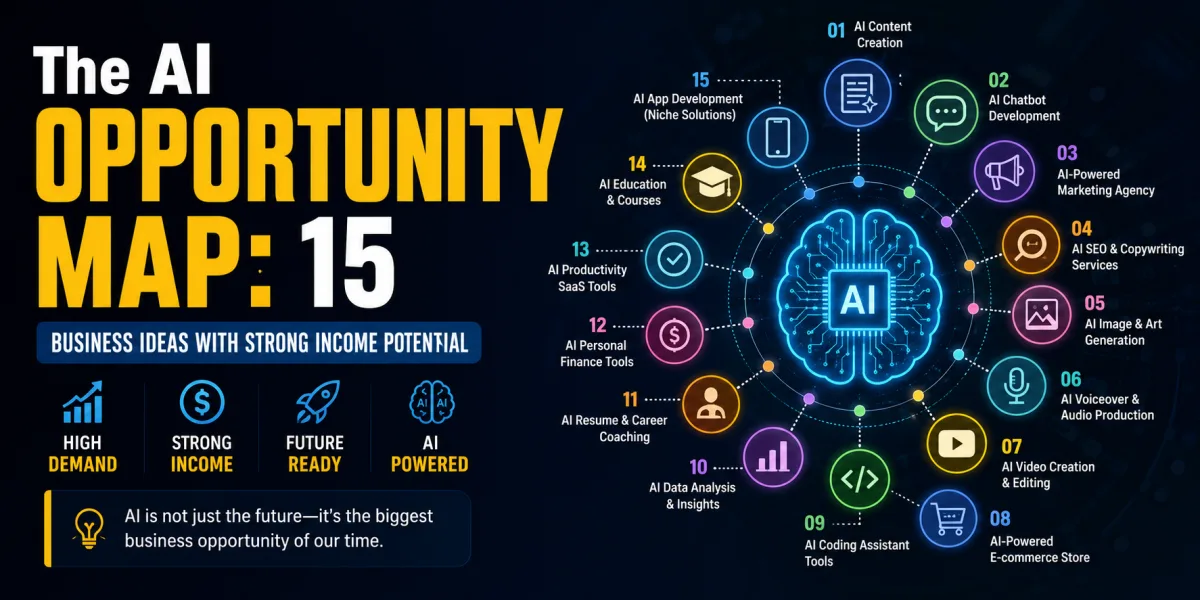
The AI Opportunity Map: 15 Business Ideas with Strong Income Potential
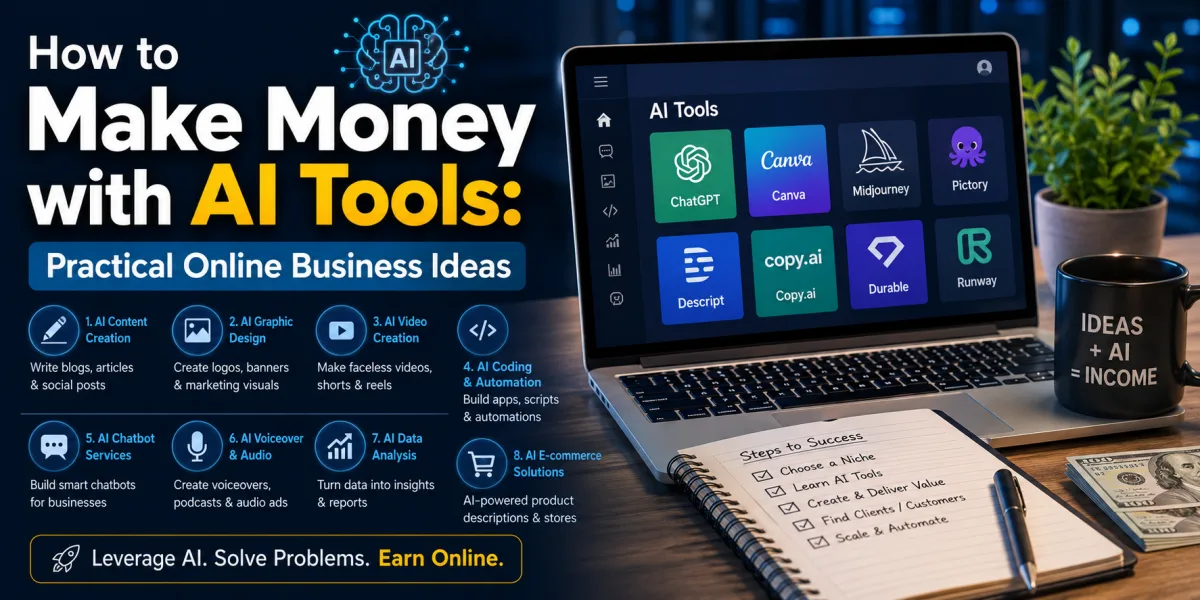
Artificial intelligence has created a new income frontier, but not in the way most online hype suggests. The opportunity is not in typing a few prompts, generating generic content, and waiting for money to arrive. The opportunity is in using AI to solve real business problems faster, cheaper, or better than traditional methods.
That distinction matters because the internet is already crowded with shallow AI income claims. People are told to sell prompt packs, generate faceless videos, create instant ebooks, launch automated stores, or build one-click agencies. Some of these tactics may produce short-term revenue for a few people, but most collapse under the weight of weak demand, poor quality, platform changes, customer distrust, and low differentiation.
The durable money in AI will be earned by people who understand customers, workflows, risk, quality, and distribution. AI is not a business model by itself. It is leverage. It can help one person do the work of several people, but only if that work is valuable in the first place.
Demand is growing because businesses are still trying to understand how AI fits into daily operations. A 2026 Goldman Sachs survey found that 93% of small businesses using AI reported a positive business impact, while only 14% said AI was fully embedded in their core operations. That gap creates room for service providers, consultants, trainers, builders, and product creators who can help businesses move from experimentation to useful implementation.
JPMorgan Chase Institute also reported that AI adoption among small businesses rose steadily from 2019 to 2025, with a notable uptick beginning around 2023. This matters for entrepreneurs because small businesses are no longer asking whether AI exists; they are asking how to use it without wasting time, money, or trust.
Large organizations are also moving from pilots toward production. Deloitte’s 2026 State of AI in the Enterprise report noted that worker access to AI rose by 50% in 2025 and that companies expected more AI projects to move into production. That creates opportunity not only in enterprise consulting, but also in downstream small business services as AI habits become normal across the economy.
The best AI business ideas are not the flashiest. They are the ones attached to recurring pain: administrative overload, slow customer response, expensive content production, messy data, poor follow-up, inefficient sales, weak documentation, inconsistent marketing, time-consuming research, and lack of AI training. Businesses pay when AI helps solve those problems with measurable value.
This article explains 15 AI business ideas with strong income potential. Each idea is evaluated as a real business model, not a trend. The goal is to identify where AI creates pricing power, where beginners can start, where expertise matters, and where the risks must be managed carefully.
1. AI Automation Agency for Small Businesses
An AI automation agency helps businesses reduce repetitive work by designing workflows that combine AI tools with existing software. This can include lead intake, email drafting, appointment reminders, customer support routing, invoice follow-up, meeting summaries, CRM updates, reporting, and internal task management.
The income potential is strong because small businesses often lose time to administrative work but cannot afford large operations teams. A local service business, coaching company, agency, clinic, real estate office, ecommerce store, or consulting firm may have dozens of repetitive tasks that consume owner time every week. If an automation saves five to ten hours per week, the value is easy to understand.
This business can be packaged in several ways. A starter package might audit workflows and build three simple automations. A higher-priced package might redesign a lead management system, connect forms to a CRM, create AI-assisted follow-up emails, and document the process. A recurring plan might monitor automations, update prompts, fix broken workflows, and review performance monthly.
The best automation agencies do not sell complexity. They sell time savings, fewer mistakes, faster follow-up, and smoother operations. A good offer might be: “We help local service businesses respond to every website inquiry within five minutes using AI-assisted intake, routing, and follow-up workflows.” That is clearer than “We build AI automations.”
The skill requirement is moderate to high. You need to understand workflow tools, AI prompting, basic data handling, customer journeys, and process documentation. You also need judgment. Not every process should be automated. Some customer moments require human attention. Some data should not be entered into public AI systems. Some automations create more risk than value.
The safest starting point is low-risk internal automation. Build systems that summarize, draft, organize, remind, and route. Avoid automating high-stakes decisions such as medical advice, legal conclusions, hiring decisions, financial recommendations, or sensitive customer disputes unless you have the proper expertise and controls.
This business has strong income potential because it solves a clear operational problem and can generate recurring revenue. The winners will be operators, not prompt sellers.
2. AI Customer Support Chatbot Setup
Many businesses answer the same customer questions repeatedly. What are your hours? Do you ship internationally? How do returns work? How much does the service cost? What happens after I book? Where is my order? Do you offer payment plans? Can I reschedule?
An AI customer support chatbot business helps companies answer routine questions, capture leads, reduce support volume, and improve response speed. The opportunity is especially strong for ecommerce stores, course creators, SaaS businesses, clinics, agencies, local service companies, and membership businesses.
The income comes from setup fees and maintenance plans. A basic package could include FAQ collection, knowledge base creation, chatbot configuration, website installation, testing, and handoff documentation. A premium package could include integrations with help desk software, CRM tagging, lead qualification, analytics review, and monthly updates.
The value is not merely that a bot exists. The value is that customers get accurate answers faster and the business receives fewer repetitive messages. A chatbot that gives vague or invented answers is worse than no chatbot. It damages trust.
This business requires careful implementation. The chatbot should be trained or configured on approved business information. It should know when to escalate to a human. It should avoid making promises about refunds, pricing exceptions, legal matters, medical issues, or anything the business has not approved. It should be tested with real customer scenarios before going live.
The best customer support chatbot businesses focus on industries with repeated questions and measurable support burden. Ecommerce is a natural market because customers frequently ask about shipping, returns, product details, sizing, and order status. Service businesses are also strong candidates because leads often ask similar pre-booking questions.
The income potential is strong because businesses can justify the cost when the chatbot reduces workload, improves customer experience, or captures leads that would otherwise leave the site.
3. AI Content Repurposing Studio
Content repurposing is one of the most practical AI businesses because many creators and businesses already have valuable source material. They record podcasts, webinars, workshops, sales calls, coaching sessions, presentations, live streams, and long-form videos. The problem is turning that material into usable content across platforms.
An AI content repurposing studio turns one piece of long-form content into multiple assets: short video clips, captions, newsletters, blog posts, LinkedIn posts, quote graphics, show notes, email sequences, and content calendars.
The income potential is strong because this is a recurring need. A podcast releases weekly. A YouTube channel publishes regularly. A consultant hosts webinars. A coach records live sessions. A business owner answers the same customer questions on calls. Each source can become a content engine.
AI tools can transcribe, summarize, identify themes, create rough drafts, suggest hooks, and generate variations. Human judgment is what makes the output valuable. You must choose the strongest ideas, preserve the speaker’s voice, remove weak sections, adapt content to each platform, and ensure the final assets are useful rather than generic.
A strong offer might be: “Send us one weekly podcast episode, and we turn it into eight short clips, one newsletter, one blog post, and ten social posts.” This is specific, measurable, and easy to understand.
Pricing can be project-based or monthly. A small creator may pay a few hundred dollars per month. A business with higher content value may pay thousands if the repurposed content supports lead generation, authority, and sales.
The main risk is commoditization. Many people can run a transcript through AI. To stand out, specialize. Serve financial advisors, fitness coaches, real estate agents, B2B consultants, medical practices, SaaS founders, or online educators. The more you understand the niche, the better you can select useful ideas and avoid shallow output.
4. AI Training Workshops for Teams
Many businesses want to use AI but do not know where to begin. Employees experiment individually, owners hear conflicting advice, and teams worry about accuracy, privacy, job disruption, and tool overload. This creates strong demand for practical AI training.
An AI training business teaches teams how to use AI responsibly in their specific work. This can include prompting, document drafting, customer communication, meeting summaries, research, spreadsheet support, content creation, workflow automation, privacy rules, and quality control.
The strongest training is role-specific. A workshop called “AI for Small Business” is broad. A workshop called “AI Workflows for Real Estate Teams,” “AI for Nonprofit Grant Research,” “AI for Accounting Firm Admin,” or “AI for Local Service Business Marketing” is more valuable because it speaks to a defined use case.
Income can come from live workshops, corporate training sessions, online courses, custom prompt libraries, follow-up consulting, and implementation packages. A beginner might charge a few hundred dollars for a small group workshop. An experienced trainer serving businesses or professional associations can charge much more, especially if the training is customized.
The opportunity is supported by the gap between adoption and integration. Many businesses have tried AI tools, but few have redesigned workflows around them. Goldman Sachs’ small business survey found widespread positive impact from AI use, yet only a small share had fully embedded AI into core operations. That creates demand for trainers who can bridge experimentation and execution.
Responsible training should include limits. Teams should learn what not to put into AI tools, when to verify outputs, when human review is required, how to handle customer data, and how to avoid misleading AI-generated content. AI literacy is not only about productivity. It is about judgment.
5. AI-Assisted Resume and Career Services
Job seekers face a communication problem. They may have valuable experience but struggle to present it clearly. They need resumes, LinkedIn profiles, cover letters, interview preparation, career-change positioning, and job search strategy. AI can help draft and refine these materials, but human judgment is essential.
An AI-assisted career service uses AI to speed up research, analyze job descriptions, identify keywords, draft resume bullets, generate interview questions, and tailor application materials. The business owner adds career judgment, industry understanding, truthful positioning, and quality control.
The income potential is strong because career outcomes are financially meaningful. A better resume or stronger interview preparation can influence salary, job access, and career mobility. Customers often pay when the problem is urgent.
The best approach is specialization. Serve nurses, project managers, engineers, teachers changing careers, military veterans, recent graduates, executives, tech workers, immigrants entering a new labor market, or people returning after a career break. Each group has different language, concerns, and hiring patterns.
Offer packages rather than vague hourly help. A resume rewrite package, LinkedIn optimization package, interview preparation intensive, or career-change positioning package is easier to sell. AI can help create drafts quickly, but the final result must be specific, truthful, and differentiated.
The risk is overpromising. Do not guarantee job offers. Do not invent experience. Do not stuff resumes with misleading keywords. Do not let AI turn a person’s real career into generic corporate language. Trust matters deeply in career services.
This business is accessible for beginners with HR, recruiting, writing, management, or industry experience. It can produce income relatively quickly because the service is close to an urgent customer need.
6. AI-Powered Research and Briefing Service
Professionals are overwhelmed by information. Executives, consultants, sales teams, investors, founders, journalists, nonprofit leaders, and small business owners often need concise research before making decisions. AI can accelerate research, but customers still need accuracy, source judgment, and relevance.
An AI-powered research and briefing service delivers summarized, source-backed information for a specific audience. Examples include competitor briefs for small businesses, prospect research for sales teams, grant opportunity scans for nonprofits, market updates for real estate investors, industry trend reports for consultants, or meeting prep briefs for executives.
The income potential depends on the stakes of the decision. Research that helps a sales team win clients, a nonprofit find grants, a business understand competitors, or an investor evaluate opportunities can command meaningful fees. Research that merely summarizes public articles without insight will struggle.
A strong product might be a weekly intelligence brief for a niche. For example: “A weekly two-page market and competitor update for boutique fitness studio owners,” or “pre-call prospect briefs for B2B sales teams selling into healthcare practices.”
AI helps gather and organize information. The business owner must verify sources, remove weak claims, interpret patterns, and present information in a decision-ready format. This distinction is important. AI summaries can be wrong or incomplete. A paid research service must be trustworthy.
The model can be sold as a subscription, retainer, or project. Recurring briefs create more stable revenue. Project-based research can command higher prices when tied to specific decisions.
This business suits people who enjoy research, writing, analysis, and niche markets. The value is not information alone. It is filtered insight.
7. AI-Enhanced Ecommerce Optimization Service
Ecommerce businesses often struggle with product pages, customer questions, reviews, conversion rates, email campaigns, and repeat purchases. AI can help analyze reviews, draft product descriptions, create FAQs, write email flows, generate ad variations, and identify customer objections.
An AI-enhanced ecommerce optimization service helps online stores turn customer data into better selling assets. This could include rewriting product pages, creating review-based FAQs, improving category descriptions, generating post-purchase emails, building abandoned cart sequences, or creating customer support response libraries.
The income potential is strong because ecommerce owners care about conversion and average order value. If better product pages, clearer FAQs, or stronger emails increase sales or reduce support questions, the service has measurable value.
A strong offer might be: “We analyze your customer reviews and support tickets, then rewrite your top 10 product pages to answer buyer objections and improve clarity.” This is more valuable than simply offering AI copywriting because it uses real customer language.
AI can process large amounts of review text quickly. It can identify repeated complaints, praise, use cases, objections, and questions. The human operator turns those insights into copy, positioning, bundles, email flows, or support materials.
The risk is inaccurate product claims. AI should not invent materials, dimensions, health benefits, certifications, shipping promises, or guarantees. Ecommerce copy must be accurate. A misleading claim can create refunds, chargebacks, platform issues, or legal problems.
This business is especially promising for people with experience in ecommerce, copywriting, merchandising, customer support, or digital marketing.
8. AI Workflow Kits and Prompt Systems
Generic prompt packs are weak products. They are easy to create, easy to copy, and often too broad to be useful. But AI workflow kits can be valuable when they help a specific professional perform a recurring task better.
A workflow kit includes prompts, instructions, examples, templates, review checklists, and use cases. It teaches the buyer how to use AI inside a real process. Examples include an AI client onboarding kit for freelance designers, an AI lesson planning kit for teachers, an AI customer response kit for ecommerce sellers, an AI grant research kit for nonprofits, or an AI weekly content planning system for real estate agents.
The income potential comes from scalability. Once created, a digital kit can be sold repeatedly. It can also lead to workshops, consulting, memberships, or custom implementation.
The key is specificity. A prompt such as “write a social media post” has little value. A workflow that helps a dentist’s office turn patient FAQs into educational posts, email reminders, and website content is more valuable. The buyer is not paying for prompts. They are paying for a repeatable system.
This business works best when the creator understands a niche deeply. If you have worked in education, healthcare administration, real estate, coaching, ecommerce, nonprofit operations, HR, recruiting, or finance, you can create workflow kits that reflect real tasks.
The risk is selling low-effort AI output. Buyers will become more skeptical as the market fills with generic products. Strong kits should be tested, clearly explained, and designed for implementation. Include examples, mistakes to avoid, and quality-control steps.
9. AI Video and Short-Form Content Agency
Short-form video remains a major channel for discovery, but creating consistent clips is time-consuming. AI tools can help with transcription, captions, clip selection, rough cuts, resizing, title suggestions, and content summaries. This creates an opportunity for an AI-assisted video agency.
The business serves creators, coaches, podcasters, consultants, ecommerce brands, educators, local businesses, and professional firms that produce source material but struggle to turn it into platform-ready content.
The income model is often recurring. A client may pay monthly for a set number of clips, captions, thumbnails, descriptions, and scheduling support. Higher-priced packages can include content strategy, analytics review, and long-form editing.
The strongest positioning is outcome-based. “We create 20 short clips per month from your podcast and webinars so you can stay visible without editing for hours.” This is clearer than “AI video services.”
Human judgment is essential. AI may identify clips, but not every clip is worth publishing. Good short-form content needs a hook, context, pacing, caption accuracy, and a clear takeaway. Brand tone matters. Sensitive industries require extra care.
The creator economy continues to attract AI-driven tools and business models. A 2026 research report estimated the AI-in-creator-economy market at $5.71 billion in 2026, projected to reach $16.81 billion by 2030. That growth reflects strong demand for tools and services that help creators produce, monetize, and manage content more efficiently.
The risk is authenticity. AI-generated or AI-edited content can feel generic if overproduced. The best agencies preserve the client’s real voice while improving speed and consistency.
10. AI Consulting for Professional Service Firms
Professional service firms often have document-heavy, communication-heavy workflows. Lawyers, accountants, consultants, insurance agencies, financial advisors, architects, recruiters, and medical practices handle client intake, meeting notes, research, proposals, reports, follow-up emails, compliance documents, and internal knowledge.
An AI consulting business for professional service firms helps identify where AI can safely improve productivity. This may include drafting internal documents, summarizing meetings, organizing knowledge bases, preparing client communication templates, building intake workflows, and training staff on responsible use.
The income potential is strong because professional firms bill for expertise and lose money when highly paid people spend time on repetitive administrative tasks. Saving a partner, advisor, consultant, or senior staff member several hours per week can justify meaningful fees.
This business requires more caution than general small business AI services. Professional firms handle sensitive client information. They may operate under confidentiality, privilege, regulatory, or ethical obligations. A consultant must understand data privacy, access controls, human review, and tool selection.
The opportunity is not to replace professionals. It is to improve support work around professionals. Drafting first versions, summarizing non-sensitive notes, organizing approved knowledge, creating internal templates, and improving follow-up can be valuable when properly governed.
A strong offer might be: “We help small accounting firms build AI-assisted client intake, document drafting, and internal knowledge workflows with clear review controls.” This speaks to a real operational problem while acknowledging professional responsibility.
This business suits people with experience in professional services, operations, compliance, or consulting.
11. AI-Powered Lead Generation and Sales Follow-Up Service
Many small businesses do not have a lead problem as much as a follow-up problem. Website inquiries go unanswered. Quotes are sent late. Prospects are not nurtured. Sales conversations are not tracked. Past customers are not reactivated.
An AI-powered lead generation and follow-up service helps businesses respond faster, personalize outreach, qualify prospects, and maintain communication. AI can draft responses, summarize lead information, personalize follow-up, identify customer segments, and support CRM updates.
The income potential is strong because lead follow-up is tied directly to revenue. If a business closes more inquiries because response time improves, the service can pay for itself.
A practical offer might serve local service businesses: “We set up an AI-assisted lead response system that replies to new inquiries, collects missing details, books consultations, and reminds you to follow up.” Another version might serve B2B firms: “We create prospect research briefs and personalized outreach sequences for your sales team.”
This business can combine tools such as forms, CRM systems, email platforms, scheduling software, and AI writing assistants. The human service provider designs the system, writes approved templates, tests the workflow, and monitors quality.
The risks include spam, poor personalization, and compliance issues. Do not build systems that send misleading outreach or violate email marketing rules. AI can make bad outreach easier to scale; that does not make it good business.
The best lead follow-up services focus on relevance, speed, and professionalism rather than mass messaging.
12. AI-Assisted Online Course Production
Many experts want to create online courses but struggle with structure, scripts, slides, workbooks, lesson sequencing, and production. AI can help organize knowledge into a teachable curriculum, but experts still need instructional judgment and subject credibility.
An AI-assisted course production business helps coaches, consultants, educators, creators, and professional experts turn their knowledge into structured training products. Services may include curriculum design, lesson outlines, slide drafts, workbook creation, quiz generation, script writing, sales page copy, onboarding emails, and content repurposing.
The income potential is strong because courses can become revenue assets for experts. A consultant who sells one-on-one services may want a scalable product. A coach may want a group program. A company may need internal training. A professional association may need member education.
A strong offer might be: “We turn your live workshop or consulting framework into a structured online course with lesson outlines, slides, workbook pages, and launch emails.” This is specific and valuable.
The key is not merely generating course content. Many AI-generated courses are shallow. A good course must have learning objectives, examples, exercises, pacing, assessments, and implementation support. Students need transformation, not just information.
This business suits people with experience in education, instructional design, coaching, content strategy, or curriculum development. AI accelerates production, but teaching quality remains human-led.
13. AI Micro-SaaS for Niche Workflows
Micro-SaaS businesses build small, focused software tools for narrow markets. AI can make these tools more powerful by adding summarization, generation, classification, recommendations, extraction, or automation.
Examples include a review response generator for local businesses, a proposal builder for freelancers, a grant application assistant for nonprofits, a meeting summary tool for coaches, a product description optimizer for ecommerce sellers, a tenant message organizer for landlords, or a compliance checklist generator for a specific industry.
The income potential can be strong because software can create recurring revenue. A tool that becomes part of a user’s workflow may generate monthly subscriptions. But software is not easy money. It requires product development, testing, customer support, security, maintenance, onboarding, and retention.
The safest path is to validate manually before building software. If you think real estate agents need an AI listing description tool, offer the service manually first. If they pay repeatedly, build a simple tool. If they do not pay for the manual version, software may not fix demand.
AI-assisted coding and no-code tools can reduce development barriers, but they do not eliminate product responsibility. A software tool must work reliably. If it handles sensitive data, security matters. If it generates important outputs, accuracy and disclaimers matter.
Micro-SaaS works best when the problem is narrow, frequent, and painful. A tool used once is hard to monetize. A tool used weekly or daily has stronger retention potential.
14. AI Data Cleanup and Reporting Service
Small businesses often have messy data. Customer lists contain duplicates. Product catalogs have inconsistent fields. Sales spreadsheets are incomplete. Survey responses are unorganized. Support tickets are hard to analyze. Inventory records are outdated. Marketing reports are scattered across platforms.
An AI data cleanup and reporting service helps businesses turn messy information into usable insight. AI can classify, summarize, identify patterns, extract fields, group responses, and generate report drafts. Human review ensures accuracy and business relevance.
The income potential is strong because better data supports better decisions. A business may pay to understand customer complaints, clean a CRM, organize product information, analyze survey responses, summarize sales notes, or produce monthly performance reports.
A strong offer might be: “We clean and organize your customer list, identify duplicates, segment contacts by purchase behavior, and create a simple monthly dashboard.” Another might be: “We analyze your support tickets and reviews to identify the top reasons customers ask for help.”
This business requires comfort with spreadsheets, data structure, privacy, and reporting. You do not need to be a data scientist for basic work, but you do need accuracy and confidentiality.
The risk is mishandling sensitive information. Customer data, financial data, health information, and employee records must be protected. Use secure tools, clear agreements, and appropriate access controls.
This business has strong potential because many companies have data but lack the time or skill to make it useful.
15. AI Compliance, Policy, and Responsible Use Consulting
As AI adoption grows, businesses need rules. Employees may paste customer data into public tools. Marketing teams may publish AI-generated claims without verification. Contractors may use AI without disclosure. Customer service bots may give inaccurate answers. Sensitive documents may be processed through inappropriate systems.
An AI policy and responsible use consulting business helps organizations create practical guidelines for safe AI use. This can include approved tool lists, data handling rules, human review requirements, disclosure standards, content verification processes, employee training, vendor evaluation, and risk checklists.
The income potential is growing because AI adoption is moving faster than governance. Large companies may hire major consultancies. Small and mid-sized businesses need simpler, practical support. They may not need a 100-page policy; they need clear rules employees can follow.
A practical package might include an AI usage audit, risk assessment, employee policy, training session, and approved workflow recommendations. Industries with sensitive data, regulated communication, or reputational risk may be especially interested: healthcare practices, financial services, law firms, HR firms, education providers, nonprofits, and professional service businesses.
This business requires seriousness. Do not present yourself as a legal authority unless qualified. A responsible consultant can help with operational policy and risk awareness while recommending legal review where needed.
Trust is the product. As AI-generated content and automated workflows spread, businesses that protect credibility will have an advantage.
How to Choose the Best AI Business Idea
The strongest AI business idea for you depends on four factors: your skill, the customer’s pain, your access to buyers, and the level of responsibility you can handle.
If you have writing and marketing skills, content repurposing, ecommerce copy optimization, AI-assisted course production, or lead follow-up may fit. If you are technical or systems-minded, automation, chatbot setup, micro-SaaS, or data cleanup may fit. If you are a strong teacher, AI workshops and workflow kits may fit. If you understand professional services, AI consulting and responsible use policy may fit.
Beginners should usually start with services before products. Services produce feedback, cash flow, and proof. After solving the same problem repeatedly, you can create templates, workshops, courses, software, or memberships.
The best first business is often the one closest to a customer who already pays for help. If businesses already pay for marketing, customer support, sales follow-up, operations consulting, training, research, or data cleanup, AI can help you deliver those services more efficiently. You are not inventing demand from scratch. You are improving delivery.
Avoid ideas where the only value is “AI generated.” That advantage disappears quickly. Build around outcomes: saved time, increased revenue, better conversion, faster response, clearer decisions, reduced errors, stronger training, or improved customer experience.
Pricing AI Businesses
Do not price AI work only by the time it takes. AI may help you complete work faster, but the customer pays for the result. If you save a business owner ten hours per week, help recover lost leads, improve product pages, or reduce customer support volume, the value may be much higher than your production time.
Package pricing is often better than hourly pricing. A chatbot setup package, automation audit, content repurposing retainer, AI training workshop, research brief subscription, or ecommerce optimization package is easier for customers to evaluate.
Recurring revenue is especially attractive. Maintenance plans, monthly content packages, ongoing automation support, weekly research briefs, CRM cleanup, and chatbot updates can create stability. One-time setup projects can generate cash, but recurring services build a more durable business.
Price should also reflect risk and expertise. Work involving sensitive data, professional firms, compliance, or business-critical systems should command higher fees and require stronger controls. Low-risk content drafting may be easier to start but more competitive.
Common AI Business Mistakes
The first mistake is selling generic output. If the customer can get the same result from a free AI tool in five minutes, the business has weak pricing power.
The second mistake is overpromising. AI can assist with writing, analysis, design, and automation, but it can also make errors. Do not promise guaranteed revenue, perfect accuracy, full automation, or human replacement.
The third mistake is ignoring trust. AI-generated testimonials, fake case studies, copied content, misleading income claims, and synthetic engagement may create short-term attention but destroy credibility. A 2026 academic analysis of YouTube videos about monetizing generative AI found recurring tensions around unverifiable income claims, content misappropriation, synthetic engagement, and changing authorship norms.
The fourth mistake is choosing tools before choosing customers. Tools change quickly. Customer problems last longer.
The fifth mistake is neglecting data privacy. AI businesses often handle customer information, transcripts, documents, support tickets, sales data, or internal processes. Protecting that information is part of the service.
The sixth mistake is building software before validating demand. A manual service can often test the market faster and cheaper than a product build.
A Practical 30-Day Start
During the first week, choose one market and one problem. Do not try to serve everyone. Pick a customer group you understand: local service businesses, creators, ecommerce sellers, consultants, nonprofits, real estate agents, coaches, accounting firms, or job seekers.
During the second week, design a simple offer. Define the result, deliverables, timeline, price, and required inputs. Create a one-page description. Keep the offer close to a problem customers already recognize.
During the third week, create proof. Build a sample automation, chatbot demo, content repurposing example, research brief, workflow kit preview, or before-and-after product page rewrite. Show what the customer receives.
During the fourth week, sell manually. Contact potential customers, ask for referrals, publish useful content, and offer a founding-client version. Focus on real conversations. AI can help draft messages, but customers create the business.
The purpose of the first month is not to build a large company. It is to prove that someone will pay for a useful AI-assisted outcome.
The Bigger Lesson
AI business ideas with strong income potential are not built on novelty. They are built on pain. Businesses need faster customer response, better content, cleaner data, stronger follow-up, more efficient operations, practical training, safer policies, and better use of existing knowledge.
AI helps entrepreneurs serve those needs with more leverage. It can reduce production time, improve research, accelerate drafting, automate repetitive work, and make one person more capable. But it does not replace the need for customer understanding, quality control, pricing, trust, and delivery.
The strongest AI businesses will combine technology with judgment. They will not merely generate more output. They will produce better outcomes.
Choose a real customer. Find a recurring problem. Use AI to deliver the solution faster or better. Add human review. Package the value clearly. Charge for the result. Build trust. Improve the system. Then turn repeated work into assets.
That is where AI income potential becomes real.
 Article
 Article
 Article
 Article
 Article
 Article
 Article
 Article