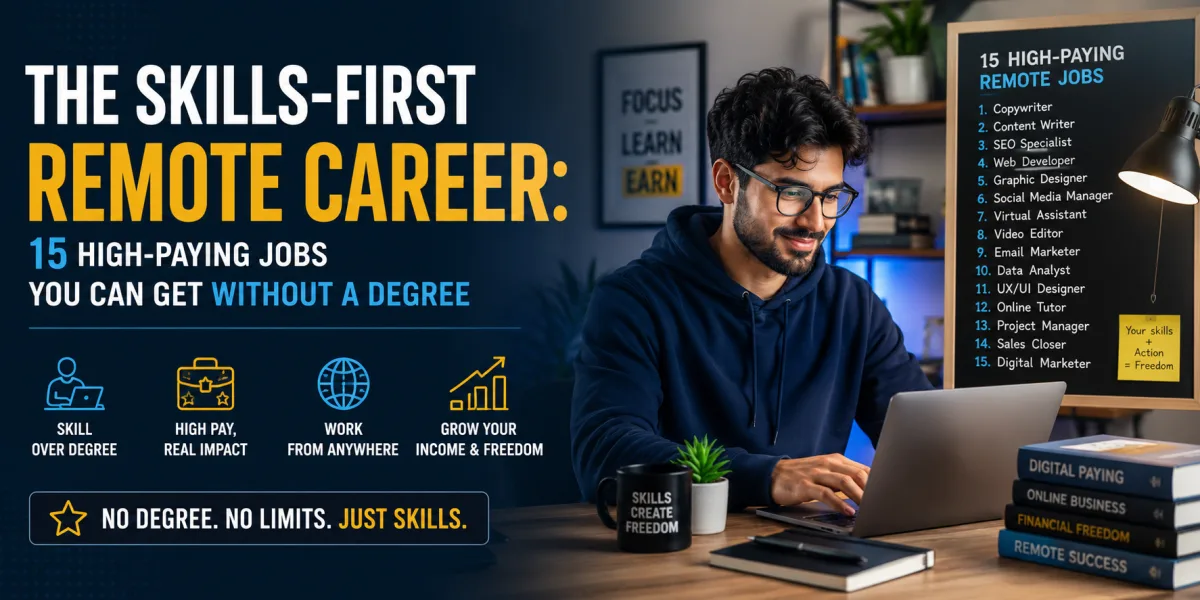
The Skills-First Remote Career: 15 High-Paying Jobs You Can Get Without a Degree
A college degree can open doors, but it is not the only door. In the remote economy, employers and clients increasingly care about something more direct: can you solve the problem, communicate clearly, use the tools, and deliver results without constant supervision?
That shift matters for people who did not attend college, did not finish college, changed careers, learned skills independently, built experience outside formal education, or cannot justify the cost of a four-year degree before needing income. Remote work has expanded the geography of opportunity. A person in a small town can support a company in another state. A parent can build a flexible career from home. A self-taught technologist can contribute to a distributed team. A bookkeeper, designer, writer, sales professional, or support specialist can work with clients they may never meet in person.
But the phrase “without a degree” is often misunderstood. It does not mean “without skill.” It does not mean “without proof.” It does not mean “easy.” High-paying remote jobs without a degree usually require something else in place of the credential: a portfolio, certifications, work samples, measurable results, software fluency, customer experience, sales ability, technical competence, or a track record of reliability.
The remote job market is also more competitive than it was during the peak pandemic years. Robert Half reported that across roles it analyzed in Q1 2026, 77% of new job postings were fully on-site, 19% were hybrid, and only 4% were fully remote. Fully remote jobs still exist, but they are scarce enough that applicants need sharper positioning. ([roberthalf.com](https://www.roberthalf.com/us/en/insights/research/remote-work-statistics-and-trends?utm_source=chatgpt.com))
At the same time, remote work can still create meaningful upward mobility. A 2026 study using millions of U.S. job transitions found that workers entering remote-eligible jobs experienced higher wage growth and higher rates of upward seniority mobility than comparable workers entering fully on-site roles, with especially large effects for lower-income workers and people from regions with fewer high-skill opportunities. ([arxiv.org](https://arxiv.org/abs/2605.01268?utm_source=chatgpt.com))
This article examines 15 high-paying remote jobs that often do not require a bachelor’s degree. Some employers may prefer degrees for certain openings, especially at large companies, but these fields have credible no-degree pathways through experience, certifications, portfolios, apprenticeships, freelancing, and self-directed learning.
The core principle is simple: if you do not have a degree, you need proof. The stronger your proof, the less your missing degree defines you.
What “High-Paying” Means in Remote Work
High-paying is relative. For one person, it means earning more than $25 per hour from home. For another, it means $75,000 per year. For another, it means building a freelance service that can produce $300 to $500 per day. The common thread is that the role pays above basic task work and offers a path to higher income as skill improves.
Many remote jobs advertised as “easy” are not high-paying. Basic data entry, survey sites, microtasks, product rating tasks, and generic online assistant work may be remote, but they often pay poorly and attract scams. High-paying remote work usually connects to business value: revenue, customer retention, technical problem-solving, financial accuracy, operational efficiency, marketing performance, or product delivery.
The income ceiling rises when the work affects money. Sales brings in revenue. Bookkeeping protects financial clarity. Technical support reduces churn. Web design helps lead generation. Digital marketing drives customers. Data analysis improves decisions. QA testing protects software quality. Project coordination keeps client work on schedule.
That is why the best no-degree remote paths are not built on convenience alone. They are built on valuable outcomes.
1. Technical Support Specialist
Technical support is one of the strongest no-degree remote career paths because it rewards problem-solving, product knowledge, patience, and communication. Technical support specialists help customers troubleshoot software, hardware, accounts, integrations, networks, devices, or digital services. They may work through chat, email, phone, screen-share sessions, or ticketing systems.
This role can pay well because businesses lose customers when technical problems go unresolved. A skilled support specialist protects revenue by helping users succeed. The Bureau of Labor Statistics reported that computer user support specialists had a median annual wage of $60,340 in May 2024, while computer network support specialists had a median wage of $73,340. The highest-paid workers in these categories earned substantially more. ([bls.gov](https://www.bls.gov/ooh/computer-and-information-technology/computer-support-specialists.htm?utm_source=chatgpt.com))
A degree may help for some employers, but many technical support roles are accessible through certifications, help desk experience, software knowledge, customer service experience, or self-taught technical skill. Entry points include SaaS support, IT help desk, customer support for technical products, web hosting support, and internal IT support.
Useful credentials may include CompTIA A+, Google IT Support, Microsoft certifications, networking basics, cybersecurity fundamentals, or product-specific certifications. Just as important are practical skills: reading error messages, documenting steps, asking clear questions, reproducing issues, escalating properly, and explaining technical concepts in plain language.
To stand out without a degree, build proof. Create a small portfolio of troubleshooting guides. Document common technical issues and solutions. Earn relevant certifications. Volunteer to support a tool used by a nonprofit or small business. Show that you can think methodically.
Technical support can lead to higher-paying paths such as systems administration, customer success engineering, cybersecurity support, solutions consulting, product operations, and technical account management.
2. Sales Development Representative
Sales development representatives, often called SDRs, help businesses create revenue opportunities. They research prospects, send outreach, qualify leads, book meetings, update CRM systems, and support account executives. Many SDR roles are remote because the work happens through email, phone, LinkedIn, CRM tools, and video calls.
Sales is one of the clearest no-degree paths to high income because performance can matter more than credentials. Employers care whether you can communicate, handle rejection, follow process, learn the product, and create qualified opportunities. FlexJobs reported that sales and business development showed the highest growth in fully remote roles in its 2026 Remote Work Index. ([flexjobs.com](https://www.flexjobs.com/blog/post/flexjobs-remote-work-economy-index?utm_source=chatgpt.com))
Compensation often includes base pay plus commission or bonuses. This can create strong upside, especially in software, B2B services, technology, recruiting, financial services, and professional services. It also creates pressure. Sales roles are measured. Activity, response rates, meetings booked, pipeline created, and revenue contribution may be tracked closely.
A degree is often not required, but proof of communication matters. Customer service experience, retail sales, call center work, hospitality, fundraising, appointment setting, or business ownership can all translate. A strong candidate can write clear outreach, research prospects, ask good questions, and stay organized in a CRM.
To enter this field, learn sales fundamentals, CRM basics, cold email structure, discovery questions, and objection handling. Create a sample prospecting sequence for a real company. Practice concise voice messages. Show evidence that you are coachable and resilient.
Remote sales is not easy, but it can be one of the fastest no-degree paths to higher earnings because companies pay for revenue creation.
3. Account Manager
Account managers maintain relationships with existing customers. They help clients use products or services, identify upsell opportunities, coordinate internal teams, solve problems, renew contracts, and protect customer satisfaction. Many account management roles can be remote, especially in software, agencies, professional services, education technology, marketing platforms, and B2B service companies.
This role can pay well because retaining customers is financially valuable. Acquiring a customer is expensive; losing one hurts revenue. A strong account manager helps prevent churn and expand accounts.
A degree may be preferred in some corporate roles, but experience often matters more. Customer service, sales, hospitality, client coordination, project management, executive assistance, or industry-specific work can provide a pathway. The role rewards communication, organization, follow-up, empathy, commercial awareness, and problem-solving.
The no-degree candidate must show maturity. Account managers often interact with decision-makers and must represent the company professionally. They need to understand client goals, document issues, coordinate solutions, and identify when an account is at risk.
To break in, start with customer support, sales development, client success coordination, or virtual assistant work for client-based businesses. Learn CRM tools, meeting follow-up, account notes, renewal tracking, and basic business metrics. Build examples of how you solved customer problems or retained relationships.
Account management can lead to customer success management, partnerships, enterprise sales, operations, or leadership roles.
4. Executive Assistant
Executive assistants support leaders with scheduling, inbox management, travel planning, meeting preparation, follow-up, document organization, communication, project tracking, and administrative judgment. Remote executive assistant roles can pay well because a strong assistant saves high-value time for executives, founders, consultants, and business owners.
FlexJobs’ 2026 list of high-paying work-from-home jobs without a degree included executive assistant roles among the highest-paying no-degree remote options it analyzed. ([flexjobs.com](https://www.flexjobs.com/blog/post/remote-jobs-that-pay-well-dont-require-a-bachelors-degree?utm_source=chatgpt.com))
The difference between a low-paid assistant and a high-paid executive assistant is judgment. A basic assistant completes tasks. A strong executive assistant anticipates needs, protects time, filters priorities, coordinates people, and prevents small issues from reaching the executive unnecessarily.
A degree is usually less important than trust, discretion, organization, communication, and tool fluency. Experience in administration, office management, hospitality, operations, customer service, or project coordination can transfer well.
Remote executive assistants must be excellent written communicators because much of the work happens through email, calendar tools, chat, and shared documents. They must understand time zones, meeting etiquette, confidentiality, and prioritization.
To stand out, create proof around systems. Show examples of calendar management processes, travel planning checklists, meeting agenda templates, or inbox organization methods. Learn tools such as Google Workspace, Microsoft 365, Slack, Zoom, Notion, Asana, ClickUp, Calendly, and CRMs.
This role can become a path into operations management, chief of staff work, project management, or business administration.
5. Bookkeeper
Bookkeeping is a strong remote job without a degree because small businesses need accurate financial records and many owners do not want to manage the details themselves. Bookkeepers categorize transactions, reconcile accounts, manage invoices, track receipts, prepare reports, and organize records for tax professionals.
Many bookkeeping roles do not require a bachelor’s degree, though training and accuracy are essential. Certifications in QuickBooks, Xero, bookkeeping fundamentals, or accounting software can improve credibility. Cloud accounting tools make the work remote-friendly because bank feeds, receipts, invoices, and reports can be accessed online.
The income potential is strong because bookkeeping is recurring. A freelancer charging monthly retainers can build stable income across clients. A $300 monthly bookkeeping package for a small client may require only a few hours if systems are clean. Several clients can create meaningful monthly revenue.
The Bureau of Labor Statistics reported median annual wages of $49,210 for bookkeeping, accounting, and auditing clerks in May 2024, but remote freelance bookkeepers and specialized small business bookkeepers may earn more depending on pricing, niche, and efficiency. ([bls.gov](https://www.bls.gov/ooh/office-and-administrative-support/bookkeeping-accounting-and-auditing-clerks.htm?utm_source=chatgpt.com))
Trust is the central issue. A bookkeeper handles sensitive financial information. Mistakes can affect cash flow, taxes, and business decisions. A no-degree bookkeeper should be careful to stay within scope and avoid presenting themselves as a CPA or tax advisor unless qualified.
Specialization improves earning power. Bookkeeping for freelancers, coaches, ecommerce sellers, real estate investors, contractors, agencies, or local service businesses allows you to understand recurring patterns and price more confidently.
6. Web Designer
Web design is a practical no-degree remote path because clients care about whether the website looks credible, works on mobile, explains the offer, and generates leads or sales. A designer does not always need a four-year degree to produce that result. They need portfolio proof.
Web designers may build websites using platforms such as WordPress, Webflow, Shopify, Squarespace, Wix, or custom tools. They may serve local businesses, consultants, ecommerce brands, coaches, creators, nonprofits, and professional firms.
The income potential can be strong. A simple one-page website may sell for hundreds or thousands of dollars depending on the market. A full business website can sell for several thousand. Recurring income can come from maintenance, updates, landing pages, hosting support, SEO content, and analytics reporting.
The Bureau of Labor Statistics reported that web developers and digital designers had median annual pay of $98,540 in 2024. Some roles require degrees, but the field also has portfolio-based pathways, especially for freelancers, agencies, and practical website-building roles. ([bls.gov](https://www.bls.gov/ooh/computer-and-information-technology/web-developers.htm?utm_source=chatgpt.com))
A no-degree web designer must demonstrate ability through examples. Build sample sites. Redesign outdated local business pages as mock projects. Show before-and-after improvements. Explain how the site supports business goals: booking calls, selling products, capturing leads, or answering customer questions.
The strongest web designers combine design with business thinking. A plumber does not care about design theory as much as phone calls. A therapist needs trust and appointment requests. A consultant needs authority and lead capture. The website is a business tool, not a digital brochure.
7. Web Developer
Web development is more technical than web design, but it remains one of the highest-ceiling remote careers without a traditional degree. Developers build and maintain websites, web applications, ecommerce stores, dashboards, integrations, and user interfaces.
Many employers prefer degrees for developer roles, but the field has a long history of self-taught and bootcamp-trained workers who prove ability through projects, portfolios, GitHub activity, freelance work, and technical interviews. The challenge is that competition is intense, especially for junior roles.
Skills may include HTML, CSS, JavaScript, responsive design, accessibility, version control, APIs, databases, frameworks, testing, and deployment. For ecommerce or small business work, Shopify development, WordPress customization, and Webflow development can be commercially useful.
The BLS median pay for web developers and digital designers shows why the field is attractive, but beginners should understand that median data reflects workers across skill levels and employment contexts. ([bls.gov](https://www.bls.gov/ooh/computer-and-information-technology/web-developers.htm?utm_source=chatgpt.com)) Entry-level remote developer roles require proof, persistence, and continuous learning.
To enter without a degree, build real projects. Create websites that solve clear problems. Contribute to open-source projects if possible. Build a portfolio that explains your decisions. Learn how to debug. Use AI coding tools carefully, but do not rely on them blindly. Employers and clients pay for working, maintainable solutions.
Freelance web development can be an entry path. Small businesses often need fixes, forms, landing pages, speed improvements, integrations, and ecommerce setup. A developer who can communicate clearly with nontechnical clients has an advantage.
8. Software Quality Assurance Tester
Software quality assurance, or QA, involves testing websites, apps, and software products to find bugs, usability problems, broken workflows, and inconsistent behavior. QA testers help protect product quality before customers experience issues.
This can be a strong no-degree remote path because manual testing rewards attention to detail, clear documentation, patience, and user empathy. More advanced QA roles involve automation, scripting, test frameworks, APIs, and technical systems.
The income potential is strong. The Bureau of Labor Statistics reported median annual pay of $102,610 for software developers, quality assurance analysts, and testers in May 2024. Degree requirements vary by employer and role; entry-level manual testing may be more accessible than advanced engineering roles. ([bls.gov](https://www.bls.gov/ooh/computer-and-information-technology/software-developers.htm?utm_source=chatgpt.com))
A no-degree candidate can build proof by learning testing fundamentals, writing sample test cases, documenting bugs clearly, testing public websites or demo apps, and understanding development workflows. A strong bug report includes steps to reproduce, expected result, actual result, screenshots or recordings, environment details, and severity.
Remote QA roles exist in software companies, agencies, ecommerce, app development, gaming, education technology, healthcare technology, and fintech. Some freelance platforms also offer testing projects, though pay varies widely.
QA can lead to automation testing, product management, UX research, support engineering, or software development. It is a strong path for detail-oriented people who want to enter tech without immediately becoming developers.
9. Digital Marketing Specialist
Digital marketing specialists help businesses attract customers online. They may work on email marketing, social media, paid ads, SEO, content strategy, landing pages, analytics, lead magnets, funnels, and campaign reporting.
This role can pay well without a degree because results matter. A business cares whether marketing brings leads, sales, subscribers, bookings, or awareness. A candidate with campaigns, portfolio examples, tool skills, and measurable outcomes can compete without formal credentials.
Remote digital marketing is common because most tools are cloud-based. A marketer can manage campaigns, review analytics, write emails, plan content, optimize landing pages, and coordinate with designers or clients from anywhere.
Specialization improves income. Email marketing, paid search, paid social, SEO, marketing operations, conversion copywriting, analytics, and lifecycle marketing often have stronger pricing power than general social posting. A beginner may start as a marketing assistant, then specialize.
Useful tools include Google Analytics, Google Search Console, Meta Ads Manager, Google Ads, Mailchimp, Klaviyo, HubSpot, Canva, WordPress, Shopify, Ahrefs, Semrush, and CRM systems. AI tools can accelerate drafting and analysis, but strategy and judgment remain essential.
To enter without a degree, build proof. Run a small campaign for a local business, nonprofit, personal project, or mock brand. Create a case study. Show the problem, strategy, execution, and result. Even small results can matter if presented clearly.
10. SEO Specialist
Search engine optimization specialists help businesses improve visibility in search results. This may include keyword research, content optimization, technical audits, local SEO, internal linking, metadata, competitor analysis, content briefs, and performance tracking.
SEO can pay well because search traffic can produce leads and sales over time. Businesses often understand the value of appearing when customers search for their services. A local dentist, attorney, plumber, therapist, consultant, ecommerce store, or software company may all invest in SEO.
A degree is usually less important than demonstrated knowledge. SEO changes frequently, so self-directed learning is normal in the field. Certifications from tool providers, Google resources, portfolio projects, and case studies can support credibility.
Entry points include SEO assistant, content optimizer, local SEO specialist, SEO writer, website auditor, or marketing assistant. A no-degree beginner can start by helping small businesses improve page titles, service pages, FAQs, internal links, Google Business Profile information, and content structure.
AI has made it easy to generate content, but that has not eliminated the need for SEO judgment. Search engines and users reward helpfulness, authority, relevance, and trust. Generic AI articles are not a durable strategy.
To stand out, specialize. Local SEO for service businesses, ecommerce SEO, content optimization for B2B companies, or technical SEO for small websites can each become a defined offer. The more your work connects to leads or revenue, the stronger the income potential.
11. Copywriter
Copywriters write persuasive business communication. This can include landing pages, sales pages, email sequences, advertisements, product descriptions, website copy, video scripts, and lead magnets. Unlike general writing, copywriting is usually tied to action: buying, booking, subscribing, clicking, replying, or requesting information.
This can be a high-paying no-degree remote job because copy affects revenue. A strong sales page, email sequence, or product description can improve conversion. Clients pay for better messaging when they believe it will produce business results.
AI tools have changed the writing market by making generic drafts easy. That makes human strategy more important. A copywriter must understand customer psychology, positioning, objections, benefits, proof, offers, and brand voice. The value is not merely writing sentences. The value is turning customer insight into persuasive communication.
The Bureau of Labor Statistics reported median annual wages of $73,690 for writers and authors in May 2024, though copywriting income varies widely and can be higher for specialized freelancers and conversion-focused roles. ([bls.gov](https://www.bls.gov/ooh/media-and-communication/writers-and-authors.htm?utm_source=chatgpt.com))
To enter without a degree, build a portfolio. Write sample landing pages, email sequences, product descriptions, and ads for specific niches. Study real customer reviews and rewrite weak product pages. Offer a small project to a local business or online entrepreneur. Show before-and-after examples.
The best copywriters specialize by market or deliverable. Email copy for ecommerce, website copy for consultants, launch copy for course creators, ads for local service businesses, or sales pages for coaches are clearer than “I write copy.”
12. Data Analyst Assistant
Data analyst assistants help businesses organize data, create reports, build dashboards, clean spreadsheets, summarize trends, and support decision-making. Many entry-level data roles do not absolutely require a degree if the candidate can prove tool skill and analytical thinking, though some employers prefer formal education.
The income potential is strong because businesses need better decisions. Sales, marketing, finance, customer support, operations, ecommerce, and product teams all generate data. Someone must turn that data into insight.
Skills may include Excel, Google Sheets, SQL, data visualization, Power BI, Tableau, Looker Studio, basic statistics, and business communication. A beginner can start with spreadsheet analysis before moving into SQL or dashboard tools.
Remote data work is common because datasets and dashboards can be accessed digitally. A small business may need a sales dashboard. An ecommerce store may need product performance reporting. A marketing team may need campaign summaries. A support team may need ticket trend analysis.
To enter without a degree, build portfolio projects. Use public datasets or fictional business data. Create dashboards that answer real questions: Which products generate the most profit? Which marketing channel converts best? Which support issues appear most often? Explain your findings in plain language.
Data analysis is not only technical. A good analyst tells the business what matters. A clear recommendation can be more valuable than a complicated chart.
13. Project Coordinator
Project coordinators help teams keep work moving. They track deadlines, update task boards, schedule meetings, prepare status reports, organize files, follow up with stakeholders, and make sure tasks do not disappear. Remote teams especially need coordination because work is spread across tools and time zones.
This role can pay well without a degree because organization has business value. Missed deadlines, unclear ownership, and poor communication cost money. A strong coordinator creates order.
Project coordinators may work in marketing agencies, software companies, consulting firms, construction administration, healthcare administration, education companies, nonprofits, ecommerce, and operations teams. Some roles are remote, while others are hybrid.
Useful tools include Asana, Trello, ClickUp, Monday.com, Notion, Jira, Slack, Microsoft Teams, Google Workspace, and spreadsheets. The work requires communication, follow-through, attention to detail, and calm under pressure.
A degree is often less important than experience coordinating people and tasks. Administrative assistants, virtual assistants, customer support workers, event coordinators, operations assistants, and team leads can transition into project coordination.
To stand out, create proof of systems. Show sample project plans, status reports, task boards, meeting notes, or process documents. Emphasize measurable outcomes: reduced missed deadlines, improved reporting, faster handoffs, or better client communication.
This role can lead to project management, operations management, client success, or chief of staff paths.
14. Claims Adjuster
Claims adjusters evaluate insurance claims, review documentation, communicate with policyholders, inspect evidence, estimate losses, negotiate settlements, and coordinate with insurers. Some claims roles can be remote or hybrid, especially desk adjuster roles, though field adjusters may travel.
FlexJobs’ 2026 list of high-paying work-from-home jobs without a degree included claims adjuster roles among its top examples. ([flexjobs.com](https://www.flexjobs.com/blog/post/remote-jobs-that-pay-well-dont-require-a-bachelors-degree?utm_source=chatgpt.com))
The role can pay well because insurance claims involve money, documentation, and judgment. It does not always require a bachelor’s degree, but licensing may be required depending on location and claim type. Training, certifications, and industry experience matter.
Claims work requires analytical thinking, communication, negotiation, empathy, and attention to detail. Claimants may be stressed after accidents, property damage, medical events, or disasters. The adjuster must balance customer communication with policy terms and documentation.
No-degree candidates can enter through insurance customer service, claims assistant roles, trainee adjuster programs, or licensing courses. Remote desk adjusting may involve reviewing photos, reports, estimates, statements, and policy documents from home.
This role is not passive or easy. It involves responsibility and sometimes conflict. But it can be a strong remote or hybrid career path for people who are detail-oriented and comfortable with regulated processes.
15. Mortgage Underwriter
Mortgage underwriters review loan applications to assess whether borrowers meet lending guidelines. They examine income, credit, assets, debt, property information, documentation, and risk. Many underwriting roles can be remote because the work is document-based and system-driven.
FlexJobs also identified mortgage underwriter roles among high-paying work-from-home jobs that may not require a degree in all cases. ([flexjobs.com](https://www.flexjobs.com/blog/post/remote-jobs-that-pay-well-dont-require-a-bachelors-degree?utm_source=chatgpt.com))
The income potential is strong because underwriting is a specialized financial function. A mistake can create serious risk for lenders, borrowers, and investors. This is not an entry-level “easy remote job.” It requires training, industry knowledge, judgment, and accuracy.
A no-degree pathway often begins in mortgage processing, loan coordination, banking, credit analysis support, or financial services administration. Over time, workers learn documentation standards, lending guidelines, compliance requirements, income calculation, credit risk, and loan systems.
This role rewards detail, patience, and analytical thinking. It is suitable for people who can work carefully through documents and rules. It may be less suitable for people who dislike compliance-heavy work.
Remote mortgage underwriting can be cyclical because mortgage volume rises and falls with interest rates and housing activity. That cyclicality is an important risk. The role can pay well, but the market may fluctuate.
Why Some No-Degree Remote Jobs Pay More Than Others
High-paying no-degree remote jobs usually share several traits. They require skill that is scarce or hard to verify. They affect revenue, risk, customer retention, or operational efficiency. They require trust. They require tools. They improve with experience. They are difficult to automate completely because judgment matters.
Technical support pays more than basic customer service because technical problems are harder to solve. Sales can pay more because it creates revenue. Bookkeeping can pay more because money records matter. Web development pays more because technical implementation is valuable. QA testing pays more because product quality affects customers. Mortgage underwriting pays more because lending risk is serious.
The remote economy rewards people who can own outcomes. If you only perform simple tasks, competition is global and pay pressure is intense. If you solve valuable problems, the market opens.
This is why no-degree job seekers should focus less on finding “easy remote jobs” and more on building “valuable remote skills.” The second path has a much higher ceiling.
How to Compete Without a Degree
Without a degree, your application must reduce doubt. Employers and clients need evidence that you can do the work.
Build a portfolio. A web designer needs sample sites. A copywriter needs writing samples. A data analyst needs dashboards. A QA tester needs bug reports. A project coordinator needs sample project plans. A bookkeeper needs certifications, sample reports, or testimonials. A sales candidate needs outreach examples or performance history.
Earn targeted certifications. Certifications are not magic, but they can help. CompTIA for IT support, QuickBooks for bookkeeping, Google Analytics for marketing, HubSpot for CRM and sales, Meta or Google Ads certifications, project management certificates, and platform-specific credentials can signal initiative.
Use experience creatively. Retail sales can translate to remote sales. Restaurant management can translate to operations coordination. Call center work can translate to customer success. Personal bookkeeping for a family business can lead to small business bookkeeping. Volunteer website work can become a web design portfolio.
Write a skills-first resume. Lead with relevant tools, projects, outcomes, and experience. Do not apologize for lacking a degree. Show evidence of capability.
Network strategically. Many remote jobs are competitive when posted publicly. Referrals and direct relationships help. Tell people exactly what role you want and what problem you solve.
Where to Find These Jobs
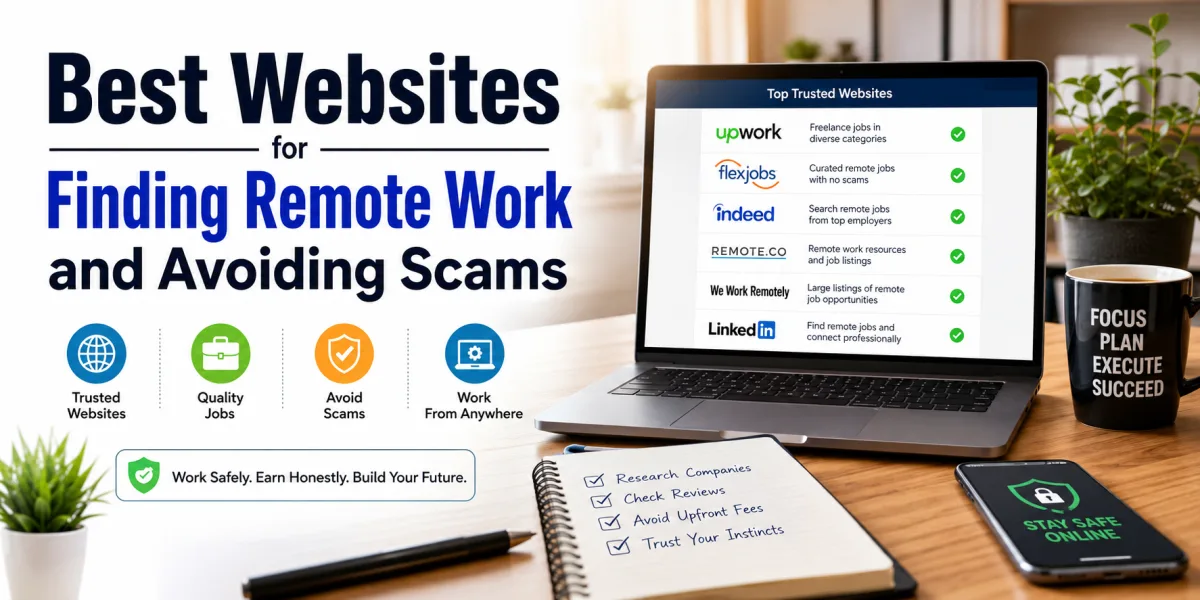
Use both general and remote-focused job boards. LinkedIn, Indeed, Glassdoor, ZipRecruiter, company career pages, FlexJobs, We Work Remotely, Remote.co, Remotive, Wellfound, and niche industry boards can all be useful. TechRadar’s 2026 review identified Indeed, LinkedIn Jobs, ZipRecruiter, Glassdoor, FlexJobs, Wellfound, and Ladders among notable job sites for different needs, with FlexJobs highlighted for remote and flexible jobs. ([techradar.com](https://www.techradar.com/best/us-job-sites?utm_source=chatgpt.com))
Search with role-specific terms instead of vague phrases. Use “remote technical support specialist,” “remote SDR,” “remote executive assistant,” “remote junior bookkeeper,” “remote web designer,” “remote QA tester,” “remote project coordinator,” “remote mortgage underwriter,” or “remote SEO assistant.”
Company career pages are especially useful for verification. If a recruiter contacts you, confirm the role on the company’s official website when possible. Remote job scams are common, especially in no-degree categories that seem accessible.
Freelancers can also find work through Upwork, Contra, Fiverr, professional communities, local business outreach, LinkedIn, referrals, and niche marketplaces. Freelance income can exceed employee income in some fields, but it requires pricing, contracts, taxes, and client management.
Avoid the No-Degree Remote Job Trap
The trap is believing that no-degree remote work should be fast, easy, and guaranteed. That belief leads people toward scams, low-paying tasks, fake recruiters, and poor training programs.
Be cautious with jobs that promise unusually high pay for simple work, require upfront payments, send checks for equipment, ask you to move money, conduct interviews only by text, or pressure you to act quickly. The Federal Trade Commission warns that scammers use work-from-home job ads and fake recruiter messages to steal money and information from job seekers. ([consumer.ftc.gov](https://consumer.ftc.gov/articles/job-scams?utm_source=chatgpt.com))
A legitimate no-degree remote job still has a real hiring process. It may require interviews, assessments, references, background checks, training, and proof of skill. That is normal. What is not normal is being hired instantly for vague work at unusually high pay.
Do not pay for a job. Do not deposit checks from strangers. Do not share sensitive information before verifying the employer. Do not install unknown software from a suspicious recruiter. Do not believe that remote work removes normal business logic.
The Best Path: Start Accessible, Move Valuable
Many people enter remote work through accessible roles, then move toward higher-value work.
A customer support representative can become a technical support specialist or customer success manager. A virtual assistant can become an executive assistant, operations coordinator, or project coordinator. A social media assistant can become a digital marketing specialist. A basic web designer can become a conversion-focused website strategist. A data entry worker can become a data cleanup specialist and then a data analyst. A call center worker can become an SDR and then an account executive.
The key is not to remain at the lowest-value layer. Use the first role to learn tools, understand business operations, build proof, and identify higher-paying adjacent skills.
Remote careers compound when skills compound.
The Bigger Lesson
High-paying remote jobs without a degree are real, but they are not shortcuts around skill. They are alternatives to traditional credential pathways. The market will pay without a degree when you bring proof, competence, and reliability.
The best no-degree remote paths are connected to valuable business outcomes: solving technical problems, creating revenue, retaining customers, managing executive time, keeping financial records accurate, building websites, testing software, improving marketing, optimizing search visibility, writing persuasive copy, analyzing data, coordinating projects, adjusting claims, or underwriting loans.
A degree can still matter in some companies and some roles. But it is not the only signal of ability. Portfolios, certifications, testimonials, work samples, tool fluency, and measurable results can also open doors.
The remote job market is competitive, and fully remote listings are limited compared with on-site and hybrid roles. That makes positioning important. Do not market yourself as someone looking for any work-from-home job. Market yourself as someone who can solve a specific problem remotely.
That is how no-degree candidates win.
Choose a path. Build the skill. Create proof. Apply strategically. Avoid scams. Start where you can enter, then move toward work with higher value and stronger income potential.
Remote work can remove geography as a barrier. Skill removes the degree as a barrier.
 Article
 Article
 Article
 Article
 Article
 Article
 Article
 Article