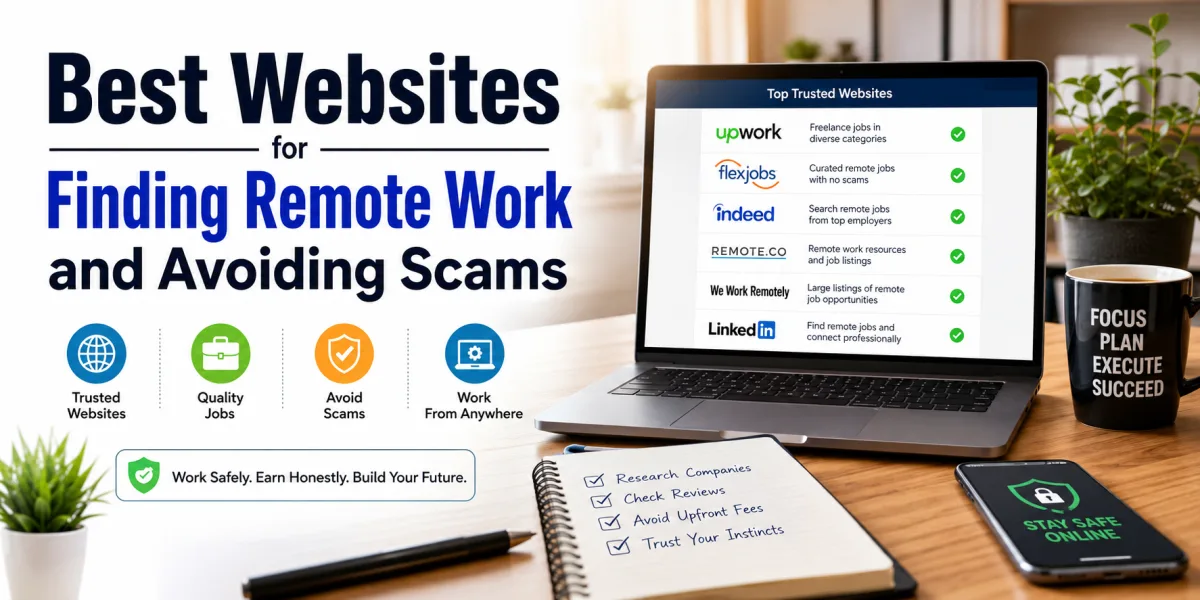
The Remote Work Marketplace: Best Websites for Finding Real Work-from-Home Jobs
Remote work has changed how people think about income. A job no longer has to be tied to the nearest office, the local business district, or the commute someone can tolerate. A skilled worker can serve customers, support software, write marketing campaigns, analyze data, manage projects, sell products, teach students, design websites, or coordinate operations from a home office.
But the remote work opportunity is not evenly distributed. Some websites list serious roles with established employers. Others are flooded with low-quality postings, vague offers, commission-only promises, fake recruiters, unpaid tests, and scams disguised as flexible work. The challenge is not merely finding remote job listings. The challenge is finding legitimate remote work that fits your skills, income needs, schedule, and risk tolerance.
That requires a marketplace strategy.
The best website for finding remote work depends on what kind of work you want. A software engineer may find strong opportunities on Wellfound, We Work Remotely, Remote OK, LinkedIn, and company career pages. A virtual assistant may use FlexJobs, Upwork, LinkedIn, and direct outreach. A writer may use ProBlogger, Contently, LinkedIn, freelance platforms, and niche communities. A customer support applicant may search FlexJobs, Remote.co, Indeed, company pages, and software company job boards. A senior executive may use Ladders, LinkedIn, retained recruiters, and specialized networks.
There is no single perfect remote job site. A serious search uses several channels, each with a clear purpose.
The market also requires realistic expectations. Robert Half reported that across roles it analyzed in Q1 2026, 77% of new job postings were fully on-site, 19% were hybrid, and only 4% were fully remote. Fully remote roles still exist, but they are more competitive than many job seekers assume.
That scarcity makes job-board selection important. A remote job seeker cannot afford to waste hours on weak listings, fake opportunities, or platforms that do not match their field. The right websites can shorten the search. The wrong websites can create frustration, risk, and false hope.
This article explains the best websites for finding remote work, how each platform fits into a job search strategy, and how to protect yourself while applying. The goal is not to apply everywhere. The goal is to build a disciplined system that puts your skills in front of real employers and clients.
Start with the Type of Remote Work You Want
Before choosing websites, choose your category. Remote work is not one market. It is several markets.
Full-time remote employment is different from freelance work. A full-time employee may receive salary, benefits, training, and a manager. A freelancer sells services to clients and must handle taxes, pricing, contracts, client acquisition, and inconsistent demand. A contract remote role may sit somewhere between the two. A startup role may offer speed and responsibility but less stability. A corporate remote role may offer structure but more competition.
The website should match the work model.
If you want full-time employment, prioritize LinkedIn, Indeed, FlexJobs, Remote.co, We Work Remotely, Wellfound, company career pages, and industry-specific boards. If you want freelance work, prioritize Upwork, Contra, Fiverr Pro, Freelancer, Toptal for advanced professionals, and direct outreach. If you want startup roles, prioritize Wellfound, Y Combinator’s job board, LinkedIn, and remote-first company pages. If you want flexible part-time work, FlexJobs, Remote.co, tutoring platforms, and niche boards may be useful.
This distinction prevents a common mistake: using the wrong platform for the desired outcome. A person seeking stable salaried employment may become frustrated on gig platforms. A freelancer seeking quick project work may find traditional job boards too slow. A senior professional may waste time on low-level remote listings instead of using networks and specialized platforms.
Choose the marketplace that matches the income model.
1. LinkedIn Jobs
LinkedIn is one of the most important websites for finding remote work because it combines job listings, networking, company research, recruiter visibility, and professional proof. It is not only a job board. It is a public professional identity system.
LinkedIn is useful for remote roles in sales, marketing, customer success, project management, technology, operations, writing, design, finance, recruiting, consulting, and leadership. It allows job seekers to filter for remote jobs, follow companies, connect with recruiters, research hiring managers, and see whether people in their network work at target companies.
TechRadar’s 2026 review of job sites identified LinkedIn Jobs as especially strong for networking and professional community, while also naming it among major job-search platforms alongside Indeed, ZipRecruiter, Glassdoor, FlexJobs, Wellfound, and others.
The greatest advantage of LinkedIn is that applications can be supported by relationships. A cold application is one signal. A profile with relevant experience, posts, recommendations, portfolio links, and mutual connections is stronger. Remote employers care about trust because they are hiring someone they may never meet in person. LinkedIn helps create that trust before the interview.
To use LinkedIn well, optimize your profile for the role you want. Do not describe yourself vaguely as “open to remote work.” State the function clearly: remote customer support specialist, email marketer, project coordinator, technical support analyst, bookkeeper, data analyst, virtual assistant, or web designer. Use the headline, About section, Featured section, and Experience bullets to show proof.
Search with specific keywords. “Remote job” is too broad. Search “remote customer success associate,” “remote SDR,” “remote project coordinator,” “remote bookkeeping,” “remote technical support,” or “remote content marketing manager.” Save searches and set alerts.
LinkedIn’s weakness is volume. Popular remote roles attract heavy competition. Many listings receive large applicant counts quickly. The best strategy is to apply early, then support the application with a thoughtful connection request or message when appropriate.
2. Indeed
Indeed is one of the largest general job boards, and its size makes it useful for remote job searching. It includes roles across industries, experience levels, employment types, and locations. For remote work, Indeed can be useful for customer support, administrative roles, data entry, sales, bookkeeping, healthcare administration, writing, tech support, and entry-level remote positions.
The advantage of Indeed is breadth. Many companies post there because it reaches a large applicant pool. The search filters can help identify remote jobs, salary ranges, and job type. The platform also includes company pages, ratings, and employer information that can support research.
The weakness is noise. Large job boards often contain duplicate listings, vague posts, outdated listings, sponsored placements, and occasional scams. A remote job seeker must read carefully and verify employers. Indeed itself publishes guidance on work-from-home scams, noting warning signs such as jobs that seem too good to be true, limited company information, eager hiring, requests for payment, and poor communication.
Use Indeed for volume, but do not rely on it alone. When you find a promising role, visit the employer’s official website and look for the same opening on the careers page. If the listing appears on the company site, apply there when possible. This can reduce scam risk and ensure your application enters the employer’s official system.
Indeed is best for job seekers who are still exploring categories or want a broad view of remote roles. It is less efficient for people seeking highly specialized remote-first companies, where niche boards may perform better.
3. FlexJobs
FlexJobs is one of the most recognized websites for remote, hybrid, freelance, part-time, and flexible jobs. Its major selling point is curation. Unlike open job boards where anyone can post, FlexJobs screens listings, which can reduce exposure to scams and low-quality opportunities.
FlexJobs is especially useful for people who value safety and structure. It covers many categories, including accounting and finance, administrative work, marketing, writing, computer and IT, account management, customer service, project management, medical and health, education, and more. FlexJobs lists top remote job categories such as accounting and finance, administrative, marketing, writing, and computer and IT.
In January 2026, FlexJobs released its 13th annual list of companies with the most remote job openings, based on job posting data in its database, which it said contains flexible job histories for more than 60,000 companies.
The advantage of FlexJobs is that it saves time for job seekers who want fewer scam risks and better filtering. It can be helpful for parents, career changers, people seeking part-time work, and professionals who want flexible arrangements rather than only full-time remote roles.
The main drawback is that FlexJobs is a paid service. The cost may be worthwhile for someone serious about remote work, but it is still an expense. Job seekers should use it actively if they subscribe: set alerts, apply regularly, track companies, and use its resources.
FlexJobs is best for people who want a safer, curated remote job search across many categories and are willing to pay for reduced noise.
4. We Work Remotely
We Work Remotely is a dedicated remote job board known for roles in technology, programming, design, customer support, sales, marketing, product, and operations. It is especially useful for people who want remote-first or remote-friendly companies rather than traditional employers occasionally posting remote roles.
The advantage of a dedicated remote board is focus. Job seekers do not have to filter through thousands of on-site postings to find remote options. Employers posting on remote-first boards are often more serious about distributed hiring.
We Work Remotely is particularly useful for software developers, product designers, customer support specialists, marketers, operations professionals, and startup-oriented candidates. It can also be useful for global job seekers because many postings indicate location or time-zone requirements.
The weakness is competition. Because the audience is remote-focused, strong postings may attract applicants from many countries. This means your application must be specific and proof-driven. Generic resumes perform poorly.
Use We Work Remotely by searching within your function and reading location restrictions carefully. “Remote” does not always mean worldwide. Some employers require candidates to be in the United States, Canada, Europe, a specific time zone, or countries where they have payroll support.
This site is best for workers with digital skills and people targeting companies that are already comfortable with remote operations.
5. Remote.co
Remote.co is a remote work job board and resource site. It lists remote jobs across categories such as customer service, writing, marketing, HR, design, accounting, sales, project management, and technology. It also provides articles and Q&A resources about remote work practices.
Remote.co is useful for job seekers who want a dedicated remote board but are not exclusively in software or engineering. Customer support, marketing, writing, HR, and administrative candidates may find relevant listings.
The advantage is focus. Like We Work Remotely, Remote.co helps reduce time wasted on on-site listings. It is also useful for understanding remote work culture, since the site includes resources beyond job posts.
The weakness is that the number of listings may be smaller than huge general boards. This is not necessarily bad. Smaller boards can be more targeted. But job seekers should combine Remote.co with other platforms.
Use Remote.co as part of a weekly search routine. Save roles, track companies, and visit company websites directly. If a company posts on Remote.co, check whether it has other open remote roles on its careers page.
6. Wellfound
Wellfound, formerly AngelList Talent, is one of the strongest websites for startup jobs. It is useful for remote roles in software engineering, product, design, marketing, sales, operations, customer success, and startup leadership.
TechRadar’s 2026 job site review identified Wellfound as strong for startup career opportunities.
The advantage of Wellfound is startup focus. Startups may be more open to remote work, flexible job design, and skills-based hiring than traditional employers. They may also move faster in hiring. Candidates can often see salary ranges, equity details, company stage, and founder information.
The downside is startup risk. Startups can be exciting but unstable. Funding, product-market fit, management quality, and workload expectations vary widely. A remote startup role may involve ambiguity, rapid change, and fewer formal processes.
Use Wellfound if you are comfortable with startup environments. Research the company’s funding stage, product, customers, team size, business model, and recent activity. Ask careful interview questions about runway, role expectations, remote culture, management style, and success metrics.
Wellfound is best for candidates who want growth, responsibility, and technology-oriented remote work, and who can tolerate some uncertainty.
7. Remote OK
Remote OK is a long-running remote job board with listings across development, design, customer support, marketing, operations, finance, education, medical, executive, and AI-related roles. Its site emphasizes remote categories and includes filters useful for people seeking distributed work.
Remote OK’s public site describes itself as a remote job platform and displays categories such as AI jobs, async jobs, customer support, marketing, operations, education, medical, finance, and engineering.
The advantage of Remote OK is that it is built specifically for remote work and often includes roles from remote-first or distributed companies. It can be useful for tech workers, marketers, designers, support professionals, and people seeking global roles.
The drawback is that remote-first boards can attract high competition, especially for popular tech and support roles. Some listings may require specific regions or time zones. Read carefully before applying.
Remote OK works best when combined with direct company research. If a company posts an interesting role, visit its website, read its remote-work policy if available, and check for other openings.
8. Remotive
Remotive is another remote-focused job board and community. It lists jobs in software development, marketing, sales, customer support, product, design, and other categories. It is especially useful for job seekers who prefer remote-first companies and curated remote listings.
The site can be valuable because remote-focused boards often attract employers that understand distributed work. These employers may be clearer about time zones, async communication, and remote culture.
Remotive is strongest for digital and tech-adjacent roles. It can be useful for developers, product managers, marketers, designers, customer support candidates, and operations professionals.
The best way to use Remotive is to set a schedule. Check new listings several times per week, save companies that repeatedly hire remotely, and build a list of target employers. Many remote job seekers focus only on individual postings, but company tracking is often more valuable. A company hiring one remote marketer today may hire customer support, sales, or operations next month.
Remotive is not a complete job-search strategy by itself, but it is a strong part of a remote-focused search stack.
9. Working Nomads
Working Nomads curates remote jobs across categories such as development, marketing, management, customer success, design, sales, and more. It is useful for job seekers who want remote roles delivered in a more curated format.
The advantage of Working Nomads is convenience. Remote job seekers can browse listings or receive job alerts. This can help maintain consistency, which matters because remote openings can fill quickly.
The site is especially useful for people with digital skills who want global or location-flexible roles. As always, read location rules carefully. Many remote roles are limited by country, time zone, employment law, or tax requirements.
Working Nomads is best used as a discovery tool. When you find a role, research the company, check the official careers page, and apply with a tailored resume.
10. Dynamite Jobs
Dynamite Jobs focuses on remote and online business roles. It has historically been associated with digital businesses, startups, agencies, ecommerce companies, and remote-first employers. It can be useful for operations, marketing, customer support, sales, and executive assistant roles in online companies.
The advantage is that many roles come from companies already operating online. These employers may have clearer remote systems and more practical expectations for distributed work.
Dynamite Jobs can be particularly useful for candidates interested in smaller companies, online business operations, marketing support, virtual assistance, ecommerce, content, and customer support.
The potential drawback is that smaller companies can vary widely in pay, structure, and management quality. Read job descriptions carefully. Ask about onboarding, communication tools, performance expectations, and whether the role is employee or contractor.
This site is best for people who want to work with lean digital companies rather than large corporate employers.
11. Jobspresso
Jobspresso is a remote job board that lists roles in technology, marketing, customer support, product, sales, writing, and other digital categories. It presents itself as a curated board, which can help reduce some of the noise found on open platforms.
Jobspresso is useful for candidates who want remote roles but prefer a cleaner, more targeted browsing experience. It may be especially relevant for software, marketing, customer service, and product-related jobs.
As with other niche boards, volume may be lower than Indeed or LinkedIn. That is not a weakness if the listings are better aligned. Job seekers should pair Jobspresso with larger platforms and direct company applications.
The strongest use is as part of a weekly rotation: LinkedIn for networking and broad search, FlexJobs for curated flexible roles, We Work Remotely and Remote OK for remote-first digital roles, Wellfound for startups, and Jobspresso for additional curated opportunities.
12. SkipTheDrive
SkipTheDrive is a remote job board with categories across account management, customer service, development, healthcare, marketing, project management, sales, and other fields. It can be useful for job seekers who want simple browsing by category.
The advantage is accessibility. Some remote boards feel heavily tech-oriented, while SkipTheDrive includes a broader mix of remote-friendly categories.
The site is best used by job seekers who want to explore remote categories and discover companies hiring outside the most popular tech boards. It should still be combined with employer verification and official career-page checks.
Because remote job scams can appear across the broader market, never assume a listing is legitimate only because it appears on a job board. Use the same verification process every time.
13. Virtual Vocations
Virtual Vocations focuses on remote and telecommuting jobs across many categories. It is useful for people seeking curated remote listings in fields such as education, healthcare, writing, customer service, project management, accounting, and information technology.
The site can be helpful for job seekers who want a broad but remote-focused search experience. Like FlexJobs, it has a model centered on remote and flexible roles rather than general job volume.
Virtual Vocations may be especially useful for people who are not in software development but still want legitimate work-from-home roles. It can help identify remote-friendly employers in administrative, education, healthcare, and professional categories.
Job seekers should compare subscription costs, features, and listing quality with alternatives before paying for any remote job service. A paid platform is worthwhile only if you use it consistently and it gives access to better leads than free sources.
14. ZipRecruiter
ZipRecruiter is a large general job board and matching platform. It can be useful for remote roles in customer service, sales, administrative support, recruiting, marketing, operations, and technology. TechRadar’s 2026 review identified ZipRecruiter as one of the major job sites and highlighted its ease of use.
The advantage of ZipRecruiter is reach and convenience. Its matching tools can surface roles based on profile and preferences. For job seekers willing to review many listings, it can help identify remote opportunities across industries.
The drawback is that, like other large boards, it requires filtering. Not every “remote” listing is fully remote. Some are hybrid, temporary remote, or remote only within a specific region. Some roles may be commission-heavy or vague.
Use ZipRecruiter as a broad discovery tool, not as your only source. Save searches with specific job titles and remote filters. Verify employers before sharing sensitive information.
15. Glassdoor
Glassdoor is useful not only for job listings but also for company reviews, salary information, interview reports, and employee perspectives. For remote job seekers, this context can be valuable because remote work quality depends heavily on company culture.
A company may advertise remote flexibility, but employee reviews may reveal whether the culture supports remote workers, whether managers communicate clearly, whether workloads are reasonable, and whether career growth is possible. Reviews are not perfect, and unhappy employees may be overrepresented, but patterns matter.
TechRadar’s 2026 job site review identified Glassdoor as useful for company reviews and salary data.
Use Glassdoor to research companies before interviews. Look for salary ranges, interview questions, management complaints, remote work comments, and turnover signals. If many reviews mention chaotic communication or return-to-office reversals, ask careful questions during the interview.
Glassdoor is less of a primary remote job board and more of a due diligence tool. It helps you decide whether a remote opportunity is worth pursuing.
16. Company Career Pages
Company career pages are one of the most underrated sources of legitimate remote work. They are also one of the safest places to apply because they reduce impersonation risk.
If you know which companies hire remotely, visit their career pages directly. Remote-first companies, software companies, online education platforms, ecommerce companies, digital agencies, financial technology firms, healthcare technology companies, and distributed startups often post roles on their own sites before or alongside job boards.
FlexJobs’ 2026 top companies list is useful not only for individual roles but for identifying employers that frequently post remote-friendly jobs. Build a target list from such sources, then check those companies weekly.
The advantage of company pages is verification. If a job appears on a company’s official domain, the risk of fake recruiter scams decreases. It does not guarantee the role is perfect, but it confirms the opening is real.
The drawback is time. Checking dozens of company pages manually can be inefficient. Solve this by building a list of 25 to 50 target companies and reviewing them on a schedule. Prioritize companies aligned with your skills.
Company pages are especially important when you find a role through a third-party site. Always compare the listing with the official careers page when possible.
17. Upwork
Upwork is one of the largest freelance platforms and can be useful for remote freelance work in writing, design, virtual assistance, bookkeeping, web development, customer support, marketing, data analysis, consulting, and administrative tasks.
Upwork is not the same as a remote job board. It is a client marketplace. This means you are usually competing for projects or contracts, not applying for employment. You must think like a business owner: profile positioning, proposals, pricing, reviews, scope, deadlines, and client communication all matter.
The advantage is access. A beginner can find real clients without having a large personal network. The platform provides payment infrastructure and some protection when used properly. It can be a strong place to build proof and testimonials.
The drawback is competition and price pressure. Many categories are crowded. Low-quality clients may request too much for too little. New freelancers may undercharge to win work, then struggle to raise rates.
Use Upwork strategically. Choose a niche. Write a profile focused on outcomes. Apply to jobs where you can solve a specific problem. Avoid vague postings. Avoid unpaid tests. Use milestones. Keep communication on-platform where required. Do not accept suspicious payment arrangements outside the platform.
Upwork can produce serious income, but it rewards freelancers who treat it as a sales channel rather than a job board.
18. Contra
Contra is a freelance platform focused on independent professionals, portfolio presentation, and client work. It can be useful for designers, developers, writers, marketers, strategists, video editors, consultants, and creators who want a modern portfolio-based marketplace.
The advantage of Contra is that it emphasizes professional presentation and independent work. For freelancers with strong portfolios, it can serve as both a profile and client acquisition channel.
Contra may be especially useful for creative and digital service providers who want to showcase projects rather than only submit proposals. A strong portfolio can help clients understand value quickly.
As with all freelance platforms, the platform alone does not create income. You still need positioning, proof, outreach, and client communication. The best freelancers use platforms as one channel among several, not as their entire business.
19. Fiverr and Fiverr Pro
Fiverr is a freelance marketplace where service providers sell defined packages, often called gigs. It can be useful for remote work in design, writing, video editing, voiceover, translation, website services, digital marketing, data tasks, AI services, and business support.
The advantage of Fiverr is productized services. Instead of waiting for job postings, freelancers can create offers that clients purchase. This works well when the service is clear and repeatable: logo design, resume review, Shopify product descriptions, podcast editing, YouTube thumbnails, website audits, or social media templates.
The drawback is price competition. Many categories are crowded with low-cost sellers. To earn well, freelancers need differentiation, strong reviews, clear packages, and a niche. Fiverr Pro can support higher-end positioning for approved professionals, but acceptance is not automatic.
Fiverr works best for services that can be standardized. If every project requires custom scoping, another platform or direct sales may be better. Package your service around a specific outcome and set boundaries around revisions.
20. Toptal
Toptal is a selective freelance platform for higher-end talent, especially in software development, design, finance, product management, and project management. It is not beginner-friendly, but it can be valuable for experienced professionals seeking remote contract work with stronger clients.
The advantage is quality positioning. Because Toptal screens talent, accepted freelancers may access better-paying opportunities than on open marketplaces. The platform is particularly relevant for experienced developers, designers, finance experts, and technical project professionals.
The drawback is selectivity. New freelancers without strong experience are unlikely to be a fit. Toptal is best viewed as an advanced platform, not a starting point.
If you are experienced and want remote contract work, Toptal may belong in your search strategy. If you are just beginning, build experience and proof elsewhere first.
21. ProBlogger and Writing Boards
For writers, general remote job boards are not enough. Niche writing boards such as ProBlogger, Freelance Writing Jobs, Contently, journalism job boards, and industry-specific writing communities can surface better opportunities.
Writing roles may include blog posts, newsletters, ghostwriting, SEO content, copywriting, technical writing, case studies, white papers, scripts, and editing. The best opportunities usually require samples and niche understanding.
The advantage of writing-specific boards is relevance. Employers and clients posting there are often looking specifically for writing talent, not general remote workers.
The drawback is competition, especially as AI tools have increased the supply of generic writing. Writers need a niche, portfolio, and proof of judgment. A finance writer, healthcare writer, SaaS writer, legal content writer, or technical writer can often position more strongly than a generalist.
Use writing boards alongside LinkedIn and direct outreach. Many strong writing clients are found by identifying companies with weak content and pitching a specific improvement.
22. Y Combinator Work at a Startup
Y Combinator’s Work at a Startup board can be useful for people interested in early-stage startup roles. It includes jobs at companies that have gone through Y Combinator, often in software, product, growth, sales, operations, and engineering.
The advantage is access to ambitious startups. Some roles may be remote or remote-friendly, though not all are. Startups may value skill, speed, ownership, and adaptability over formal credentials in many roles.
The drawback is risk and intensity. Early-stage startups can change direction quickly, and job stability may depend on funding, product traction, and founder execution. Candidates should ask about runway, team structure, compensation, equity, expectations, and remote practices.
This board is best for candidates who want startup exposure and are comfortable with ambiguity. It is less ideal for people seeking highly structured remote employment.
23. Ladders
Ladders focuses on higher-paying professional roles, often $100,000 and above. It can be useful for experienced job seekers seeking remote or hybrid roles in management, technology, sales, finance, marketing, operations, and leadership.
TechRadar’s 2026 job site review identified Ladders as useful for $100k+ salary jobs.
The advantage is salary focus. Experienced professionals may prefer a platform that filters for higher-compensation roles rather than sorting through entry-level postings.
The drawback is that many roles may be hybrid, location-specific, or highly competitive. A senior remote job search often depends on reputation, referrals, and recruiter relationships, not only job boards.
Ladders is best for experienced professionals with strong resumes and clear leadership or specialized expertise.
24. Industry-Specific Job Boards
Some of the best remote jobs are found on industry-specific boards rather than general platforms. Technology workers may use Stack Overflow Jobs alternatives, GitHub-related communities, Hacker News “Who is Hiring” threads, cybersecurity boards, or product management communities. Designers may use Dribbble, Behance, AIGA, or design-specific boards. Marketers may use MarketingHire, Superpath, Demand Curve communities, or niche Slack groups. Nonprofit professionals may use Idealist. Education workers may use online tutoring and instructional design boards. Healthcare workers may use medical coding, telehealth, and healthcare administration boards.
The advantage of niche boards is relevance. Employers posting there know the skill category. Candidates face less irrelevant competition.
The drawback is that some niche boards have fewer postings. That is acceptable if the postings are better aligned.
Remote job seekers should identify the boards specific to their profession. A generic search may miss high-quality opportunities circulating within professional communities.
25. Professional Communities and Private Networks
Some remote work never appears on public job boards. It circulates through Slack groups, Discord communities, alumni networks, professional associations, newsletters, creator communities, and referral networks.
This is especially true for freelance work, startup roles, writing opportunities, consulting projects, design contracts, and specialized technical roles. People prefer hiring through trust. A referral reduces uncertainty.
Professional communities can be more valuable than job boards because they allow you to build familiarity before asking for work. Answer questions. Share useful resources. Post examples. Participate consistently. Over time, people associate you with a skill.
The weakness is that communities require patience. You cannot join and immediately spam your services. Trust must be earned.
For remote work, communities are powerful because remote hiring is trust-sensitive. A person who is known as helpful and competent has an advantage over an anonymous applicant.
How to Use Multiple Websites Without Getting Overwhelmed
A remote job search can become chaotic if you check too many sites randomly. The solution is a weekly system.
Choose three primary sources and two secondary sources. For example, a customer support applicant might use LinkedIn, FlexJobs, Remote.co, company career pages, and Indeed. A developer might use LinkedIn, We Work Remotely, Wellfound, Remote OK, and company pages. A freelancer might use Upwork, Contra, LinkedIn, niche communities, and direct outreach.
Check primary sources several times per week. Check secondary sources once or twice per week. Save searches and create alerts. Track every application in a spreadsheet with company, role, website, date applied, salary, location restrictions, contact person, follow-up date, and status.
This tracker prevents wasted effort. It also reveals patterns. If you receive no responses from general boards but better responses from niche boards, adjust your effort. If you get interviews but no offers, improve interview preparation. If you apply mostly to roles outside your region, refine filters.
Remote job searching should be treated like project management. A scattered search produces scattered results.
How to Verify Remote Job Listings
Verification is essential. The Federal Trade Commission warned in April 2026 about fake recruiter texts offering remote jobs, often mentioning pay without giving real details about the work.
Before applying deeply, verify the company. Check the official website, careers page, LinkedIn company page, employee profiles, business registration where relevant, reviews, press mentions, and domain name. If a recruiter contacts you, check whether their email address matches the company domain. Be careful with Gmail, Outlook, or domains that imitate real companies with small spelling changes.
Search the company name plus “scam,” “complaint,” “job scam,” or “reviews.” The FTC recommends searching the company or hiring person with terms like scam, review, or complaint when evaluating work-from-home opportunities.
Never pay to get a job. Never deposit a check from an employer and send money elsewhere. Never share sensitive identity documents before verifying the employer and receiving a legitimate offer through official channels. Never move money, process payments, or reship packages for a supposed remote employer.
Job boards help you find opportunities. Verification protects you from the bad ones.
How to Spot Weak Remote Job Websites
Not every remote job website deserves your time. Weak sites often have vague listings, no employer details, copied job descriptions, excessive ads, unrealistic pay claims, poor filtering, outdated postings, or roles that redirect through suspicious pages.
A useful job site should provide clear job titles, employer names, location rules, employment type, application path, posting dates, and enough detail to evaluate fit. It should not require sensitive personal information before showing job details. It should not promise guaranteed employment.
Be cautious with websites that market “secret remote jobs,” “instant hiring,” “daily pay for simple tasks,” or “no interview work from home.” Those phrases often attract desperate job seekers rather than serious employers.
A good platform saves time. A bad platform monetizes your attention.
The Best Websites by Job Seeker Type
For entry-level remote job seekers, start with FlexJobs, Remote.co, Indeed, LinkedIn, company career pages, and customer-support-focused listings. Search for customer support, virtual assistant, data cleanup, appointment setting, administrative assistant, and technical support trainee roles.
For tech workers, use LinkedIn, Wellfound, We Work Remotely, Remote OK, Remotive, company pages, GitHub communities, and industry-specific boards. Build portfolio proof and apply early.
For freelancers, use Upwork, Contra, Fiverr, Toptal if experienced, LinkedIn, niche communities, and direct outreach. Build service packages rather than waiting for perfect job posts.
For writers and marketers, use LinkedIn, ProBlogger, Superpath-style communities, FlexJobs, Remote.co, company pages, Upwork, and direct outreach. Specialize by industry or deliverable.
For senior professionals, use LinkedIn, Ladders, company pages, executive recruiters, referrals, and industry networks. Public job boards alone may not be enough.
For startup-oriented candidates, use Wellfound, Y Combinator Work at a Startup, LinkedIn, Remote OK, We Work Remotely, and startup communities. Research company risk carefully.
Do Not Ignore Direct Outreach
Job boards are reactive. Direct outreach is proactive.
If you know the kind of company you want to work for, build a list of target employers. Follow them. Check their career pages. Connect with people who work there. Learn their products. Identify where your skill fits. When a role opens, you will apply with more context than the average candidate.
For freelancers, direct outreach can outperform job boards because you are not competing in the same public applicant pool. A web designer can contact local businesses with outdated sites. A bookkeeper can contact freelancers and small agencies. A writer can pitch companies with weak newsletters. A virtual assistant can approach coaches, consultants, and creators with operational bottlenecks.
Direct outreach should be specific and respectful. Do not send mass generic messages. Name the business problem and offer a small next step.
Remote work is often found through visibility, not just applications.
Build a Remote Job Search Portfolio
The best websites will not help if your proof is weak. Remote employers and clients need confidence that you can deliver without being physically supervised.
Create a portfolio even if your field is not traditionally creative. Writers need samples. Designers need examples. Developers need projects. Data analysts need dashboards. Virtual assistants can show process documents and testimonials. Project coordinators can show sample status reports. Bookkeepers can show anonymized sample reports or certifications. Customer support applicants can show sample help articles or response templates.
Remote hiring rewards evidence. A resume says what you did. A portfolio shows how you think.
Place portfolio links on LinkedIn, resumes, proposals, and applications where appropriate. Make it easy for employers to see proof quickly.
Remote Work Websites Are Tools, Not Guarantees
No website can guarantee a remote job. The best platforms improve access. They do not replace positioning, skill, persistence, networking, verification, or interview preparation.
Remote work can improve opportunity because it reduces geographic limits. A 2026 study using 48 million U.S. job transitions found that entering remote-eligible jobs was associated with higher wage growth and higher upward seniority mobility than entering fully on-site roles, especially for lower-income workers and people from regions with fewer high-skill opportunities.
That promise is real, but it is not automatic. The same remote posting may attract applicants across cities, states, and countries. To compete, you need more than availability. You need a clear role target, relevant skills, proof, and a disciplined search process.
A Practical Weekly Search System
On Monday, check LinkedIn, your primary remote job board, and target company pages. Apply to fresh roles that fit your skills. Save promising companies.
On Tuesday, work on networking. Send thoughtful connection requests, follow up on prior conversations, and engage with people in your field.
On Wednesday, check niche boards and freelance platforms. Apply or pitch only where you can solve the specific problem.
On Thursday, improve your proof. Add a portfolio sample, rewrite a resume bullet, earn a small certification module, or create a case study.
On Friday, review your tracker. Which websites produced good leads? Which applications received responses? Which roles appear repeatedly? Which skills are missing? Adjust next week’s search based on evidence.
This system turns the remote job search from emotional browsing into repeatable work.
The Bigger Lesson
The best websites for finding remote work are not all the same. LinkedIn is powerful for networking and visibility. Indeed and ZipRecruiter provide broad volume. FlexJobs offers curated flexible listings. We Work Remotely, Remote.co, Remote OK, Remotive, Working Nomads, Jobspresso, and similar boards focus on remote-first opportunities. Wellfound and Y Combinator’s job board are useful for startups. Upwork, Contra, Fiverr, and Toptal serve freelancers. Glassdoor helps with company research. Company career pages provide verification and direct access.
The strongest job seekers use these websites strategically. They do not apply randomly. They match platform to role, verify every employer, track applications, build proof, and use networking to rise above crowded applicant pools.
Remote work is still one of the most important income opportunities of the modern labor market, but it must be approached with discipline. Fully remote postings are limited, competition is high, and scams are real. A good website can help you find opportunities. Judgment helps you choose the right ones.
Start with your target role. Choose three to five websites that fit that role. Set alerts. Apply early. Verify employers. Build a portfolio. Track results. Avoid vague offers. Protect your identity. Use direct outreach alongside job boards.
The remote work marketplace rewards people who search like professionals, not browsers.
A website can open the door. Skill, proof, and trust help you walk through it.
 Article
 Article
 Article
 Article
 Article
 Article
 Article
 Article