How to Price Freelance Services for Consistent Income
Learn how to price freelance services with clear rate math, simple packages, and scope rules. Stop undercharging and earn confidently with a plan.
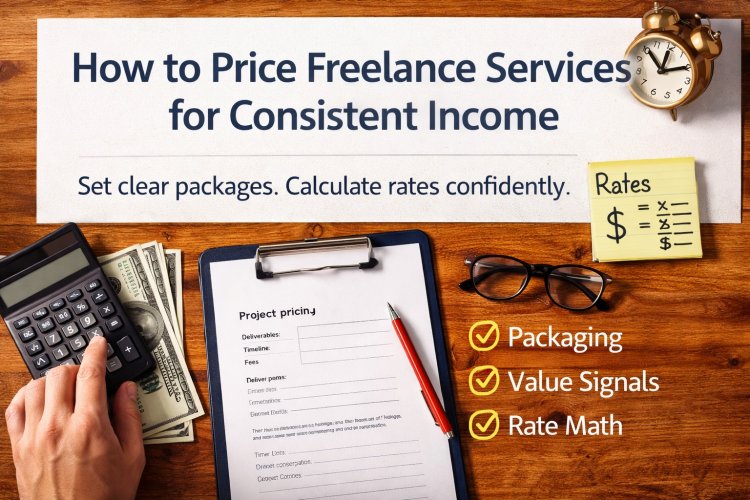
How to Price Freelance Services for Consistent Income
Freelance pricing can feel like guessing.
Charge too low and you burn out. Charge too high and you fear rejection.
This guide shows how to price freelance services with a clear system. You will learn rate math, packaging, and simple scripts you can use today.
What Freelance Pricing Really Does
Your price is not only a number.
Your price also signals quality, confidence, and who you serve.
Pricing is a business decision
Freelancing is a business. Businesses need margins.
Your price must cover time, taxes, tools, and slow months.
Pricing shapes your client list
Low prices attract price shoppers. They often demand more.
Fair prices attract serious clients. They value outcomes.
Step 1: Define Your Offer in One Sentence
Pricing is hard when your offer is vague.
Clarity makes pricing easier and sales faster.
Use this simple offer formula
- I help [type of client].
- Get [specific result].
- By [your service method].
Examples:
- I help coaches get more leads by writing high-converting landing pages.
- I help stores increase sales by setting up email automations.
- I help startups save time by managing content calendars and publishing.
When you know the result, you can price the result.
Step 2: Calculate Your Minimum Sustainable Rate
You need a floor price. This protects your energy.
It also protects your finances during slow weeks.
Use the “real hourly rate” math
Start with your monthly personal expenses.
Add business costs and savings.
- Personal expenses: rent, food, transport, debt payments.
- Business costs: tools, internet, software, hardware, outsourcing.
- Savings: emergency fund, investing, taxes buffer.
Then use this formula:
- Monthly target income = expenses + business costs + savings.
- Billable hours = hours you can sell per month.
- Minimum hourly rate = monthly target income ÷ billable hours.
Example
Your monthly target income is $3,000.
You can sell 60 billable hours per month.
Your minimum rate is $3,000 ÷ 60 = $50 per hour.
This is your floor. Do not go below it.
Why billable hours are lower than you think
You will not bill 160 hours per month.
You have admin work, sales calls, revisions, and learning.
Many freelancers bill 40 to 80 hours monthly.
Step 3: Choose the Right Pricing Model
Different projects need different models.
Pick the model that fits the work and the client.
Hourly pricing
Best for unclear scope or short tasks.
Also useful when you are still learning speed.
- Pros: simple, flexible.
- Cons: punishes speed, invites micromanaging.
Project pricing
Best for clear deliverables and timelines.
Clients like fixed numbers.
- Pros: easier to sell, rewards efficiency.
- Cons: scope creep risk.
Retainer pricing
Best for ongoing work each month.
It stabilizes income and planning.
- Pros: predictable cash flow, deeper client relationships.
- Cons: requires strong boundaries and reporting.
Value-based pricing
Best when you drive measurable business outcomes.
Price is tied to impact, not hours.
- Pros: higher earnings potential.
- Cons: needs strong positioning and proof.
Step 4: Build Packages That Sell Themselves
Packages remove confusion.
They also reduce endless custom quotes.
Start with three tiers
Three options work well for most services.
- Starter: the basics, fast delivery.
- Standard: best value, most popular.
- Premium: highest support, fastest timeline, bonus features.
Package example for a writer
- Starter: 1 blog post, 1 revision, basic SEO.
- Standard: 2 blog posts, 2 revisions, SEO outline.
- Premium: 4 blog posts, internal links, content plan.
Package example for a designer
- Starter: 1 landing page design.
- Standard: landing page + mobile + style guide.
- Premium: full funnel pages + brand kit + handoff support.
Packages are easier to buy than “hours.”
Step 5: Price With Scope, Risk, and Speed
Two projects can look similar but cost more.
Pricing should reflect reality, not hope.
Use these pricing factors
- Scope: number of deliverables and revisions.
- Risk: unclear inputs, many stakeholders, tight deadlines.
- Speed: rush work should cost more.
- Access: meetings, reporting, and support time.
Add rush fees the simple way
If a project compresses your schedule, add a fee.
- Delivery in half the time: add 25% to 50%.
- Weekend work required: add 50% or decline.
Step 6: Use Value Signals Without Overpromising
Clients pay more when they trust outcomes.
You can build trust with simple proof.
Value signals that increase your price
- Case studies with before and after results.
- Testimonials that mention specific wins.
- A clear process with timelines and checkpoints.
- A niche focus, not “I do everything.”
How to talk about results safely
Never guarantee revenue. You cannot control everything.
Instead, promise deliverables and process quality.
Share examples of past outcomes as context.
Step 7: Write Quotes That Prevent Scope Creep
Scope creep kills profit.
A good quote protects both sides.
Include these five lines in every quote
- Deliverables: what you will produce.
- Timeline: start date and delivery date.
- Revisions: how many are included.
- Client inputs: what you need to start.
- Out-of-scope: what costs extra.
Simple out-of-scope wording
- Extra revisions are billed at $X per round.
- New pages are quoted separately.
- Meeting time beyond X hours is billed at $X.
Step 8: How to Raise Your Rates Without Losing Clients
Rate increases are normal in business.
Do it with clarity and respect.
When to raise rates
- You are booked weeks ahead.
- You deliver faster with better quality.
- Your work drives clear business value.
- You want fewer clients and more focus.
A simple rate increase message
Keep it short. Offer options.
- New rate starts on [date].
- Current clients keep old rate for 30 days.
- Offer a retainer to lock in priority support.
Real Pricing Examples You Can Copy
Examples make the system easier to use.
Example 1: Social media management
You can bill 50 hours per month.
Your minimum is $40 per hour. Floor is $2,000.
You create three packages:
- Starter: $600 for 8 posts.
- Standard: $1,200 for 20 posts + reporting.
- Premium: $2,000 for 30 posts + strategy calls.
Example 2: Website copy project
You estimate 25 hours of work at $60 per hour.
Base price is $1,500.
You add 20% for strategy and scope risk.
Quote becomes $1,800 with clear deliverables.
Example 3: Monthly design retainer
You offer 12 hours per month for $1,200.
That is $100 per hour effective.
Client gets priority and predictable support.
Common Pricing Mistakes That Keep You Underpaid
Most pricing problems come from a few habits.
- Copying competitors without knowing their costs.
- Charging hourly for projects with clear outcomes.
- Offering unlimited revisions.
- Discounting before you explain value.
- Taking “exposure” instead of cash.
Quick Scripts for Pricing Conversations
These scripts reduce stress on calls.
When a client asks, “What is your rate?”
- I price based on scope and outcomes. What do you need done?
- Once I know the deliverables, I can quote accurately.
When a client says, “That’s too expensive.”
- Which part feels high: scope, timeline, or budget?
- We can adjust scope to match your budget.
When a client wants a discount
- I can reduce the price by reducing scope.
- Or we can keep scope and adjust the timeline.
Conclusion
Freelance pricing gets easier when you use a system.
You do not need perfect confidence to start.
- Set a minimum sustainable rate to protect your finances.
- Choose a pricing model that fits the project.
- Use packages to simplify buying decisions.
- Define scope to prevent revisions from stealing profit.
- Raise rates when demand and skill improve.
CTA: Calculate your minimum rate today. Then build three packages and publish them.
What's Your Reaction?