How to Price Freelance Services for the First Time
Learn how to price freelance services for the first time using rate math, simple packages, and scope rules. Stop guessing and earn confidently today.
How to Price Freelance Services for the First Time
Your first freelance price can feel terrifying.
You want to be fair, but you also want to get hired.
This guide shows how to price freelance services for the first time using a simple system. You will learn rate math, beginner-friendly packages, and scope rules that protect your time.
Why First-Time Freelancers Undercharge
Most beginners price from fear, not from math.
Fear makes you focus on being “cheap enough.”
Common reasons you undercharge
- You compare yourself to experts.
- You feel guilty charging for thinking time.
- You copy low prices online without context.
- You ignore taxes, tools, and admin work.
- You believe a low price guarantees a yes.
Low prices do not guarantee good clients.
They often attract clients who push boundaries.
Start With This Mindset Shift
Pricing is not a personality test.
It is a business decision.
You are not selling hours
You are selling an outcome and a process.
Clients pay to reduce risk and save time.
Your first price is not permanent
Your first price is a starting point.
You will adjust as you gain proof and speed.
Step 1: Clarify What You Are Selling
Pricing becomes easy when the offer is clear.
Confusing offers create endless quotes and revisions.
Write your offer in one sentence
- I help [type of client].
- Get [result they want].
- By [service you deliver].
Examples:
- I help online stores increase sales by writing product pages.
- I help busy founders save time by managing social content.
- I help service businesses get leads by building landing pages.
List your deliverables
Deliverables are what the client receives.
Use clear items, not vague promises.
- One landing page copy draft
- Two revisions
- Final formatted document
- Basic SEO recommendations
Step 2: Calculate Your Beginner Minimum Rate
You need a floor price you will not cross.
This protects your finances and energy.
Use “monthly target ÷ billable hours”
First, estimate your monthly target income.
- Personal expenses
- Business costs
- Savings and investing
- A taxes buffer
Then estimate billable hours.
Billable hours are hours you can sell.
Beginners often overestimate this number.
Billable hours reality check
In freelancing, many hours are not billable.
- sales calls
- writing proposals
- client communication
- project management
- learning and practice
A realistic beginner range is 40 to 80 billable hours per month.
Rate example you can copy
Monthly target income: $2,400
Billable hours: 60
Minimum hourly rate = $2,400 ÷ 60 = $40
$40 per hour is your floor in this example.
You can charge more when the project is complex.
Step 3: Choose the Right Pricing Model for Beginners
Your first clients need clarity.
You also need protection from scope creep.
Hourly pricing
Use this when scope is unclear.
Use it for short tasks or consulting calls.
- Good for: audits, fixes, coaching, support.
- Risk: clients may monitor every minute.
Project pricing
Use this when deliverables are clear.
Clients like fixed prices.
- Good for: websites, logos, blog posts, video edits.
- Risk: scope creep if you do not set limits.
Retainers
Use this for ongoing monthly work.
It makes income more stable.
- Good for: content, design support, social posting.
- Risk: unclear expectations without boundaries.
If you are new, start with project pricing.
It is simple and easier to sell.
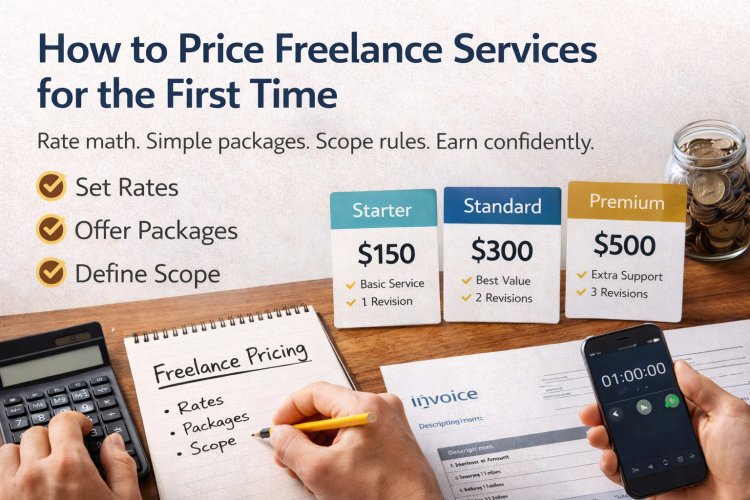
Step 4: Create 3 Beginner-Friendly Packages
Packages stop endless “custom” requests.
They also help clients choose fast.
The 3-tier structure
- Starter: basic deliverable, limited revisions.
- Standard: best value, most popular.
- Premium: more speed, more support, extra value.
How to price packages from your hourly floor
Estimate hours for each package.
Then multiply by your hourly floor.
Add a buffer for complexity and communication.
Simple formula:
- Package price = (estimated hours × hourly floor) + buffer
Example package set for a beginner writer
- Starter ($150): 800-word blog post, 1 revision.
- Standard ($300): 1,500-word blog post, 2 revisions, SEO outline.
- Premium ($500): 2,500-word blog post, 2 revisions, internal links plan, content brief.
Example package set for a beginner designer
- Starter ($200): 1 simple logo concept, 1 revision.
- Standard ($450): 2 concepts, 2 revisions, basic brand colors.
- Premium ($750): 3 concepts, 2 revisions, mini brand kit, file handover support.
Your numbers will differ. The structure stays the same.
Step 5: Add Scope Rules That Protect Your Time
Beginners lose money through unclear scope.
Scope rules keep projects profitable.
Include these in every quote
- Deliverables: what you will deliver.
- Timeline: when you deliver.
- Revisions: how many rounds are included.
- Client inputs: what you need to start.
- Out of scope: what costs extra.
Simple revision rules
Revisions are normal. Unlimited revisions are not.
- Include 1 to 2 revision rounds in Starter.
- Include 2 revision rounds in Standard and Premium.
- Charge for extra rounds, or reduce scope.
Simple out-of-scope wording
- Extra revisions are billed at $X per round.
- New pages or deliverables are quoted separately.
- Meetings beyond X minutes are billed at $X.
Step 6: Use Confidence Scripts When Talking Price
You do not need to sound aggressive.
You need to sound clear.
When a client asks, “What’s your rate?”
- I price based on scope and deliverables. What do you need done?
- Once I confirm the scope, I will share a fixed quote.
When a client says, “That’s too expensive.”
- Which part feels high: scope, timeline, or budget?
- We can reduce scope to fit your budget.
When a client asks for a discount
- I can lower the price by reducing scope.
- Or we can keep scope and adjust the timeline.
Discounting without scope changes trains clients to push.
Step 7: Price Higher When Any of These Are True
Not all projects are equal.
Some projects carry more risk and more effort.
Reasons to charge more
- Rush deadline
- Unclear inputs
- Multiple stakeholders
- Heavy meetings and reporting
- High complexity or technical work
Simple rush fee rule
- Half the normal timeline: add 25% to 50%.
- Work required on weekends: add 50% or decline.
Step 8: Your First Pricing Page Template
Publishing prices builds trust and saves time.
You can keep it simple.
What to include
- Who you help
- What you deliver
- 3 packages with clear deliverables
- What is included and not included
- How to start, with a simple next step
Beginner positioning line
Use an honest, confident line.
- I offer clear packages and reliable delivery for simple projects.
- My process is structured, and scope is defined upfront.
You do not need to pretend to be a giant agency.
Real First-Time Pricing Examples
These examples show how the system works in real life.
Example 1: Beginner video editor
Monthly target: $2,000
Billable hours: 50
Hourly floor: $40
Estimated hours for one short video: 3 hours
Base: 3 × $40 = $120
Add buffer for revisions and exports: $30
Project price: $150
Example 2: Beginner website developer
Hourly floor: $50
Estimated hours for a simple landing page: 10
Base: 10 × $50 = $500
Add buffer for meetings and testing: $150
Project price: $650
Example 3: Beginner social media manager
Standard retainer includes 12 hours monthly.
Hourly floor: $35
Base: 12 × $35 = $420
Add buffer for reporting and planning: $80
Retainer price: $500 per month
Common Beginner Mistakes That Kill Profit
These are normal mistakes. Fix them early.
- Charging “friends prices” for strangers.
- Offering unlimited revisions to feel safe.
- Starting work without a deposit.
- Quoting before you confirm deliverables.
- Accepting vague “we’ll see” project plans.
Use deposits to protect your time
A deposit reduces risk on both sides.
Many freelancers use 30% to 50% upfront.
How to Raise Prices After Your First Clients
Your first projects teach you time and effort.
Use that data to raise prices.
Raise prices when
- You are booked consistently.
- You finish faster with better quality.
- Clients say yes without long negotiations.
- You have proof, even small proof.
Simple rule for raises
Increase 10% to 20% every few projects.
Keep raising until you get some no answers.
No answers are part of healthy pricing.
Conclusion
Your first freelance price should be simple, clear, and protected by rules.
You do not need to “guess” forever.
- Define your offer and deliverables first.
- Calculate a minimum hourly floor using real math.
- Start with project pricing and simple packages.
- Set scope rules to prevent endless revisions.
- Raise prices as your proof and speed grow.
CTA: Do the math today. Set your hourly floor and publish three starter packages.
What's Your Reaction?