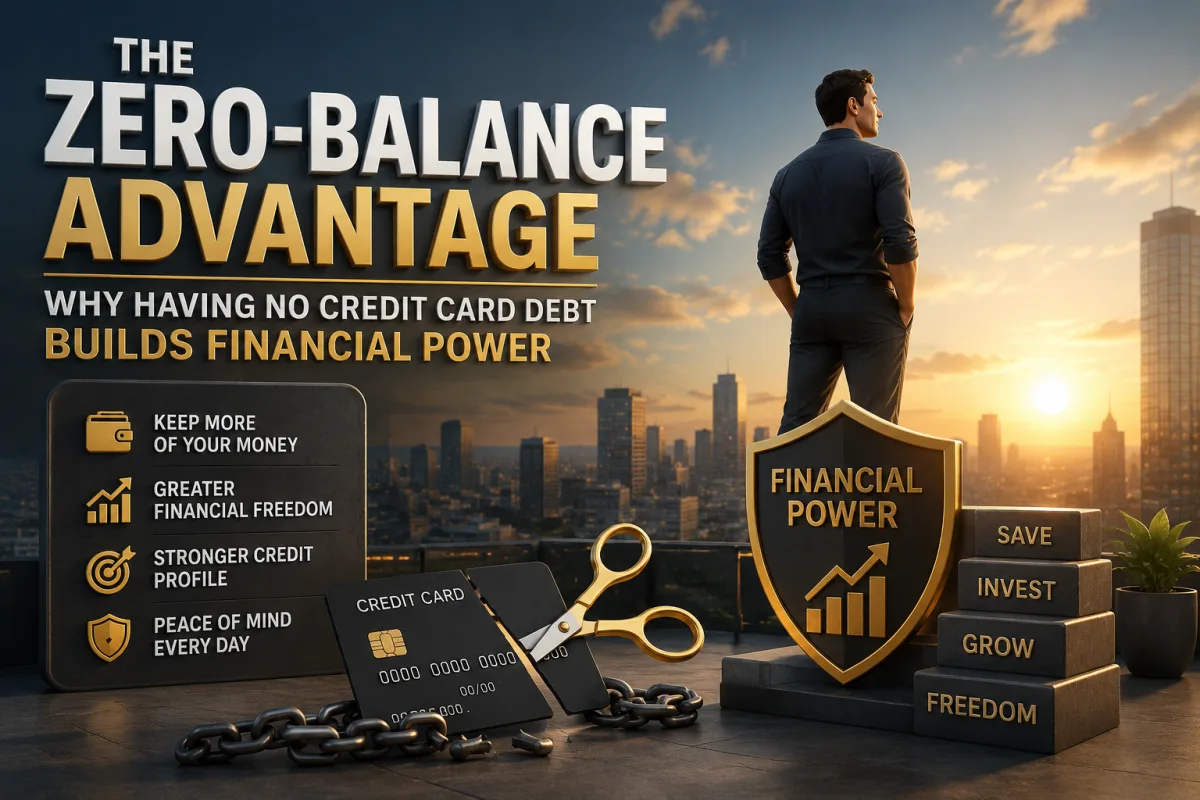
The Zero-Balance Advantage: Why Having No Credit Card Debt Builds Financial Power
Having no credit card debt is one of the quietest forms of financial strength.
It does not draw attention the way a luxury purchase does. It does not appear in photographs, impress strangers, or announce itself in daily conversation. There is no public applause for paying the full statement balance, avoiding interest, or declining to finance a lifestyle through revolving debt. Yet the absence of credit card debt can be one of the most important advantages in a person’s financial life.
A zero credit card balance means income is not already claimed by yesterday’s spending. It means future earnings remain available for present needs, savings, investing, emergencies, family priorities, and opportunity. It means the household is not paying high interest for meals already eaten, clothes already worn, trips already taken, or purchases already forgotten. It means money can move forward instead of backward.
Credit cards are not automatically harmful. Used carefully, they can provide payment convenience, fraud protection, rewards, recordkeeping, travel benefits, and short-term flexibility. But when a credit card balance is carried from month to month, the tool changes character. It becomes a high-cost loan attached to consumption. The convenience remains, but the cost begins to compound.
This is the danger. Credit card debt often grows quietly. A few purchases become a small balance. The small balance becomes normal. Minimum payments create the illusion of control. Interest is added. New purchases continue. The balance becomes larger, and the cardholder begins sending more of each paycheck to the past.
Having no credit card debt breaks that cycle completely.
It allows a person to use income for building rather than repairing. It creates mental clarity. It reduces financial anxiety. It strengthens the ability to save and invest. It protects against the trap of lifestyle inflation funded by borrowed money. It also creates a sharper understanding of affordability: if something cannot be paid for without carrying a balance, it may not yet be affordable.
The zero-balance advantage is not only about avoiding debt. It is about keeping financial control.
Why Credit Card Debt Is Different From Other Debt
Not all debt behaves the same way.
A mortgage may help someone buy a home. A business loan may help finance productive expansion. A student loan may increase earning power if the education is valuable and the debt is manageable. Even these debts require caution, but they may be connected to assets or future income.
Credit card debt is often different. It is frequently used for consumption: groceries, dining, clothing, travel, entertainment, subscriptions, electronics, gifts, household items, and emergencies. Some of these expenses are necessary. Others are discretionary. But once they are placed on a credit card and not paid in full, the cardholder begins paying interest on past consumption.
This distinction matters because consumption does not usually create future cash flow. A business loan may fund equipment that produces revenue. A mortgage may finance a property that provides shelter and may build equity. Credit card debt may finance purchases that have no lasting economic value by the time the bill arrives.
That does not mean every person with credit card debt was careless. Many people use cards during medical emergencies, job loss, family crises, income disruptions, or periods of rising living costs. Credit card debt can be a symptom of financial pressure, not merely poor discipline. But regardless of how the debt begins, the financial mechanics are harsh.
Credit card balances usually carry high interest compared with many other forms of borrowing. High interest means the debt can grow even when the cardholder is making payments. The longer the balance remains, the more income is diverted away from wealth-building uses.
This is why eliminating credit card debt is often one of the highest-impact financial moves a person can make.
The Hidden Cost of Carrying a Balance
The cost of credit card debt is not limited to the interest printed on a statement.
The first cost is obvious: interest. A balance carried month after month accumulates finance charges. The cardholder pays more for every purchase than the original price. A meal, pair of shoes, appliance, or weekend trip may become far more expensive when financed over time.
The second cost is reduced cash flow. Monthly payments consume income that could have gone to savings, investing, insurance, education, debt reduction, business capital, or emergency reserves. A household may feel that income is too low when the deeper problem is that past spending is still being paid for.
The third cost is opportunity cost. Money paid in credit card interest cannot compound in an investment account. It cannot build an emergency fund. It cannot reduce a mortgage. It cannot fund a business idea. It cannot support a child’s education. Every interest payment is a transfer of future possibility to a lender.
The fourth cost is stress. Credit card balances create mental noise. The cardholder may check balances anxiously, avoid statements, juggle payments, worry about due dates, or feel guilt after spending. Debt becomes emotional weight.
The fifth cost is reduced flexibility. A person with no credit card debt can respond to opportunities and emergencies more easily. A person with large revolving balances may be trapped. Even if income is strong, the debt absorbs room to maneuver.
The most dangerous part is normalization. Once carrying a balance becomes normal, the household may stop seeing credit card interest as a warning sign. It becomes another monthly bill. But unlike rent, utilities, or insurance, credit card interest often represents money paid for no new value.
The zero-balance household avoids this leakage entirely.
The Minimum Payment Illusion
Minimum payments are one of the most misunderstood features of credit cards.
A minimum payment can make debt feel manageable because the required amount appears small relative to the total balance. The cardholder may think, “I can afford this.” But affordability based on minimum payments is often misleading. The minimum payment is designed to keep the account current, not to eliminate debt quickly.
When only the minimum is paid, much of the payment may go toward interest rather than principal. The balance falls slowly. If the cardholder continues using the card, the debt may not fall at all. It may grow.
The minimum payment creates a psychological trap. It turns a large debt into a small monthly obligation, making the balance feel less urgent. The cardholder may avoid confronting the total cost because the monthly requirement appears tolerable. But the true cost is measured over time.
A person with no credit card debt does not live under this illusion. They do not ask, “Can I afford the minimum payment?” They ask, “Can I afford to pay this in full?” That question creates a different standard.
Paying in full transforms the credit card from a borrowing tool into a payment tool. The cardholder can still use the card for convenience or rewards, but they are not renting purchasing power from the bank.
How Credit Card Debt Blocks Wealth Creation
Wealth creation depends on surplus. A surplus exists when income exceeds expenses and the difference is directed toward savings, investing, debt reduction, or productive assets.
Credit card debt attacks surplus from two directions. First, it often reflects spending that exceeded available cash. Second, it adds interest that increases future expenses. The household must now use tomorrow’s income to pay for yesterday’s gap.
This makes wealth building harder. A person may want to invest, but credit card payments consume available cash. They may want to build an emergency fund, but interest charges keep interfering. They may want to save for a home, but revolving balances reduce borrowing capacity and cash flow. They may want to start a business, but debt creates pressure and limits risk-taking ability.
High-interest credit card debt can be especially damaging because it may effectively outperform investments in reverse. If a person pays very high interest on credit card balances while hoping to earn moderate returns in the market, the debt may be undermining progress faster than the investments can build it.
This does not mean every person must stop all investing until every debt is gone. Some may contribute enough to capture an employer retirement match or maintain essential long-term habits. But ignoring expensive credit card debt while trying to build wealth is usually inefficient.
Having no credit card debt frees the surplus. Once the balance is gone, the payment that once served the lender can be redirected toward the owner’s future.
The Psychological Freedom of a Zero Balance
Money is not only mathematical. It is emotional.
A person carrying credit card debt may feel behind even when income is adequate. They may hesitate to open statements. They may feel embarrassed by the balance. They may avoid financial planning because the debt feels discouraging. They may work hard but feel as if progress disappears into bills.
A zero balance changes the emotional atmosphere. It creates a sense of reset. The cardholder no longer begins each month with old consumption attached to income. They can plan from a cleaner position. They can use money proactively instead of reactively.
This psychological freedom matters because confidence affects behavior. A person who feels trapped may avoid decisions. A person who feels in control may save more, invest more, negotiate better, spend more intentionally, and plan more clearly.
Debt freedom also reduces financial shame. Many people judge themselves harshly for past credit card mistakes. But the purpose of eliminating debt is not self-punishment. It is liberation. Once the debt is gone, the lesson remains, but the burden does not have to.
The zero-balance advantage is a financial condition and a mental condition. It restores choice.
Credit Cards Are Tools, Not Income
One of the most important rules of credit card use is simple: a credit limit is not income.
A bank may approve a person for a high credit limit based on income, credit history, and risk models. That limit can feel like financial capacity. But it is borrowed capacity. Spending against it without cash available creates future obligation.
This distinction is especially important during periods of rising income. A person earns more, qualifies for better cards, receives higher limits, and begins spending at a higher level. The lifestyle expands before savings and investments catch up. The credit card becomes a bridge between desired lifestyle and actual cash flow.
This is how financial fragility can hide behind professional success. A person may have a strong salary, premium credit card, and polished lifestyle while carrying revolving balances. From the outside, they appear affluent. In reality, they may be transferring wealth to lenders every month.
A credit card should be treated like a payment method, not an extension of income. If the cash does not exist to pay the statement in full, the purchase deserves closer examination.
The Difference Between Using Credit and Depending on Credit
Responsible credit card use is possible. Many financially disciplined people use cards regularly and never pay interest. They use cards for convenience, consumer protection, rewards, travel benefits, digital subscriptions, and expense tracking. The key is that they do not depend on the card to afford the purchase.
Using credit means the card is a tool. Depending on credit means the card is a lifeline.
The difference can be seen in behavior. A responsible user knows the card balance before the statement arrives. They have cash available to pay in full. They do not make purchases because the limit allows it. They do not carry balances for ordinary spending. They do not view rewards as a reason to spend more.
A dependent user may need the card to cover groceries before payday, transfer balances repeatedly, pay only minimums, rely on cash advances, or feel anxious when available credit falls. The card is no longer a convenience. It has become part of survival.
There should be no shame in recognizing dependency. Many people reach that point because of difficult circumstances. But once identified, it should be addressed directly. Credit cards are expensive tools for long-term survival. A household relying on them needs a cash-flow repair plan, not more credit.
Rewards Can Become a Trap
Credit card rewards are attractive. Cash back, points, miles, discounts, lounge access, purchase protection, and travel benefits can create real value when the card is paid in full.
But rewards become dangerous when they encourage extra spending or disguise interest costs. A person earning 2 percent cash back while paying high interest on a carried balance is not winning. The interest cost overwhelms the reward. The reward becomes a small rebate on a much larger financial leak.
Rewards also influence behavior. People may justify purchases because they are earning points. They may choose a more expensive trip, meal, or item because the card offers benefits. They may focus on optimization while ignoring the simplest rule: no reward is worth carrying a balance.
The financially disciplined cardholder treats rewards as secondary. The primary goal is avoiding interest. If rewards come from spending that would have happened anyway and the balance is paid in full, they are useful. If rewards cause more spending or debt, they are harmful.
Rewards should serve the budget. The budget should not serve rewards.
How Having No Credit Card Debt Strengthens Cash Flow
Cash flow is the movement of money through a household. Income comes in. Expenses go out. What remains determines financial progress.
Credit card debt weakens cash flow because it creates a fixed claim on future income. Each month, part of the paycheck must go toward past balances. If the balance is large, the payment may crowd out savings and investing. If interest is high, progress may feel slow even when payments are made consistently.
Having no credit card debt removes this claim. The household can decide where money goes rather than responding to lender demands. The amount that would have gone to minimum payments can become an emergency fund contribution, retirement investment, sinking fund, mortgage prepayment, education savings, or business capital.
This is where debt freedom becomes wealth building. The same cash flow that once repaired the past can now build the future.
The key is to redirect the old payment immediately. Many people pay off debt and then allow the freed cash to disappear into lifestyle. The balance is gone, but wealth does not grow because the payment was absorbed by spending. A disciplined household captures the freed payment and assigns it a new job.
Debt payoff creates opportunity. Wealth building requires using it.
The Emergency Fund Connection
Credit card debt and emergency savings are closely connected.
Many people carry credit card debt because they lack cash reserves. When the car breaks down, a medical bill arrives, a family member needs help, or income is delayed, the card becomes the emergency fund. This solves the immediate problem but creates a new one: high-interest debt.
A true emergency fund reduces the need to borrow for predictable unpredictability. Emergencies are unpredictable in timing but predictable in existence. Something will eventually break, fail, cost more, or arrive unexpectedly. Cash reserves prepare for that reality.
A person with no credit card debt should still build and maintain an emergency fund. The absence of debt is not enough if the next emergency will recreate it. The goal is not only to reach zero. The goal is to stay at zero.
For someone currently paying off credit card debt, the emergency fund decision can be balanced. A small starter emergency fund may prevent new borrowing while extra cash attacks the card balance. After high-interest debt is eliminated, the emergency fund can be expanded.
The zero-balance life is protected by liquidity.
How to Stay Out of Credit Card Debt
Staying out of credit card debt requires systems, not willpower alone.
The first system is paying the card in full every month. This rule should be non-negotiable. If a purchase cannot fit within the monthly payoff plan, it should be delayed, reduced, or funded another way.
The second system is tracking spending before the statement closes. Waiting until the bill arrives can create surprises. A cardholder should know the running balance and how it compares with available cash.
The third system is separating needs from wants. Credit cards make spending painless because no cash leaves the account immediately. This can blur judgment. A brief pause before discretionary purchases helps restore awareness.
The fourth system is using sinking funds. A sinking fund is money set aside gradually for known future expenses: insurance premiums, holidays, car maintenance, school costs, home repairs, annual subscriptions, gifts, or travel. These expenses are not emergencies if they are predictable. Funding them ahead of time prevents card reliance.
The fifth system is reducing card access if necessary. Some people can use cards responsibly. Others may need to remove saved card details, lower credit limits, use debit for discretionary spending, or temporarily stop carrying the card. The best system is the one that protects behavior.
The sixth system is reviewing statements. Statements reveal patterns. Dining, subscriptions, impulse purchases, fees, and small transactions can accumulate quietly. Awareness is the beginning of control.
When No Credit Card Debt Does Not Mean Financial Health
Having no credit card debt is powerful, but it is not the entire financial picture.
A person can have no credit card debt and still have no emergency fund. They may be one crisis away from borrowing. Another person may have no credit card debt but carry expensive personal loans, auto loans, payday loans, or family debts. Another may avoid credit cards entirely but fail to invest, insure, or plan for retirement.
The zero-balance advantage is a foundation, not the finish line.
Once credit card debt is absent, the next steps matter. Build emergency savings. Pay down other high-cost debt. Invest consistently. Protect income. Review insurance. Plan for retirement. Increase earning power. Avoid lifestyle inflation. Build assets.
No credit card debt creates room for these actions. It does not perform them automatically.
The Social Pressure to Spend
Credit card debt often grows in social environments where spending is normalized.
Dinners, travel, weddings, birthdays, holidays, fashion, electronics, home upgrades, and social events can create pressure to spend beyond cash capacity. People may use credit cards to avoid embarrassment, keep up with friends, maintain appearances, or participate in experiences they cannot currently afford.
This is one reason debt freedom requires personal clarity. A person must know what they value enough to pay for and what they are willing to decline. Without that clarity, social pressure can decide the budget.
Having no credit card debt sometimes requires invisible courage. It may mean choosing a simpler holiday, attending fewer expensive events, buying a used item, delaying an upgrade, or being honest about limits. These choices may feel uncomfortable in the moment, but they protect financial freedom.
The irony is that many people appearing financially confident are themselves under pressure. Visible spending is not proof of wealth. It may be proof of available credit.
The person with a zero balance may look less extravagant but possess more actual control.
Credit Card Debt and Relationships
Debt affects relationships because money affects trust, planning, and stress.
In couples, undisclosed credit card debt can create tension. One partner may believe the household is financially stable while the other carries balances privately. The issue is not only the debt but the secrecy. Financial decisions made in isolation can damage shared goals.
Families may also feel the impact. Credit card payments can reduce money available for children, parents, housing, savings, or emergencies. Debt stress can affect mood, communication, and household peace.
Healthy financial relationships require transparency. Couples should know what debts exist, what interest rates apply, how payments are made, and what plan is in place. The goal is not blame. The goal is alignment.
Having no credit card debt simplifies household planning. It removes one source of tension and allows partners to focus on shared goals rather than past balances.
How to Pay Off Credit Card Debt and Reach Zero
For someone who currently has credit card debt, the path to zero begins with honesty.
List every card, balance, interest rate, minimum payment, due date, and available limit. The total may feel uncomfortable, but clarity is necessary. Debt cannot be managed well when it is vague.
Next, stop adding new balances. This may require switching to debit or cash temporarily, cutting discretionary spending, building a small emergency cushion, or removing saved card details from online accounts.
Then choose a payoff strategy. The debt avalanche method focuses extra payments on the highest-interest card first while making minimum payments on the others. This usually saves the most interest. The debt snowball method focuses on the smallest balance first to create quick psychological wins. Both can work. The best method is the one the person will follow consistently.
Consider whether balance transfers, consolidation loans, or hardship programs can reduce interest. These tools can help, but they are not cures. If spending behavior does not change, consolidation simply moves the debt. A lower rate is useful only when paired with a payoff plan.
Increase cash flow where possible. This may include reducing expenses, selling unused items, taking temporary extra work, negotiating bills, pausing nonessential subscriptions, or redirecting bonuses and refunds. The goal is to create a focused period of debt attack.
Finally, after the balance reaches zero, keep the old payment alive. Redirect it to savings and investing. This turns the debt payoff journey into the beginning of wealth building.
The Role of Credit Scores
Some people worry that avoiding credit card debt means avoiding credit cards entirely, which may affect credit history. The issue is more nuanced.
A person can use a credit card and still have no credit card debt by paying the full statement balance every month. This can support a healthy credit profile while avoiding interest. Payment history, credit utilization, account age, and responsible management often matter more than carrying debt.
Carrying a balance is not necessary to prove responsibility. Paying interest is not a requirement for financial credibility. In fact, high balances relative to limits can hurt a credit profile and signal financial strain.
The strongest credit card user is often the person who uses credit lightly, pays on time, keeps utilization modest, and never carries a balance.
Credit should support financial life. It should not control it.
Credit Card Debt and Inflation
When living costs rise, credit card debt can become more tempting. Groceries, transport, utilities, rent, school fees, and medical costs may increase faster than income. Households may use cards to bridge the gap.
This is understandable, but dangerous. If the underlying cash-flow gap remains, credit cards only delay the reckoning while adding interest. The household may need a deeper response: renegotiating expenses, increasing income, adjusting lifestyle, seeking support, reviewing housing costs, or restructuring obligations.
Inflation makes debt more painful because essentials consume more income, leaving less room for repayment. A household already carrying credit card balances may find progress slowing just as pressure rises.
Having no credit card debt during inflation is a major advantage. It leaves more income available to absorb higher prices. It also reduces the chance that rising costs will trigger a debt spiral.
Credit Card Debt and Wealth Mindset
A zero-balance lifestyle reflects a particular money mindset.
It does not say, “Never spend.” It says, “Spend from strength.” It does not reject comfort or enjoyment. It rejects paying high interest for ordinary consumption. It does not require fear of credit. It requires respect for credit.
This mindset understands that wealth is built by directing money toward assets, not interest charges. It recognizes that every dollar has a future. Money can become a payment to a lender, or it can become savings, investments, insurance, education, business capital, or freedom.
Having no credit card debt also builds patience. It teaches delayed gratification. It encourages planning for purchases. It reduces impulse spending. It forces the household to distinguish between desire and affordability.
These habits extend beyond credit cards. A person who learns to avoid revolving debt often becomes better at managing loans, investments, lifestyle inflation, and long-term goals. The discipline transfers.
What to Do After Reaching Zero
Reaching zero is a milestone. What happens next determines whether it becomes a turning point.
The first step is to build or strengthen emergency savings. This prevents the next disruption from becoming new debt.
The second step is to create sinking funds for predictable expenses. Annual bills, car repairs, holidays, gifts, school costs, and home maintenance should be funded gradually.
The third step is to invest. The monthly amount once used for credit card payments can now buy assets. This is where debt freedom becomes wealth creation.
The fourth step is to review other debts. Personal loans, auto loans, student loans, mortgages, and business debts should be evaluated by interest rate, purpose, and repayment strategy.
The fifth step is to protect income. Insurance, emergency reserves, skill development, and multiple income streams can reduce the chance of returning to debt during crisis.
The sixth step is to set rules for future card use. These rules may include paying in full, keeping utilization low, using one card only, avoiding cash advances, refusing purchases without available cash, and reviewing statements weekly.
Zero should become a system, not a temporary condition.
The Long-Term Wealth Impact
The long-term wealth impact of having no credit card debt is larger than it first appears.
Assume a person was paying several hundred dollars or the local equivalent each month toward credit card debt. Once the debt is gone, that same amount can be invested. Over years, the difference can become substantial. The person is no longer paying compound interest. They are earning compound returns.
This reversal is one of the most important shifts in personal finance. Debt makes compounding work against the borrower. Investing makes compounding work for the owner. The zero-balance advantage moves a person from the wrong side of compounding to the right side.
The change also affects decisions. A debt-free cardholder may be more willing to negotiate salary, change jobs, start a business, move cities, take parental leave, or invest during market declines because their monthly obligations are lower. Financial freedom is not only about net worth. It is also about flexibility.
Credit card debt reduces flexibility. No credit card debt expands it.
Common Myths About Credit Card Debt
One myth is that everyone carries credit card debt. Many people do, but normal does not mean healthy. Financial habits can be common and still damaging.
Another myth is that carrying a balance improves credit. Responsible use can help credit history, but paying interest is not necessary. Paying on time and keeping balances low is usually more powerful than carrying debt.
A third myth is that rewards make debt worthwhile. Rewards rarely come close to offsetting high interest on carried balances.
A fourth myth is that a higher credit limit means greater affordability. A limit is permission to borrow, not proof that a purchase fits the budget.
A fifth myth is that credit card debt is only a problem for low-income households. High-income households can also carry large balances if spending rises faster than discipline.
A sixth myth is that small balances do not matter. Small balances become habits. Habits become systems. Systems determine wealth.
Final Thoughts
Having no credit card debt is not just a financial detail. It is a strategic advantage.
It protects cash flow. It reduces stress. It prevents high-interest payments from draining income. It keeps future earnings available for future goals. It helps households build emergency reserves, invest consistently, and make decisions from strength rather than pressure.
Credit cards can be useful tools, but only when the cardholder remains in control. The moment a balance is carried month after month, the tool becomes a lender, and the lender begins claiming part of the future.
The zero-balance life restores that future to its owner.
For someone with credit card debt, reaching zero may require sacrifice, structure, and patience. For someone already at zero, staying there requires systems, emergency savings, and clear spending rules. In both cases, the reward is more than a cleaner statement. It is a stronger financial foundation.
Wealth is built not only by what people earn, but by what they refuse to let leak away. Credit card interest is one of the most avoidable leaks in personal finance. Eliminating it allows money to move toward ownership, stability, and freedom.
The balance that matters most is not the credit limit. It is the balance between present desire and future power. Having no credit card debt keeps that balance in the hands of the person earning the money.
 Article
 Article
 Article
 Article
 Article
 Article
 Article
 Article