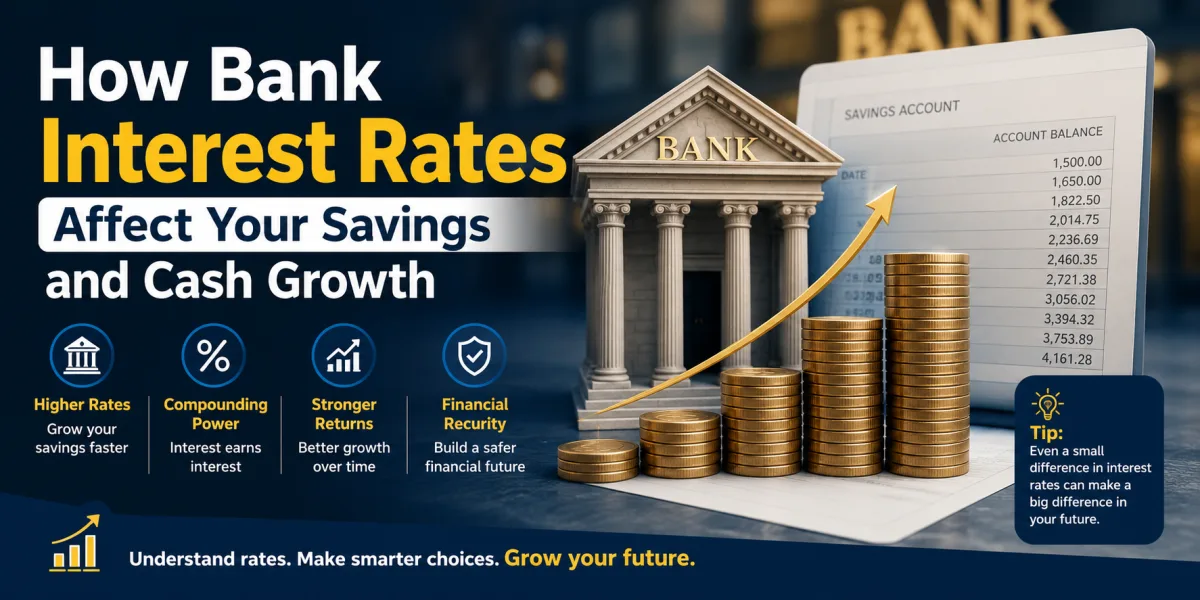
The Savings Rate Gap: How Bank Interest Rates Quietly Shape Your Wealth
Most people think of a savings account as a safe place to keep money. That is true, but incomplete. A savings account is not only a storage container. It is also a financial instrument with a price attached to it. That price is the interest rate.
When the rate is high, your cash works harder while staying liquid. When the rate is low, your money may be safe in nominal terms but weak in economic terms. The balance remains visible on the screen, yet its buying power may erode quietly. This is why bank interest rates matter far more than many savers realize.
A household with $500 in savings may not feel a dramatic difference between a low-rate account and a high-yield account. A household with $20,000, $50,000, or $100,000 in emergency savings, tax reserves, home-buying money, or business cash can feel a meaningful difference over time. The gap between earning almost nothing and earning a competitive rate can become hundreds or thousands of dollars each year.
Bank interest rates influence how quickly savings grow, how much inflation reduces purchasing power, how attractive cash feels compared with investing, and how disciplined people are about keeping money set aside. They also reveal an important truth about personal finance: where money sits matters.
Many people work hard to earn income, negotiate salaries, reduce expenses, and budget carefully, then leave large amounts of cash in accounts paying little or no interest. That is not always a crisis. Cash has a job: safety, liquidity, and stability. But once cash is needed, it should be managed intelligently. A savings account should not be treated as an afterthought.
Interest rates are the bridge between cash and time. They decide whether your savings slowly expand, stand still, or fall behind the rising cost of life. Understanding that bridge helps savers make better decisions about emergency funds, short-term goals, bank accounts, certificates of deposit, money market accounts, and the line between saving and investing.
What Bank Interest Rates Really Mean
A bank interest rate is the amount a bank pays you for keeping money on deposit, usually expressed as an annual percentage. In a savings account, this is often shown as an annual percentage yield, or APY. APY reflects the effect of compounding, which means it accounts for interest earning interest over time.
At its simplest, interest is compensation. When you deposit money, the bank can use that money as part of its funding base. Banks may lend, invest, or manage those funds within regulatory requirements. In return, some of the value created by those deposits is paid back to customers as interest.
The rate you receive is not random. It reflects competition, monetary policy, bank funding needs, account type, customer behavior, and the institution’s business model. A large traditional bank with millions of loyal customers may not need to offer a high savings rate to attract deposits. An online bank trying to win rate-sensitive customers may offer a much higher rate. A community bank may adjust rates based on local lending demand. A credit union may offer competitive rates because of its member-owned structure.
Interest rates also reflect the broader economy. In the United States, the Federal Reserve influences short-term rates through monetary policy. The effective federal funds rate is the rate banks charge each other for overnight lending, and it is influenced by Federal Reserve tools such as the interest rate on reserve balances. The Federal Reserve Bank of St. Louis explains that the effective federal funds rate is market-determined but influenced by the Fed as it uses the interest on reserve balances rate to steer the federal funds rate toward the target range.
That policy rate does not directly set the rate on your savings account, but it strongly affects the environment in which banks compete for deposits. When short-term rates rise, banks can often earn more on safe assets and loans, which gives them more room to pay savers. When short-term rates fall, savings rates usually decline as well.
This is why savings rates can change over time. A savings account paying 4% one year may pay 3% later. A certificate of deposit opened when rates are high may look attractive after rates fall. A low-rate checking account may remain low regardless of the cycle because checking accounts are primarily designed for transactions, not yield.
The Difference Between Interest Rate and APY
Savers often see two terms: interest rate and annual percentage yield. They are related, but not identical.
The interest rate is the stated rate paid on the account. APY shows what you earn over a year after compounding is included. If interest compounds monthly, the bank calculates interest periodically and adds it to your balance. The next period’s interest is then calculated on a slightly larger balance. Over time, this creates a small but important difference.
For example, a savings account with a 4.00% interest rate compounded monthly will have an APY slightly above 4.00%. The difference is not dramatic over one month, but it becomes more visible over longer periods and larger balances. That is why APY is the better comparison tool when evaluating savings accounts.
APY makes banks easier to compare because it incorporates compounding frequency. One bank may compound daily, another monthly, and another quarterly. The APY translates those mechanics into a clearer annual number.
When comparing accounts, always compare APY, not just the stated interest rate. Also read the conditions. Some accounts advertise a high APY only up to a certain balance. Others require direct deposit, debit card usage, minimum balances, or account bundles. Some promotional rates expire. A high APY with restrictive conditions may be less useful than a slightly lower APY with simple access and no fees.
Why Small Rate Differences Become Large Over Time
Interest rates feel small because they are expressed as percentages. A difference between 0.50% and 4.00% may not sound dramatic at first glance. But on real balances, over real time, the gap becomes meaningful.
Consider $25,000 in savings. At 0.50%, it earns about $125 in one year before taxes. At 4.00%, it earns about $1,000 in one year before taxes. The difference is $875. That is not abstract. It could cover insurance premiums, utility bills, car maintenance, school supplies, travel costs, or part of a rent payment.
Now consider $50,000. At 0.50%, the annual interest is about $250. At 4.00%, it is about $2,000. The difference is $1,750 before taxes. For a household carefully building a home down payment or emergency fund, that extra interest can accelerate the goal without requiring extra labor.
This is the core lesson: interest rates allow saved money to participate in time. The saver has already done the hard work of earning and retaining the money. The account choice determines whether the bank rewards that discipline or captures most of the benefit for itself.
The gap becomes especially important for people holding cash for short-term goals. Money intended for a home purchase, tuition payment, tax bill, business expense, or emergency reserve should usually not be exposed to stock market volatility. But it also should not be ignored. A competitive savings rate can help preserve value while keeping the money available.
Compounding: The Quiet Engine Behind Savings Growth
Compounding is often discussed in investing, but it also applies to savings. When your account earns interest, that interest becomes part of the balance. Future interest is calculated on the original deposit plus the interest already earned. This creates interest on interest.
In a savings account, compounding is usually modest compared with long-term investing because savings rates are lower than expected equity returns over long periods. But compounding still matters, especially when balances are large and rates are competitive.
Imagine depositing $10,000 into an account earning 4.00% APY and leaving it untouched for five years. Without any additional deposits, the balance grows to roughly $12,167 before taxes. The account earned more than $2,000 simply because the money remained in a productive cash account. At 0.10%, the same $10,000 would grow to only about $10,050 over five years.
The difference is not caused by risk-taking. It is caused by rate selection. Both accounts may be insured. Both may be liquid. Both may be called savings accounts. Yet the economic result differs sharply.
Compounding becomes even more powerful when paired with regular contributions. A saver who starts with $5,000, adds $500 per month, and earns 4.00% APY will build wealth faster than a saver making the same deposits into an account earning almost nothing. The difference is not only mathematical. It is motivational. Watching interest appear each month can reinforce the habit of saving.
This psychological benefit matters. People often save more when progress is visible. A competitive interest rate turns a savings account into an active partner rather than a silent vault.
The Role of Inflation
The most important enemy of savings is not always spending. Sometimes it is inflation.
Inflation reduces the purchasing power of money over time. If prices rise by 3% and your savings earn 0.50%, your account balance may increase slightly, but your real purchasing power falls. You have more dollars, but those dollars buy less.
This is why the real return on savings matters. The real return is the interest rate after inflation. If a savings account earns 4% while inflation is 3%, the real return is roughly 1% before taxes. If the account earns 0.25% while inflation is 3%, the real return is deeply negative.
Cash is still necessary even when real returns are low. Emergency funds should not be judged by investment standards. Their primary job is to prevent financial emergencies from becoming debt emergencies. Cash allows you to handle job loss, medical bills, car repairs, home repairs, family needs, or temporary income disruption without selling investments at the wrong time or relying on high-interest debt.
But the existence of inflation means savers should seek reasonable yield where they can do so safely. The goal is not to make cash behave like stocks. The goal is to reduce unnecessary erosion.
A person who keeps $30,000 in a low-yield account for years may lose significant purchasing power compared with someone who keeps the same money in a competitive insured account. Both are savers. One is simply allowing inflation and bank pricing to take a larger share of the value.
Why Banks Pay Different Rates
Two banks can offer dramatically different savings rates on the same day. This surprises people because a savings account seems like a standard product. But banks have different funding needs, customer bases, cost structures, and competitive strategies.
Large traditional banks often hold massive deposit bases. Many customers use them for convenience, branch access, direct deposit, mortgages, credit cards, and bill pay. If those customers do not move money for better rates, the bank does not need to pay more. Inertia becomes profitable.
Online banks often compete by offering higher rates. Without large branch networks, they may have lower operating costs. They also attract customers who actively compare rates. These customers are more likely to move money when yields become uncompetitive, so online banks face greater pressure to offer attractive APYs.
Community banks and credit unions may fall somewhere in between. Some offer excellent rates to attract local deposits. Others focus more on relationship banking, lending, and community service. Their rates depend on strategy, balance sheet needs, and competitive environment.
Bank profitability also matters. A bank that wants more deposits may raise rates. A bank with more deposits than it needs may keep rates low. A bank trying to fund loan growth may become more competitive. A bank managing liquidity carefully may adjust rates to influence deposit flows.
This means savers should not assume their current bank is paying a fair market rate. A bank is not obligated to maximize your interest. It is managing its own economics. Your job is to manage yours.
High-Yield Savings Accounts
A high-yield savings account is a savings account that pays a rate meaningfully above the national average. These accounts are often offered by online banks, digital banking platforms, credit unions, and some regional institutions.
As of July 17, 2026, reporting on high-yield savings accounts showed that competitive accounts were still offering yields far above the national average savings rate. The Wall Street Journal reported that the FDIC national average savings rate was 0.38%, while top savings accounts were offering materially higher APYs, with some high-yield accounts around 4% or more depending on institution and terms.
This gap is the reason high-yield savings accounts receive so much attention. The difference between 0.38% and 4.00% is not cosmetic. On $40,000, a 0.38% account earns about $152 per year before taxes. A 4.00% account earns about $1,600 before taxes. The difference is roughly $1,448 in one year.
High-yield savings accounts are especially useful for emergency funds, down payment savings, tax reserves, annual insurance payments, medical deductibles, vacation funds, wedding funds, tuition money, and other near-term goals. These are funds that should remain safe and accessible but do not need to sit in a low-paying account.
The main risks are not usually market losses if the account is insured and properly structured. The risks are operational and behavioral: transfer delays, rate changes, withdrawal limits, account restrictions, cybersecurity issues, and the temptation to chase rates too frequently.
A good high-yield savings account should have a competitive APY, no monthly maintenance fee, reasonable transfer limits, clear deposit insurance, reliable customer support, and a simple interface. The highest rate is attractive, but reliability matters. Cash reserves are not only about return. They are about access when life becomes unpredictable.
Certificates of Deposit
A certificate of deposit, or CD, is a bank account that usually pays a fixed rate for a fixed term. In exchange for locking up money for a set period, the saver may receive a higher or more certain rate than a regular savings account. Common terms include three months, six months, one year, two years, and five years.
CDs can be useful when you know you will not need the money before the maturity date. For example, if you plan to pay tuition in twelve months, buy a car in eighteen months, or hold part of your emergency fund in a second-tier reserve, a CD may provide predictable interest.
The trade-off is flexibility. Withdrawing early may trigger penalties. If rates rise after you open a CD, your money remains locked at the old rate unless you accept the penalty. If rates fall, the fixed CD becomes attractive because it preserves the higher rate.
CDs are not automatically better than high-yield savings accounts. The comparison depends on the rate, term, penalty, liquidity needs, and rate outlook. A CD paying only slightly more than a liquid savings account may not be worth the loss of access. A CD paying a meaningful premium may be useful for money with a known timeline.
Some savers use CD ladders. A CD ladder divides money across several CDs with different maturity dates. This creates periodic access while still earning fixed rates. For example, a saver might place money into three-month, six-month, nine-month, and twelve-month CDs. As each matures, the saver can use the money or roll it into a new CD.
CDs reward planning. They are less useful for money that may be needed suddenly.
Money Market Accounts
A money market account is a deposit account that may combine features of savings and checking. It may pay interest, allow limited check writing or debit access, and require a higher minimum balance. Like savings accounts, money market deposit accounts at insured banks can qualify for deposit insurance within applicable limits.
Money market accounts can be useful for savers who want interest plus limited transaction flexibility. They may fit people who keep a large emergency fund, manage household reserves, or want to write occasional checks from savings.
The term can create confusion because money market accounts are different from money market mutual funds. A bank money market deposit account is a deposit product. A money market mutual fund is an investment product offered through a brokerage or fund company. Money market mutual funds are generally designed to be stable and liquid, but they are not the same as FDIC-insured bank deposits.
Savers should understand which product they are using. Similar names do not mean identical protections.
Deposit Insurance and Safety
Interest rates should never be evaluated without safety. A high rate is not attractive if the account structure is unclear or uninsured. In the United States, FDIC deposit insurance covers $250,000 per depositor, per FDIC-insured bank, for each account ownership category.
This protection is one of the foundations of public confidence in the banking system. The FDIC describes itself as an independent agency created by Congress to maintain stability and public confidence in the financial system; it insures deposits, supervises financial institutions, and manages receiverships.
For most households, staying within insurance limits is straightforward. A single account holder with less than $250,000 at one insured bank in one ownership category is typically within standard coverage. Couples, joint accounts, retirement accounts, trust accounts, and business accounts can have different coverage calculations. Large cash balances should be structured carefully.
Deposit insurance does not protect against every inconvenience. It does not prevent temporary account freezes, fraud investigations, transfer delays, poor customer service, or phishing losses caused by compromised credentials. It protects insured deposits if an insured bank fails, subject to coverage rules.
This distinction matters because savers sometimes focus only on APY. The proper order is safety first, access second, yield third. A competitive rate is valuable only when the account is secure, understandable, and usable.
How Rising Rates Affect Savers
When interest rates rise, savers can benefit. Banks may increase savings rates, CD rates, and money market rates. New deposits can earn more. Retirees and conservative savers may receive more income from cash and short-term fixed-income products.
Higher rates can also improve discipline. When cash earns a visible return, people may become more motivated to save. An emergency fund earning meaningful interest feels less idle. A down payment fund grows while waiting. A tax reserve produces income before the bill comes due.
But rising rates are not universally positive. Borrowing becomes more expensive. Credit card rates, auto loans, mortgages, personal loans, and business loans may rise. A saver earning more on cash may also face higher costs if carrying debt or trying to buy a home.
Rising rates can create a psychological trap. Cash begins to feel attractive, sometimes too attractive. A 4% or 5% savings yield may tempt people to keep long-term money in cash instead of investing. That may be appropriate for short-term goals, but it can damage long-term wealth if money needed decades from now avoids ownership assets entirely.
The job of cash is not to beat every asset class. It is to provide liquidity and stability. Higher rates make cash more rewarding, but they do not change the long-term role of productive assets in wealth building.
How Falling Rates Affect Savers
When interest rates fall, savers often see lower APYs. Banks may reduce savings account rates quickly, especially on variable-rate products. New CDs may offer lower rates than older CDs. Money market yields may decline. Cash income falls.
Falling rates can frustrate savers who became accustomed to higher interest. A household that earned $2,000 annually on cash may later earn $1,000 or less on the same balance if rates decline. This does not mean the saver made a mistake. It means cash rates are cyclical.
Falling rates may benefit borrowers. Mortgage rates, personal loan rates, and other borrowing costs may decline, although not always immediately or evenly. Lower rates may also support asset prices by making future cash flows more valuable and reducing financing costs.
For savers, the key is flexibility. Do not build a financial plan that depends on today’s savings rate lasting forever. A high-yield account is useful, but the rate can change. A CD can lock in a rate, but at the cost of liquidity. A diversified financial plan does not rely solely on bank interest.
Interest Rates and Emergency Funds
An emergency fund is one of the clearest places where bank interest rates matter. Emergency money should be available, safe, and separate from daily spending. It should not be invested aggressively because emergencies do not wait for favorable markets.
At the same time, emergency funds can become large. A household spending $5,000 per month may want three to six months of essential expenses, or $15,000 to $30,000. A self-employed person, single-income family, or household with variable income may want more. Keeping that amount in a low-yield account can sacrifice real money.
The best emergency fund account is not necessarily the one with the highest possible rate. It is the one that balances yield with access. If your car breaks down, your roof leaks, or your income stops, you need money quickly. A high-yield savings account linked to checking can work well. Some people keep one month of expenses in local checking or savings and the rest in an online high-yield account.
This tiered approach provides both access and yield. The first layer handles immediate needs. The second layer earns more while remaining available through transfer. The third layer, for larger reserves, may include CDs or Treasury bills if the saver understands liquidity and timing.
The emergency fund is not supposed to make you rich. It is supposed to keep you from becoming financially fragile. Interest makes that protection less expensive to maintain.
Interest Rates and Short-Term Goals
Short-term goals are one of the most practical uses of bank interest. These goals include a home down payment, wedding, vacation, tuition payment, tax bill, car purchase, home renovation, medical procedure, or planned family expense.
The defining feature of a short-term goal is that the money has a timeline. If you need the money within one to three years, exposing it to stock market volatility may be inappropriate. A market decline just before the goal could force you to delay the purchase or sell investments at a loss.
High-yield savings accounts, CDs, and money market accounts can help match the money to the timeline. Savings accounts work when flexibility matters. CDs work when the date is known. Money market accounts work when you want some transaction ability.
Interest can reduce the amount you need to contribute from income. If you are saving $40,000 for a down payment and earn a competitive rate for two years, the interest may cover closing costs, moving expenses, inspections, furniture, or part of the final contribution. The money remains conservative, but it is not idle.
The mistake is treating all savings the same. Money for next month’s rent, next year’s taxes, and retirement in thirty years should not sit in the same type of account. Time horizon should decide account choice.
Interest Rates and Debt Decisions
Bank interest rates affect savings, but they also interact with debt. A person earning 4% on savings while paying 22% on credit card debt is losing ground. The savings account feels productive, but the debt is compounding against them at a much higher rate.
This does not mean every dollar should go to debt before savings. A small emergency fund can prevent more borrowing. But once a basic cushion exists, high-interest debt usually deserves priority because the guaranteed savings from paying it down often exceeds the return on cash.
For example, paying off a credit card charging 20% is economically similar to earning a guaranteed 20% return before considering taxes. Very few safe savings accounts can compete with that. Keeping excessive cash while carrying expensive debt may feel secure but can be costly.
The right balance depends on income stability, debt type, emergency fund size, and psychological comfort. A household with no savings and high-interest debt may first build a small buffer, then attack the debt aggressively. A household with stable income and a strong emergency fund may direct more surplus toward debt repayment. A household with low-interest fixed debt may prioritize savings and investing.
Interest rates reveal the hierarchy. Earn 4% on savings while paying 7% on a car loan and 24% on a credit card, and the math is clear: the credit card is the emergency.
Taxes on Savings Interest
Savings interest is usually taxable income. This means the rate you see is not always the rate you keep. If a savings account earns $1,000 in interest, that interest may be reported to tax authorities and taxed according to your situation.
Taxes reduce the after-tax return. A person in a higher tax bracket keeps less of the interest than a person in a lower bracket. State taxes may also apply depending on location and account type.
This does not make interest unimportant. Earning $1,000 and paying tax is still usually better than earning $50 and paying little tax. But after-tax return matters when comparing options.
Tax awareness is especially important for large cash balances. Business owners, high earners, retirees, and households holding large reserves should consider the after-tax yield of savings accounts, CDs, Treasury bills, municipal money market funds, and other conservative vehicles. Different products may have different tax treatment.
The key principle is simple: compare what you keep, not only what is advertised.
The Risk of Chasing Rates
Rate shopping is healthy. Rate chasing can become counterproductive.
A saver should periodically compare accounts and move money if their bank becomes uncompetitive. But moving money every few weeks for a slightly higher APY can create complexity, tax forms, transfer delays, account clutter, and operational risk. The extra interest may not justify the friction.
Suppose you have $20,000 in savings. Moving from 0.25% to 4.00% is worth serious attention. Moving from 4.20% to 4.30% may not be worth opening a new account unless the institution is clearly better in other ways. The first move changes your financial outcome. The second may be noise.
Rate chasing can also lead savers toward unfamiliar institutions, promotional offers, or confusing fintech arrangements. A high advertised rate should prompt questions: Who holds the deposit? Is it insured? Are there balance limits? Are there fees? How easy is withdrawal? How strong is customer service? Has the institution changed rates often?
The goal is not to win a rate contest. The goal is to earn a fair return on safe cash without compromising access or simplicity.
Building a Smart Savings Structure
A strong savings structure begins with purpose. Every cash account should have a job.
Your checking account should handle income and bills. It should have enough cash to prevent overdrafts and timing problems, but not so much that large sums sit idle. One to two months of expenses may be appropriate for some households, while others may keep less or more depending on income volatility.
Your emergency savings should sit in a safe, liquid, competitive account. A high-yield savings account is often suitable. The balance should reflect your risk profile: job stability, family responsibilities, insurance deductibles, housing situation, health needs, and income variability.
Your goal-based savings should be separated. If the same account holds emergency money, vacation money, tax money, and home repair money, it becomes harder to know what is truly available. Separate accounts or savings buckets create clarity.
Your medium-term cash can be laddered. If you know certain money will not be needed immediately, CDs or other conservative instruments may improve yield. But do not lock up money you may need suddenly.
Your long-term money should not remain in savings indefinitely. Once emergency reserves and short-term goals are funded, surplus capital should usually move toward investments, retirement accounts, business assets, education, or debt reduction depending on your financial plan.
This structure helps prevent two common mistakes: keeping too little cash and becoming fragile, or keeping too much cash and missing long-term growth.
How Much Should You Keep in Savings?
The right savings balance depends on your life, not a universal rule.
A stable dual-income household with strong insurance, low debt, and predictable expenses may need a smaller emergency fund than a self-employed household with variable income. A renter may face fewer sudden property expenses than a homeowner. A family with children may need more reserves than a single person with flexible expenses. A person supporting relatives may need a larger cushion than someone with fewer obligations.
Many financial planners use three to six months of essential expenses as a starting point. That is a useful benchmark, not a law. Some households need three months. Others need twelve. The right amount is the level that allows you to handle disruption without panic, high-interest debt, or forced asset sales.
Interest rates can influence how comfortable it feels to hold cash. When savings accounts pay very little, people may feel pressure to invest more aggressively. When savings rates are higher, holding cash feels less costly. But the decision should still begin with need. Cash is insurance against uncertainty.
Once the proper reserve is built, additional savings should be assigned to specific goals. If no goal exists and the time horizon is long, the money may belong outside the bank.
The Wealth-Building Limit of Bank Interest
Bank interest can strengthen savings, but it rarely builds significant long-term wealth by itself. This is an important distinction.
A high-yield savings account can protect cash from being completely idle. It can help preserve purchasing power. It can reward discipline. It can reduce the opportunity cost of liquidity. But over decades, wealth usually grows through ownership: businesses, stocks, real estate, productive assets, and investments that participate in economic expansion.
Cash is defensive. Ownership is offensive. A healthy financial life needs both.
The danger of low rates is that cash quietly loses value. The danger of high rates is that cash begins to feel like a complete strategy. It is not. Even a 4% savings yield may not be enough for long-term goals after inflation and taxes. Retirement, financial independence, and generational wealth usually require assets with higher expected long-term returns.
This does not diminish the importance of savings. It clarifies the role. Savings create stability. Stability allows investing. Investing creates growth. Growth creates wealth. A person without savings may be forced to sell investments during downturns or borrow at high rates. A person with too much savings may avoid risk so completely that long-term growth suffers.
The art is balance.
Practical Steps to Improve Your Savings Return
Start by checking your current APY. Many people do not know what their savings account pays. Log in and look for the annual percentage yield. If it is far below competitive market rates, ask why you are accepting that trade.
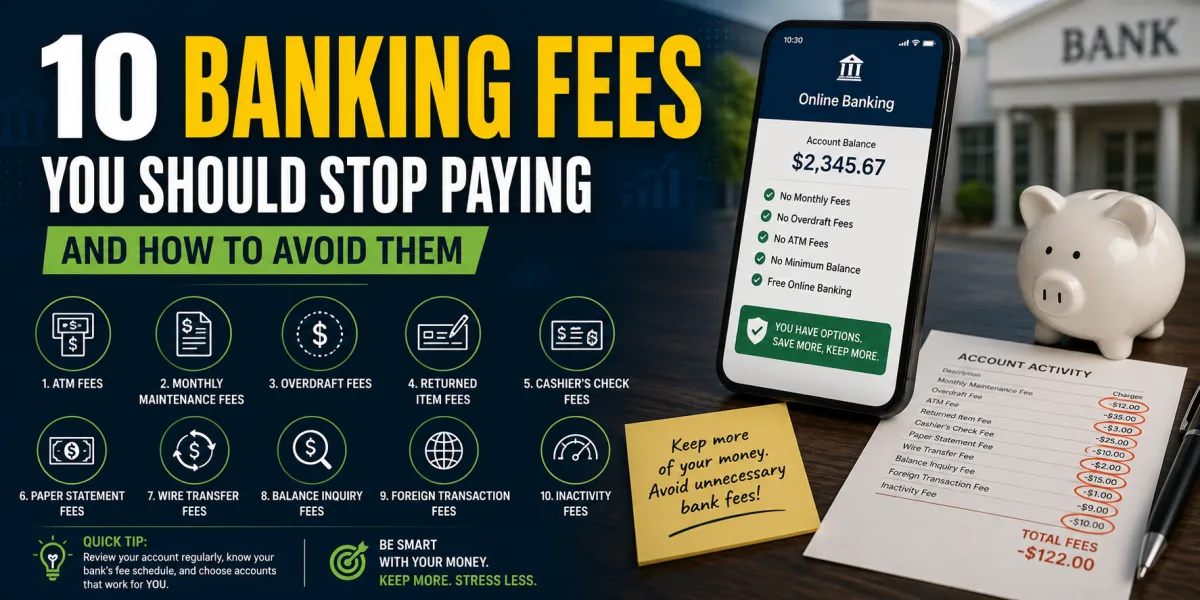
Next, review fees. A low interest rate becomes worse when combined with monthly maintenance fees. A savings account should not charge you for the privilege of earning almost nothing.
Then compare insured alternatives. Look at online banks, credit unions, money market accounts, and CDs. Confirm deposit insurance. Review account terms. Check transfer limits and support options. Make sure the institution fits how you actually use money.
Move idle cash deliberately. Do not drain your checking account to the point of stress. Keep enough for bills and timing issues. Move excess cash to a better savings vehicle.
Automate contributions. Interest helps, but deposits matter more. A high APY on a small balance will not transform finances. Regular saving builds the base on which interest works.
Separate goals. Use different accounts or buckets for emergency savings, annual bills, taxes, home repairs, travel, and major purchases. Clarity reduces accidental spending.
Review rates periodically, not obsessively. Once or twice a year may be enough for many households, unless rates are changing quickly or your bank becomes obviously uncompetitive.
Keep long-term money moving. After your cash needs are covered, direct surplus toward debt reduction, retirement contributions, brokerage investments, business development, or other wealth-building priorities.
The Bigger Lesson
Bank interest rates affect your savings in three ways. They affect the visible growth of your balance. They affect the invisible preservation of purchasing power. They affect your behavior by either rewarding or discouraging the habit of saving.
A low-rate account can make disciplined savers less efficient. A competitive account can turn cash into a more productive part of a financial plan. The difference is not only mathematical. It is strategic.
The saver’s job is not to predict every rate change. It is to understand the role of cash, avoid lazy account choices, protect deposits properly, and ensure that money assigned to safety still earns a fair return.
Interest rates will rise and fall. Banks will adjust offers. Inflation will change. Economic cycles will shift. But the underlying principle remains stable: money should be placed according to purpose.
Cash needed soon belongs in safe, accessible accounts. Cash needed later may earn more through CDs or other conservative tools. Money needed decades from now usually belongs in productive assets. Emergency reserves should be protected. Idle balances should be questioned. Fees should be avoided where they provide no value. Yield should be pursued intelligently, not blindly.
A savings account may look simple, but the rate attached to it carries real consequences. Over time, those consequences become visible in the household that reaches its emergency fund target sooner, the buyer who earns extra money while preparing a down payment, the business owner who earns on tax reserves, and the family that keeps cash safe without letting it sit completely unproductive.
Bank interest rates do not replace earning, budgeting, investing, or ownership. They enhance the foundation beneath them. When you understand how rates work, your savings stop being passive. They become a deliberate part of your wealth system.
 Article
 Article
 Article
 Article
 Article
 Article
 Article
 Article