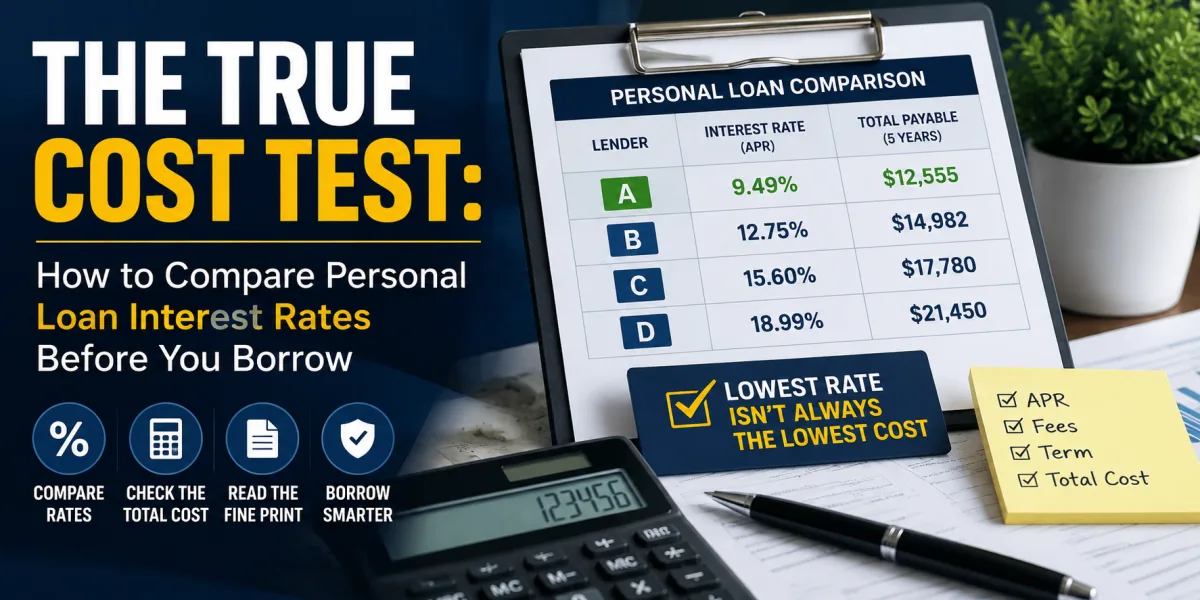
The True Cost Test: How to Compare Personal Loan Interest Rates Before You Borrow
A personal loan can look simple from a distance. You borrow a fixed amount, receive the money, and repay it over time through scheduled payments. The lender advertises an interest rate. The borrower compares a few numbers. The lowest rate seems like the best deal.
That simplicity is where many borrowers make expensive mistakes.
The advertised interest rate is not always the true cost of the loan. A loan with a lower interest rate can cost more if it has a large origination fee. A loan with a lower monthly payment can cost more if the term is longer. A loan that looks affordable today can become burdensome if the borrower ignores fees, prepayment penalties, late charges, variable-rate terms, or the total amount repaid. A fast approval can hide a costly contract. A clean-looking monthly payment can stretch debt for years.
Comparing personal loan interest rates is not really about finding the smallest percentage printed on a lender’s website. It is about identifying the loan that gives you the money you need at the lowest responsible cost, with a payment your budget can support, from a lender whose terms you understand.
The Consumer Financial Protection Bureau explains that a loan’s interest rate is the cost paid to the lender for borrowing money, while the annual percentage rate, or APR, measures the interest rate plus additional fees charged with the loan. Both are expressed as percentages, but APR gives borrowers a broader view of borrowing cost.
That difference is the foundation of intelligent loan shopping. If you compare interest rate to interest rate while ignoring APR, fees, term length, and repayment structure, you may choose the wrong loan. If you compare APR but ignore whether the monthly payment fits your budget, you may choose a loan that is cheap on paper but unsafe in practice. If you compare payment only, you may choose a long loan that quietly costs far more over time.
The right comparison uses three lenses at once: the rate, the payment, and the total cost.
Start with the Purpose of the Loan
Before comparing rates, define why you are borrowing. A personal loan should have a specific purpose. The purpose affects how much you should borrow, how quickly the loan should be repaid, and how much cost is reasonable.
A personal loan used to consolidate high-interest credit card debt may be worthwhile if the APR is lower than the credit card APR, the payment is affordable, and the borrower stops adding new card balances. A loan used to repair a car needed for work may be justified if it protects income. A loan used for necessary medical or dental care may solve a real problem. A loan used for a vacation, lifestyle upgrade, or recurring budget shortfall may create more financial pressure than value.
The purpose matters because borrowing always trades future income for current cash. A personal loan turns tomorrow’s paychecks into today’s funding. That can be wise when the loan reduces cost, protects income, solves a necessary problem, or replaces more expensive debt. It can be dangerous when it funds spending that does not improve the household’s financial position.
Good rate comparison begins with discipline. Borrow the amount needed for a defined reason, not the maximum amount offered. Lenders may approve more than you should take. Approval is not a financial recommendation. It is a lender’s willingness to sell you debt.
Interest Rate vs APR
The interest rate is the cost of borrowing expressed as a percentage of the loan balance. It helps calculate how much interest accrues. But the interest rate may not include certain fees.
APR is broader. It includes the interest rate and certain loan fees, expressed as an annualized percentage. Because APR incorporates more of the cost, it is usually the better number for comparing loan offers.
Imagine two personal loan offers. Loan A has a 14 percent interest rate and no origination fee. Loan B has a 12 percent interest rate but a 6 percent origination fee. At first glance, Loan B looks cheaper. But if the fee is deducted from the loan proceeds or added to the amount financed, the borrower may pay more than expected. The APR helps reveal that difference.
This is why lenders are often required to disclose APR. Borrowers should use it. The interest rate tells you part of the story. APR tells you more of the story. The monthly payment tells you whether the loan fits cash flow. The total repayment amount tells you the full price.
Never choose a personal loan based only on the interest rate. That is like judging a house only by the front door.
Why Advertised Rates Can Mislead
Many lenders advertise rates using ranges: for example, a personal loan may be promoted with rates “as low as” a certain percentage. That lowest rate is usually available only to the strongest borrowers: high credit scores, stable income, low debt-to-income ratios, strong repayment history, and sometimes autopay enrollment or other conditions.
A borrower with average credit may receive a much higher APR. A borrower with bad credit may receive the top of the range or be denied. Some lenders may offer lower rates only for shorter terms, larger loans, secured loans, or specific loan purposes. Others may charge origination fees that increase the APR.
The advertised rate is a marketing number. Your rate is an underwriting result.
This is why prequalification matters. Experian states that checking personal loan rates through its platform generates a soft inquiry that does not hurt credit scores. Soft-inquiry prequalification can help borrowers compare possible offers without committing to a full application, though final approval and terms may still change after verification.
When shopping, do not ask, “What rate does this lender advertise?” Ask, “What APR does this lender offer me, for this loan amount, over this term, after fees?”
The Role of Credit Score
Credit score is one of the most important factors in personal loan pricing. Lenders use credit history to estimate repayment risk. Borrowers with strong credit generally qualify for lower rates because lenders view them as less likely to default. Borrowers with weaker credit usually pay more because lenders price in higher risk.
Credit score is not the only factor. Lenders may also review income, employment, debt-to-income ratio, housing costs, existing loans, recent credit inquiries, bank account history, and loan purpose. But credit score heavily influences the starting point.
This matters because comparing loan rates without knowing your credit profile can create false expectations. A lender’s lowest advertised rate may be irrelevant if your score does not qualify. A borrower with excellent credit should shop aggressively because small rate differences can save real money. A borrower with fair or bad credit should still compare, but the focus may be on avoiding high fees, predatory terms, and unaffordable payments.
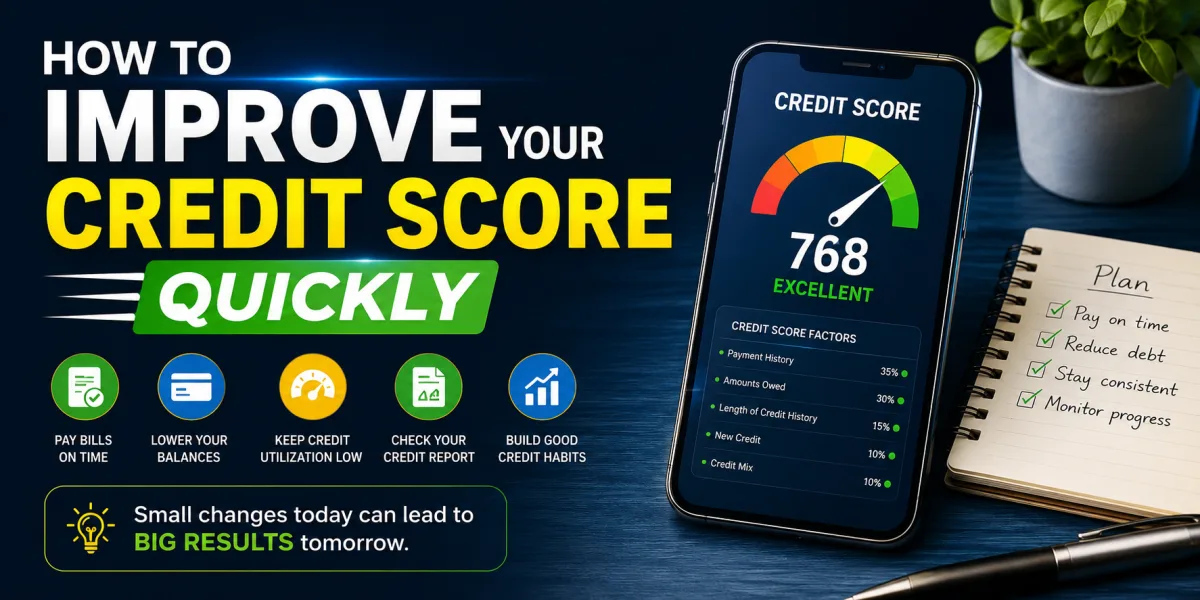
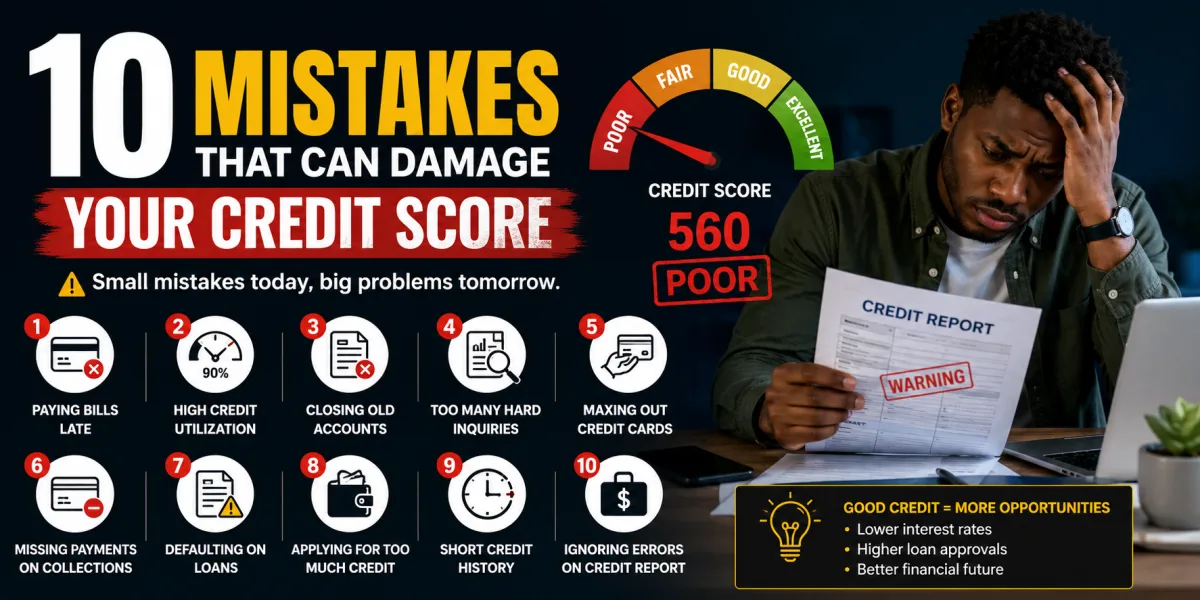
Before applying, check your credit reports for errors. Correcting a false late payment, incorrect balance, duplicate collection, or account that is not yours may improve loan options. Also look at credit card utilization. Paying down revolving balances before applying may improve your profile if time allows.
A better credit profile can be worth more than a better search strategy. The cheapest personal loan is often the one you qualify for after improving what lenders measure.
Compare Loan Amounts After Fees
One of the most overlooked personal loan details is the difference between the approved loan amount and the cash actually received. Many personal loans charge origination fees. An origination fee may be deducted from the loan proceeds or added to the loan balance.
Suppose you are approved for a $10,000 loan with a 5 percent origination fee deducted upfront. You may receive only $9,500, but repayment may be based on the full $10,000. If you need exactly $10,000 to pay a bill or consolidate debt, this creates a shortfall. You may need to borrow more, use savings, or leave part of the original problem unresolved.
When comparing loans, ask four questions. What is the approved amount? What fee is charged? How much cash will be deposited? What amount will interest be charged on? These questions reveal whether the offer provides enough usable funding.
A loan with no origination fee may have a higher interest rate but still be cheaper or more useful than a lower-rate loan with a large fee. APR helps compare this, but the cash-received number matters too.
Borrowers should compare money in hand, not just money approved.
Compare Monthly Payments
The monthly payment determines whether the loan survives contact with real life. A loan can have a good APR and still be a bad choice if the payment strains the budget.
Start with net income, not gross income. Subtract rent or mortgage, utilities, groceries, transportation, insurance, childcare, medical costs, minimum debt payments, savings contributions, and irregular expenses. What remains is the space available for a loan payment. If the loan payment consumes all remaining cash, the loan is too tight. A budget needs margin because life is uneven.
A lower monthly payment may feel safer, but it often comes from a longer repayment term. Longer terms can increase total interest. A higher monthly payment may save interest but create default risk if income fluctuates. The best payment is not the lowest possible payment. It is the payment that can be made consistently while still allowing the household to cover essentials and maintain a small safety buffer.
For debt consolidation, compare the new payment to the combined payments on the debts being consolidated. But do not stop there. Compare the total interest cost and payoff timeline too. A consolidation loan that lowers the monthly payment by extending debt from three years to seven years may improve cash flow but increase total interest.
Monthly payment is the affordability test. Total repayment cost is the wealth test. You need both.
Compare Total Repayment Cost
Total repayment cost is the full amount you will pay over the life of the loan, including principal, interest, and fees. This number often reveals the real trade-off between loan offers.
A $10,000 loan repaid over three years at a higher monthly payment may cost less in total than a $10,000 loan repaid over seven years at a lower monthly payment. The longer loan may feel easier each month, but the borrower pays interest for more years.
Long-term personal loans can be tempting because they reduce monthly pressure. A 2026 Wall Street Journal Buy Side personal loan guide notes that long-term personal loans allow borrowers to spread payments over more years, which can lower monthly installments but result in higher total interest costs.
This is the central loan term trade-off. Lower payment does not automatically mean lower cost. Shorter term does not automatically mean better if the payment is unaffordable. The borrower must choose the shortest term that can be repaid safely.
Total repayment cost also helps judge whether the loan’s purpose is worth it. Paying $1,500 in interest to consolidate expensive credit card debt and become debt-free faster may be reasonable. Paying $3,000 in interest for a discretionary purchase may not be.
A personal loan should be evaluated over its entire life, not just at funding.
Understand Fixed vs Variable Rates
Most personal installment loans have fixed rates, meaning the interest rate and monthly payment remain the same over the repayment period. This makes budgeting easier. But some personal lines of credit or variable-rate products can have rates that change over time.
The CFPB advises borrowers shopping for a personal line of credit to look at the APR, whether and how much the APR can change, fees to access the line, annual fees, late payment fees, and other costs. This guidance matters because variable-rate borrowing can become more expensive if rates rise.
If a loan has a variable rate, ask how often it can adjust, what index it follows, whether there is a cap, what the maximum payment could be, and whether your budget can handle that maximum. A low starting rate may not be a low lifetime rate.
Fixed-rate loans are usually easier to compare because the payment schedule is clear. Variable-rate loans require stress testing. A borrower who can barely afford the initial payment may not be able to handle future increases.
Rate stability is valuable. Do not ignore it.
Check for Prepayment Penalties
A prepayment penalty is a fee charged for paying a loan off early. Not all personal loans have them, but borrowers should verify. A loan without a prepayment penalty gives flexibility. If your income rises, you receive a bonus, or you consolidate and later refinance, you can reduce interest by paying early.
A loan with a prepayment penalty can trap the borrower in the scheduled cost. Even if the APR looks competitive, the inability to pay early without penalty reduces flexibility.
Also ask how extra payments are applied. Ideally, extra payments should reduce principal, not simply advance the next due date. Principal reduction lowers future interest. Advancing the due date may not save as much.
If you intend to pay the loan off aggressively, prepayment terms matter as much as the rate.
Watch for Precomputed Interest
Some loans use precomputed interest, meaning the total interest for the loan term is calculated upfront and built into the repayment schedule. This can make early payoff less beneficial than with a simple interest loan, depending on the contract.
With a simple interest loan, interest generally accrues on the outstanding principal. Paying extra toward principal can reduce future interest. With precomputed interest, the borrower may not receive the same savings from early repayment unless rebates or rules apply.
Borrowers should ask whether the loan uses simple interest or precomputed interest. If the answer is unclear, request the contract language. A lender should be able to explain how interest accrues and how early payoff works.
Do not assume every installment loan rewards early repayment equally. The structure matters.
Compare Lender Fees Beyond Origination
Origination fees are not the only fees to review. Personal loans may include late fees, returned-payment fees, check processing fees, administrative fees, document fees, unsuccessful payment fees, and optional add-ons such as credit insurance or debt protection products.
Late fees matter because life happens. A loan with a harsh late-fee structure may be risky for borrowers with irregular income. Returned-payment fees matter if the payment account can run low. Autopay discounts matter, but only if the borrower can reliably keep funds available.
Optional add-ons deserve skepticism. Credit insurance, debt protection, or payment protection may sound comforting, but they increase cost and may have exclusions. Ask whether the product is required. If not, compare the loan with and without it. Read what the add-on actually covers.
Fees can turn an average loan into an expensive one. They can also signal the lender’s business model. A transparent lender should disclose fees clearly before you sign.
Compare Secured and Unsecured Offers
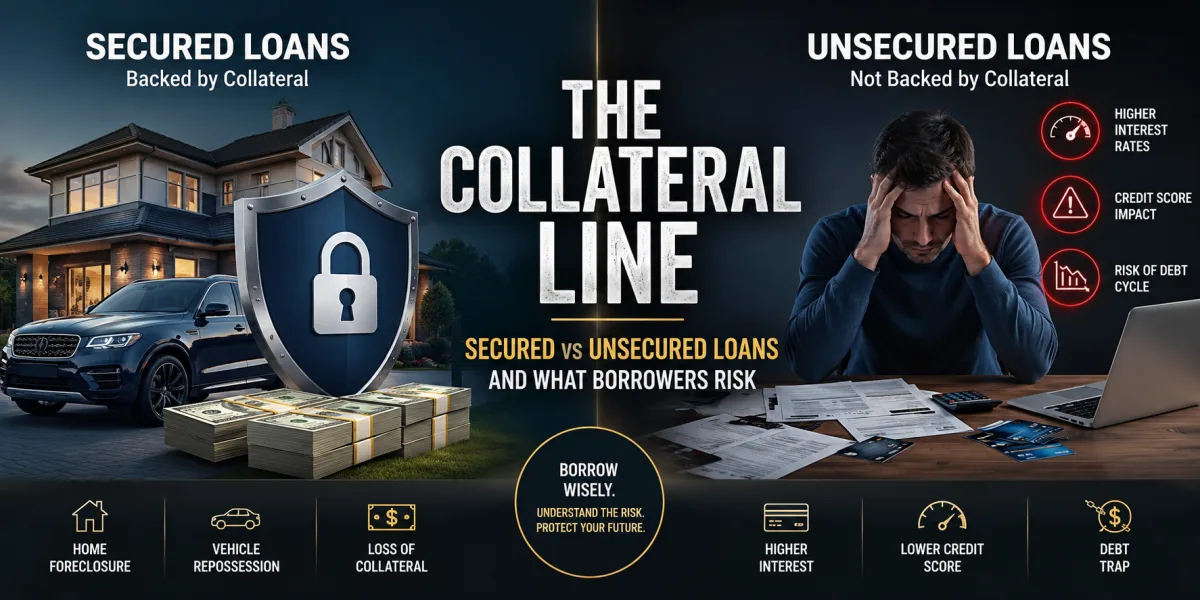
Some personal loans are unsecured, meaning no collateral is required. Others are secured by an asset such as a savings account, vehicle, or other property. Secured loans may offer lower rates or better approval odds because the lender has collateral. But the borrower accepts the risk of losing the pledged asset if repayment fails.
A secured loan can make sense when the collateral risk is acceptable, the rate savings are meaningful, and the payment is affordable. It can be dangerous when the collateral is essential. A loan secured by a car needed for work may threaten income if default leads to repossession. A loan secured by savings may weaken the emergency fund.
Unsecured loans may cost more but do not put a specific asset at risk at the start. They can still damage credit, lead to collections, and create legal consequences if unpaid. Unsecured does not mean harmless.
When comparing rates, do not compare secured and unsecured loans only by APR. Compare the consequences of failure. A lower secured rate may not be worth risking an asset the household cannot lose.
Use Prequalification to Build a Real Comparison Set
Prequalification can help borrowers compare offers before submitting formal applications. Many lenders use soft inquiries for prequalification, which generally do not affect credit scores. Final approval usually requires a hard inquiry and verification.
Use prequalification with several reputable lenders. Include banks, credit unions, established online lenders, and existing financial institutions. Credit unions may be especially useful for borrowers who want human underwriting or smaller loans. Online lenders may provide speed and easy comparison. Banks may offer relationship discounts.
Record each offer in a table. Include lender name, loan amount, cash received after fees, APR, interest rate, origination fee, term, monthly payment, total repayment cost, prepayment penalty, late fee, secured or unsecured status, funding speed, and any special requirements.
Do not rely on memory. Loan offers blur together quickly. A written comparison exposes the true winner.
Do Not Compare Loans with Different Assumptions
A common mistake is comparing a three-year loan from one lender to a seven-year loan from another and judging only by monthly payment. Another mistake is comparing a $10,000 loan with no fee to a $12,000 loan with a fee and treating the APRs as though the cash need is the same. Another is comparing a secured loan to an unsecured loan without considering collateral risk.
To compare properly, standardize the assumptions. Use the same loan amount, same repayment term, same purpose, and same collateral status where possible. Then compare APR, payment, fees, and total cost.
If lenders offer different terms, adjust the comparison. Ask: what would each loan cost over the same term? What payment would each require? What total interest would I pay? What cash would I actually receive?
Comparing loans unfairly can make the wrong offer look better. Precision saves money.
Understand the Market Context
Personal loan rates move with broader credit conditions, lender competition, borrower risk, and market interest rates. A borrower shopping during a higher-rate environment may see more expensive offers than a borrower shopping during a lower-rate period.
The Federal Reserve’s consumer credit data reported that the finance rate on 24-month personal loans at commercial banks was 11.86 percent in May 2026, up from 11.36 percent in February 2026. This does not mean every borrower should expect that exact rate. It is a market reference point, not a personal quote. Borrowers with excellent credit may do better; borrowers with weak credit may see much higher offers.
Market context helps borrowers recognize whether an offer is broadly reasonable, but it does not replace shopping. Your credit profile, lender type, fees, loan term, and purpose will determine your actual offer.
Use market averages as a compass, not a contract.
Debt Consolidation: Compare Against Current Debt
If the personal loan is for debt consolidation, the comparison should include the debts being replaced. List each current debt, balance, APR, minimum payment, and estimated payoff timeline. Then compare the consolidation loan.
The consolidation loan should ideally do at least one of three things: lower the APR, create a fixed payoff date, or reduce payment complexity without increasing total cost too much. The strongest consolidation loans do all three.
But consolidation can fail. If the borrower pays off credit cards with a loan and then uses the cards again, total debt increases. If the new loan lowers the payment only by extending the term, the borrower may pay more interest. If origination fees are high, savings may disappear.
When comparing rates for consolidation, calculate break-even. How much interest will you save after fees? How long will it take to recover the origination fee through lower interest? What happens if you pay extra? What happens if you continue using the old cards?
A consolidation loan should simplify the exit from debt. It should not create room for more debt.
Emergency Loans: Compare Speed Against Cost
Some borrowers need a personal loan quickly for a medical bill, car repair, rent issue, family emergency, or urgent home repair. In these cases, speed matters. But speed can become expensive.
Fast-funding lenders may charge higher APRs or fees. Payday loans, title loans, and high-cost installment loans may offer immediate cash but create severe repayment pressure. A borrower in crisis may focus on funding date and ignore total cost.
Compare emergency options in order of cost and risk. Could the biller offer a payment plan? Could a credit union provide a small-dollar loan? Could a medical provider arrange interest-free payments? Could savings cover part of the need? Could a family loan with written terms work? Could a reputable lender fund within a few days at a reasonable APR?
When the need is urgent, choose the fastest responsible option, not simply the fastest option.
Bad Credit: Compare for Damage Control
Borrowers with bad credit may not qualify for low rates. The comparison becomes a damage-control exercise. The goal is to avoid unaffordable payments, predatory fees, collateral traps, and loans that make the credit situation worse.
Use prequalification before formal applications when possible. Check credit reports for errors. Consider credit unions, secured loans with acceptable collateral risk, co-borrowers, or smaller loan amounts. Avoid lenders that demand upfront fees before funding. Be wary of guaranteed approval claims.
For bad-credit borrowers, the lowest APR available may still be high. That does not automatically mean the loan is wrong, but the purpose must justify the cost. A high-APR loan for a necessary car repair that protects income may be different from a high-APR loan for discretionary spending.
Calculate whether the payment can be made without relying on more debt. If not, the loan may deepen the problem. A denied application or bad offer may be a signal to seek credit counseling, negotiate bills, or explore alternatives before borrowing.
The more expensive the credit, the more disciplined the purpose must be.
Excellent Credit: Compare for Fine Print
Borrowers with excellent credit may receive attractive offers, but they should still compare carefully. A strong credit profile can create competition among lenders. Small rate differences matter on larger loan amounts. No-fee loans may beat lower-rate loans with fees. Autopay discounts may reduce cost. Shorter terms may save interest.
Excellent-credit borrowers should pay attention to prepayment flexibility, funding speed, customer service, lender reputation, and whether the loan purpose qualifies for the best terms. They should also compare personal loans against alternatives such as 0 percent balance transfer offers, home equity products, or simply paying from savings, depending on the situation.
Good credit is financial leverage. Use it to make lenders compete, not to borrow carelessly.
Build a Personal Loan Comparison Worksheet
A good worksheet prevents emotional decisions. Create columns for each lender and rows for the major decision points.
Start with loan amount requested. Then list cash received after fees, APR, interest rate, origination fee, term in months, monthly payment, total of payments, total interest and fees, prepayment penalty, late fee, payment due date flexibility, autopay discount, secured or unsecured status, collateral at risk, funding speed, credit bureau reporting, and lender reputation.
Then add a final row: purpose fit. Does this loan solve the defined problem? If a loan has the best APR but does not provide enough cash after fees, it may fail the purpose. If a loan has the lowest payment but highest total cost, it may be too expensive. If a secured loan has the lowest rate but risks an essential asset, it may be unsafe.
The best offer should pass all three tests: affordable payment, low total cost, and acceptable risk.
Questions to Ask Every Lender
What APR am I being offered?
What is the interest rate?
Is the rate fixed or variable?
What origination fee or other upfront fee applies?
How much cash will I receive after fees?
What is the monthly payment?
What is the total repayment cost?
What is the loan term?
Is there a prepayment penalty?
How are extra payments applied?
Does the loan use simple interest or precomputed interest?
Are there late fees or returned-payment fees?
Is autopay required for the quoted rate?
Will the lender report to the credit bureaus?
Is the loan secured by collateral?
Can the due date be changed?
What happens if I experience hardship?
A lender that cannot answer these questions clearly does not deserve your signature.
When the Lowest APR Is Not the Best Loan
The lowest APR is usually attractive, but it is not always the best loan. A lower APR with an unaffordable monthly payment may create default risk. A lower APR secured by essential collateral may be too dangerous. A lower APR with slow funding may not work for an urgent need. A lower APR on a larger loan than needed may encourage overborrowing. A lower APR with poor service or confusing terms may create problems later.
Sometimes the best loan is the one with the slightly higher APR but no origination fee, flexible prepayment, affordable payment, and enough cash received. Sometimes the best loan is no loan at all because the cost is too high relative to the purpose.
Interest rate comparison should lead to judgment, not autopilot.
When to Walk Away
Walk away if a lender demands an upfront fee before funding. Walk away if the lender guarantees approval without reviewing credit, income, or repayment ability. Walk away if the APR is extreme and the payment will not fit the budget. Walk away if the contract is unclear. Walk away if the lender pressures you to sign immediately. Walk away if collateral risk is too high. Walk away if the loan funds a recurring budget deficit without a plan to fix it.
Also walk away if the loan is being used to avoid a deeper decision. If debt payments are already unmanageable, another loan may not solve the problem. Nonprofit credit counseling, creditor hardship programs, debt management plans, or legal debt relief may be more appropriate.
The ability to walk away is part of financial strength. Not every approval is an opportunity.
The Wealth Lesson
Comparing personal loan interest rates is really about comparing the full cost of borrowing. The interest rate matters, but APR matters more. Fees matter. Loan term matters. Monthly payment matters. Total repayment cost matters. Collateral risk matters. Prepayment flexibility matters. The purpose of the loan matters most of all.
A borrower who compares only advertised rates may choose a loan that is expensive after fees. A borrower who compares only monthly payments may choose a loan that lasts too long and costs too much. A borrower who compares only approval speed may choose a predatory product. A borrower who compares total cost without checking affordability may choose a loan that looks efficient but fails in the budget.
The right personal loan should pass the true cost test. It should provide enough cash after fees. It should have a competitive APR. It should fit monthly cash flow. It should have a repayment term that does not stretch debt unnecessarily. It should avoid unnecessary collateral risk. It should allow early payoff without punishment. It should solve a defined problem.
Debt is not automatically bad. Expensive, careless, unclear debt is bad. A personal loan can reduce interest, simplify repayment, protect income, or fund a necessary expense. It can also become another payment in a budget already under pressure.
Compare like a borrower who expects to keep their future income, not give it away. Read the APR. Count the fees. Test the payment. Add the total cost. Question the term. Protect your collateral. Then choose only the loan that leaves your financial life stronger than it was before you borrowed.
 Article
 Article
 Article
 Article
 Article
 Article
 Article
 Article