Buying vs. Renting: The Ultimate 2026 Financial Decision Guide
Is it better to buy or rent in 2026? This comprehensive guide breaks down the costs, benefits, and psychological factors of the housing market to help you make the right choice.
Introduction: The Great Housing Debate
Deciding whether to sign a lease or a mortgage is one of the most significant financial crossroads a person will ever face. For decades, the "American Dream" and similar global ideals have championed homeownership as the ultimate sign of stability and success. However, as global economies evolve and the workforce becomes increasingly mobile, the rigid binary of "buying is good, renting is bad" has dissolved.
This guide explores the intricate nuances of the housing market in 2026. Whether you are a young professional, a growing family, or a retiree, the choice between buying and renting is rarely just about the monthly payment. It is a complex calculation involving market timing, lifestyle goals, and opportunity costs.
Part I: The Financial Anatomy of Buying
When you buy a home, you are essentially transitioning from a consumer to an investor. You are purchasing an asset that, historically, appreciates over time.
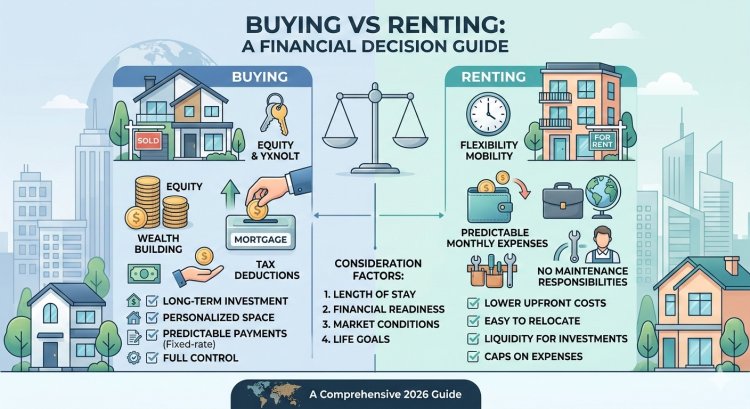
1. Equity and Wealth Building
The primary advantage of buying is equity. Every month you pay your mortgage, a portion goes toward the principal. Think of this as a forced savings account. Over thirty years, a homeowner ends up with a paid-off asset, whereas a renter has thirty years of receipts but no ownership.
2. Tax Advantages
In many jurisdictions, homeowners benefit from tax deductions on mortgage interest and property taxes. While tax laws fluctuate, the incentive to own remains a staple of many national economic policies.
3. The Hidden Costs of Ownership
Buying is not just the mortgage. Prospective buyers often overlook:
-
Property Taxes: These can rise significantly over time.
-
Homeowners Insurance: Essential for protecting your investment.
-
Maintenance: The "1% rule" suggests setting aside 1% of the home's value annually for repairs.
-
Closing Costs: You typically pay 2% to 5% of the home's price just to finalize the deal.
Part II: The Financial Anatomy of Renting
Renting is often unfairly labeled as "throwing money away." In reality, renting is the purchase of a service: shelter without the risk of asset depreciation or maintenance liability.
1. Liquidity and Flexibility
The greatest financial benefit of renting is liquidity. A down payment on a house might be $100,000. If that money stays in a diversified stock portfolio or a high-yield savings account, it may outperform real estate appreciation. Renters also have the "mobility premium"—the ability to move for a better job or lifestyle change without the six-month process of selling a house.
2. Predictable Monthly Expenses
As a renter, your housing cost is capped. If the water heater bursts or the roof leaks, the financial burden falls on the landlord. This predictability is invaluable for professionals who need to manage a strict budget.
3. Opportunity Cost
We must consider the mathematical formula of opportunity cost. If you spend $50,000 on a down payment and $5,000 a year on maintenance, what would those same funds look like if invested in the S&P 500? In many high-cost urban areas, renting and investing the difference actually results in a higher net worth over twenty years than buying.
Part III: Market Conditions in 2026
The 2026 housing market is characterized by high technological integration and shifting demographic demands.
-
Interest Rate Fluctuations: With central banks adjusting to post-inflationary cycles, the cost of borrowing remains a volatile variable.
-
Remote Work Impact: The necessity of living in city centers has diminished, making suburban and rural purchases more attractive, yet potentially riskier if companies recall workers to offices.
-
Supply Constraints: In many global hubs, housing supply has not kept pace with population growth, keeping prices high regardless of interest rates.
Part IV: The Psychological Factor
Wealth is not just a number on a spreadsheet; it is a state of mind.
The Homeowner’s Peace of Mind: For many, the security of knowing no landlord can evict them is priceless. There is a sense of pride in customizing a space—painting walls, landscaping, and building a permanent community.
The Renter’s Peace of Mind: Conversely, some feel trapped by a mortgage. The "golden handcuffs" of a low-interest rate or a physical property can prevent people from taking risks, such as traveling or starting a business in a different country.
Part V: A Step-by-Step Decision Matrix
To decide which path is right for you, evaluate the following:
-
Duration of Stay: If you plan to live in a location for less than five years, renting is almost always more cost-effective due to the high transaction costs of buying and selling.
-
Debt-to-Income Ratio: Can you afford a mortgage without being "house poor"?
-
Local Rental Yields: Compare the monthly cost of a mortgage to the monthly cost of a similar rental. If the mortgage is significantly higher, renting and investing the difference is the logical choice.
-
Market Temperature: Is it a buyer's market or a seller's market? In 2026, data transparency tools make it easier than ever to see if properties are overvalued.
Conclusion: The Hybrid Future
The future of housing may not be a simple choice between two poles. We are seeing the rise of rent-to-own schemes, fractional ownership, and long-term lease protections that mimic the stability of ownership.
Ultimately, buying a home is a lifestyle choice funded by a financial strategy. Renting a home is a financial strategy that enables a flexible lifestyle. Neither is universally "correct." The right decision is the one that aligns with your five-year career plan, your family's needs, and your personal comfort with debt.
Comparative Analysis Table
| Feature | Buying | Renting |
| Upfront Cost | High (Down payment + Closing) | Low (Deposit + First Month) |
| Monthly Cost | Variable (Taxes/Repairs can spike) | Fixed (For the lease term) |
| Equity | Built over time | None |
| Mobility | Low (Difficult to move quickly) | High (Easy to relocate) |
| Maintenance | Owner's responsibility | Landlord's responsibility |
| Risk | Market value could drop | Rent could increase |
Final Thoughts for the Global Professional
In the globalized economy of 2026, your greatest asset is your ability to adapt. If buying a home anchors you to a declining market, it is a liability. If renting prevents you from building a nest egg, it is a missed opportunity. Audit your finances annually, keep an eye on interest rates, and remember that a home—whether owned or rented—should serve your life, not the other way around.
What's Your Reaction?