How to Automate Your Savings (Without Stress): The Ultimate Guide to Wealth on Autopilot
Master your finances with our comprehensive guide on automating your savings. Learn how to build wealth, eliminate financial anxiety, and reach your goals effortlessly.
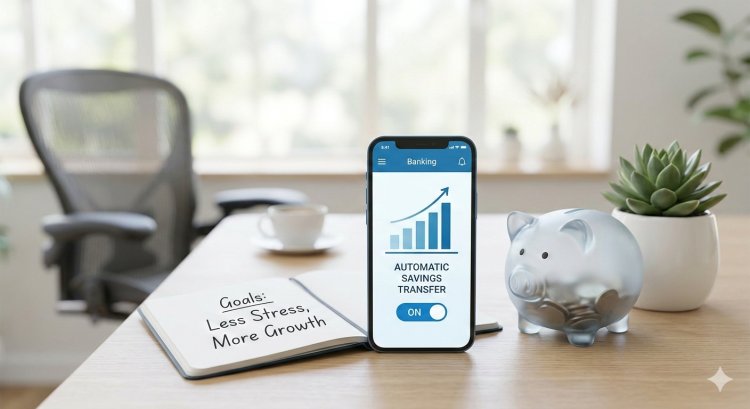
The Psychology of Effortless Wealth
In an era of instant gratification and constant digital distractions, the traditional method of "saving what is left at the end of the month" is a recipe for financial stagnation. For most people, the end of the month brings a balance of zero, regardless of their income level. This phenomenon, often referred to as Lifestyle Creep, ensures that our expenses rise to meet our earnings.
To break this cycle, we must move away from willpower and toward systems. Human willpower is a finite resource; we use it to resist dessert, to stay focused at work, and to navigate social complexities. Asking it to also manage our long-term financial security every single day is asking too much. Automation is the antidote to decision fatigue. By setting up a system that prioritizes your future self before you even see your paycheck, you remove the stress of choice and the guilt of spending.
The Foundation: Pay Yourself First
The "Pay Yourself First" principle is the cornerstone of modern personal finance. Historically, people paid their rent, their utility bills, their grocer, and their entertainment subscriptions, hoping to save the remainder. Automation flips this script.
When you automate your savings, your "future self" becomes your most important creditor. You pay that creditor the moment your income arrives. This forces you to live on the remaining balance, which naturally adjusts your spending habits without the need for restrictive, soul-crushing budgets.
Step 1: Audit Your Infrastructure
Before you can build an automated machine, you need the right parts. Not all bank accounts are created equal. To maximize this strategy, you should look for:
-
High-Yield Savings Accounts (HYSA): Traditional big-box banks often offer interest rates that are practically invisible. A high-yield account ensures your money grows while it sits.
-
No-Fee Checking: Ensure your primary hub doesn't bleed money through maintenance fees.
-
App Integration: Your bank should have a robust mobile interface that allows for scheduled recurring transfers.
Step 2: The Direct Deposit Split
The most effective way to automate is to bypass your checking account entirely. Most employers allow you to split your direct deposit into multiple accounts.
-
The 10% Rule: Direct 10% (or whatever amount fits your current situation) of your paycheck straight into a dedicated savings or investment account.
-
The Psychological Advantage: If the money never hits your checking account, you never "have" it to begin with. You cannot miss what you never saw.
Step 3: Setting Up Recurring Transfers
If your employer doesn't offer split deposits, or if you are a freelancer with fluctuating income, recurring bank transfers are your best friend.
Set a "Push" transfer from your checking to your savings for the day after your expected payday. By timing the transfer close to the arrival of funds, you minimize the window of opportunity to spend that money impulsively.
Step 4: Automating Investments
Saving is for protection; investing is for growth. Once you have an emergency fund—typically three to six months of expenses—automation should extend to your investment accounts.
-
Retirement Accounts: Ensure your 401(k) or equivalent workplace plan is set to a percentage that at least captures any employer match. This is effectively a 100% return on investment.
-
Index Funds and ETFs: Set up a monthly contribution to a broad-market index fund. This utilizes Dollar Cost Averaging, a strategy where you buy more shares when prices are low and fewer when prices are high, smoothing out market volatility over time.
The Emergency Fund: Your Financial Shield
Stress often stems from the unknown. An unexpected car repair or medical bill can derail a month of progress. Your automated system must prioritize an emergency fund first. This is not "investment" money; it is "peace of mind" money. Keep it in a liquid, easily accessible high-yield savings account. Once this fund is capped at your desired level, you can redirect those automated flows toward more aggressive investment vehicles.
Avoiding the "Set It and Forget It" Trap
While the goal is to reduce stress through automation, a periodic review is essential. Life changes. You might get a raise, get married, or decide to buy a home.
-
The Annual Audit: Once a year, review your automated amounts. If you received a 3% raise, increase your automated savings by 1.5%. You still feel the benefit of the raise in your daily life, but your wealth-building accelerates simultaneously.
-
The Subscription Cleanse: While automating savings, ensure you aren't also "automating waste." Review recurring subscriptions that no longer provide value and redirect those small amounts into your savings flow.
Global Perspectives on Saving
Whether you are a professional in London, a freelancer in Manila, or a teacher in New York, the principles of compound interest and systematic saving remain universal. The math of wealth does not change based on geography.
$A = P \left(1 + \frac{r}{n}\right)^{nt}$
The formula for compound interest demonstrates that time ($t$) is the most powerful variable. By automating today, you maximize the time your money has to grow, regardless of your starting principal ($P$).
Conclusion
Automating your savings is the single most impactful financial decision you can make. It transforms saving from a chore into a background process. It replaces the monthly anxiety of "will I have enough?" with the quiet confidence of "it is already handled."
Start small. Even a small automated transfer of $25 a week can build the habit. Over time, these small streams join to form a river of financial security that can carry you through any economic weather.
What's Your Reaction?