Saving vs Investing: What Comes First? The Ultimate Strategy for Financial Freedom
Should you save or invest first? Discover the essential differences, the right order of operations for your money, and how to build a global wealth strategy that lasts.
Introduction: The Great Financial Crossroads
In the journey toward financial independence, everyone eventually stands at the same crossroads: Do I put my next dollar into a savings account, or do I put it into the market?
This isn't just a technical question about math; it is a question of psychology, timing, and risk. For a global audience spanning different cultures, age groups, and career paths, the answer varies based on individual circumstances. However, the underlying principles of wealth remain constant. Whether you are a young professional in Tokyo, a small business owner in Nairobi, or a retiree in London, understanding the tension between "saving for safety" and "investing for growth" is the most critical step you will take toward a secure future.
Section 1: Defining the Fundamentals
Before we can decide which comes first, we must define what these terms actually mean in a modern economic context.
What is Saving?
Saving is the act of setting aside money for future use, typically in low-risk, highly liquid environments. Think of it as your "financial fortress." The primary goal of saving is preservation. You want the money to be there exactly when you need it, down to the last cent.
What is Investing?
Investing is the act of committing capital to an asset with the expectation of generating a profit or an income over time. Think of this as your "financial engine." The primary goal of investing is growth. Unlike saving, investing involves risk, meaning your principal value can fluctuate.
Section 2: The Core Differences
To choose the right path, you must understand the trade-offs between these two pillars.
| Feature | Saving | Investing |
| Risk | Minimal to none | Moderate to high |
| Return | Low (Interest) | Potentially high (Capital gains/Dividends) |
| Liquidity | High (Instant access) | Variable (May take days or years) |
| Objective | Short-term needs / Emergencies | Long-term wealth / Retirement |
| Enemy | Inflation | Market Volatility |
Section 3: Why Saving Usually Comes First
For the vast majority of people, saving is the prerequisite for investing. You cannot safely build a skyscraper on a swamp; you need a foundation of cold, hard cash.
1. The Emergency Fund
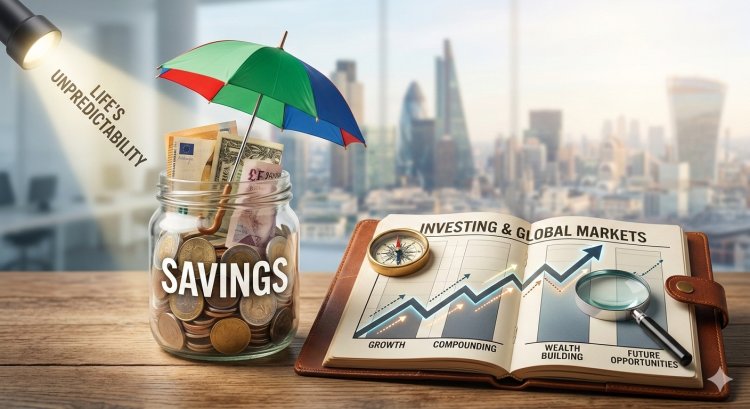
Life is unpredictable. Medical emergencies, job losses, or urgent home repairs can happen to anyone. If you have all your money invested in the stock market and the market crashes on the same day your car breaks down, you are forced to sell your investments at a loss. Saving 3 to 6 months of expenses acts as your "insurance policy" against the volatility of life.
2. Psychological Peace of Mind
Investing involves seeing your account balance go down during market corrections. If that money is your only safety net, you will likely panic and sell at the wrong time. Having a robust savings account gives you the "staying power" to let your investments grow over decades.
Section 4: Why You Cannot Save Your Way to Wealth
While saving provides safety, it has a silent, invisible enemy: Inflation.
If you leave 10,000 dollars in a standard bank account for thirty years, it might still be 10,000 dollars (plus a tiny bit of interest), but its purchasing power will have vanished. What bought a car today might only buy a bicycle in three decades.
Investing is the only reliable way to outpace inflation. By purchasing assets like stocks, real estate, or commodities, you are participating in the growth of the global economy. Over long periods, the compounding effect of investing is the most powerful force in finance.
Section 5: The "Order of Operations" for Your Money
If you are wondering where to put your next paycheck, follow this globally recognized framework:
-
Budget for Essentials: Cover your housing, food, and utilities.
-
The Starter Emergency Fund: Save at least one month of expenses.
-
High-Interest Debt: Pay off credit cards or loans with interest rates above 7-8%. These are "guaranteed negative investments."
-
Full Emergency Fund: Build that 3-6 month cushion.
-
Employer Match/Tax-Advantaged Accounts: If your employer or government offers tax incentives for retirement, take them. It is "free money."
-
Broad-Based Investing: Put your remaining funds into diversified index funds or real estate.
Section 6: Tailoring the Strategy to Your Life Stage
-
The Student/Early Career: Your greatest asset is time. Focus on building a small emergency fund, then start investing even tiny amounts. Small sums invested at age 20 become massive sums by age 60.
-
The Mid-Career Professional: You likely have higher expenses (family, mortgage). Your savings needs are higher, but your investing should be aggressive to maximize your peak earning years.
-
The Pre-Retiree: Shift the balance back toward saving and "capital preservation." You have less time to recover from a market crash, so your "fortress" needs to be bigger.
Section 7: Global Considerations
In different parts of the world, "saving" looks different. In countries with high inflation, saving in local currency may be risky, leading people to "save" in hard currencies or gold. Regardless of your local economy, the principle remains: secure your immediate survival (saving) before seeking to expand your empire (investing).
Conclusion: A Symbiotic Relationship
Saving and investing are not rivals; they are partners. Saving protects you from the present, while investing protects you from the future.
The answer to "What comes first?" is almost always Saving, but the answer to "What makes me wealthy?" is always Investing. By maintaining a healthy balance of both, you create a financial life that is both resilient to shocks and positioned for exponential growth.
What's Your Reaction?