Why Schools are Failing Our Kids: The Urgent Case for Financial Education
Discover why financial literacy is the most critical missing piece in modern education. Learn how teaching money management in schools can bridge the wealth gap and secure the next generation's future.

In classrooms around the world, students spend thousands of hours mastering the intricacies of Pythagorean theorems, the chemical composition of periodic elements, and the dates of ancient battles. Yet, many of these same students graduate without knowing how to read a paycheck, how a credit card interest rate functions, or how to start a retirement fund.
We are sending young adults into a complex, consumer-driven world without a map. Financial literacy is no longer a "luxury" skill; it is a fundamental survival tool.
1. Breaking the Cycle of Generational Debt
For many families, financial habits are passed down through observation. If a child grows up in a household where debt is the norm and savings are non-existent, they are likely to replicate those patterns. By introducing financial education into the formal school system, we provide an "exit ramp" from the cycle of poverty.
Education serves as the great equalizer. When a school teaches a student about the dangers of predatory lending or the benefits of a high-yield savings account, it empowers that student to make decisions based on logic rather than desperation.
2. The Power of Time and Compound Interest
The most significant advantage young people have is time. In finance, the mathematical concept of compound interest is often called the "eighth wonder of the world."
When students understand this formula—not just as a math problem, but as a wealth-building reality—their perspective on saving changes. Teaching 15-year-olds that a small investment today can grow exponentially by the time they are 50 can change the trajectory of their entire lives. Without this knowledge, they miss the most critical decade of their financial growth.
3. Navigating the Digital Economy
We are living in an era of "invisible money." With the rise of digital wallets, "Buy Now, Pay Later" schemes, and cryptocurrency, the barrier to spending has never been lower. It is easier than ever to lose track of digital assets.
Financial education in schools must evolve to include:
-
Digital Security: Protecting oneself from identity theft and online fraud.
-
Understanding Algorithms: How targeted ads influence spending habits.
-
The Reality of Virtual Assets: Distinguishing between speculative investments and stable assets.
4. Mental Health and Financial Stress
There is a profound, often overlooked link between financial literacy and mental well-being. Financial stress is one of the leading causes of anxiety, depression, and marital breakdown globally. By teaching students how to manage their resources, we are essentially teaching them how to manage their future stress levels.
A person who understands how to build an emergency fund is a person who can breathe easier when a car breaks down or a medical bill arrives. We owe it to the next generation to give them the peace of mind that comes with fiscal competence.
5. Preparing for Professional Reality
Regardless of whether a student becomes a doctor, an artist, or a plumber, they will all have to interact with the tax system. They will all need to understand contracts. They will all need to plan for a time when they can no longer work.
Professional success is often undermined by personal financial failure. A high-earning professional who does not understand cash flow can still end up bankrupt. Integrating these lessons into schools ensures that "professionalism" includes the ability to manage the fruits of one's labor.
The Path Forward
The implementation of financial literacy programs requires more than just textbooks; it requires a shift in how we value practical life skills. It requires trained educators and a curriculum that reflects the real-world economy.
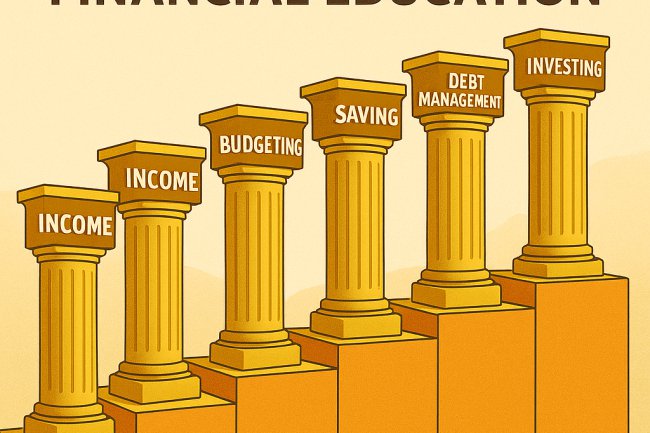
If we want a society that is stable, equitable, and prosperous, we must start in the classroom. We must stop treating money as a taboo subject and start treating it as a core academic pillar.
What's Your Reaction?