Stocks vs. Bonds: The Essential Guide to Building Wealth and Securing Your Future
Discover the fundamental differences between stocks and bonds. This comprehensive guide breaks down risks, returns, and strategic asset allocation for investors of all levels.
Introduction
The journey toward financial independence often begins with a single, fundamental question: Where should I put my money? For decades, the answer has largely revolved around two primary pillars of the financial world: Stocks and Bonds.
While the world of finance can often feel like a labyrinth of complex jargon and intimidating charts, the core distinction between these two assets is remarkably straightforward. At its heart, the choice between stocks and bonds is a choice between ownership and lending.
Whether you are a student looking to start a small savings pot, a mid-career professional planning for retirement, or a retiree looking to preserve your nest egg, understanding the mechanics of these two instruments is non-negotiable. This guide will dismantle the complexities of the market to provide a clear, comprehensive, and actionable comparison of stocks and bonds.
What Are Stocks? The Power of Ownership
When you buy a stock (also known as equity), you are buying a piece of a company. If a corporation issues one million shares and you buy one hundred, you literally own a tiny fraction of that business, including its office furniture, its patents, and—most importantly—its future earnings.
How You Make Money with Stocks
-
Capital Appreciation: This is the "buy low, sell high" strategy. As a company grows, innovates, and increases its profits, the value of the company rises, and so does the price of your shares.
-
Dividends: Some established companies distribute a portion of their earnings back to shareholders. This provides a steady stream of passive income.
The Risk Factor
Stocks are inherently volatile. Their value can fluctuate wildly based on economic data, geopolitical events, or even a single tweet from a high-profile CEO. In a worst-case scenario, if a company goes bankrupt, stockholders are the last in line to get paid. This means you could lose your entire investment.
What Are Bonds? The Security of Lending
When you buy a bond, you are not an owner; you are a lender. You are essentially giving a loan to an entity—usually a government or a corporation—for a specific period. In exchange for your loan, the issuer promises to pay you back the original amount (the principal) on a specific date (the maturity), plus regular interest payments along the way.
How You Make Money with Bonds
-
Interest (Coupon) Payments: This is the primary way bondholders earn. You receive fixed, predictable payments (usually twice a year) for the duration of the bond’s life.
-
Principal Repayment: At the end of the term, you get your original investment back in full, provided the issuer remains solvent.
The Risk Factor
Bonds are generally considered "safer" than stocks, but they are not risk-free. The primary risks include Interest Rate Risk (if market rates rise, your existing bond becomes less valuable) and Default Risk (the possibility that the issuer cannot pay you back).
Comparing the Two: Side-by-Side
To better understand which asset fits your goals, let’s look at the key differences across various categories:
| Feature | Stocks (Equity) | Bonds (Fixed Income) |
| Role | You are an Owner | You are a Lender |
| Return Potential | Theoretically unlimited | Fixed and limited |
| Risk Level | High (High Volatility) | Lower (Stable) |
| Payment Priority | Last (Residual claimant) | First (Priority over stockholders) |
| Market Behavior | Generally performs well in growth | Generally performs well in stability |
Risk vs. Reward: The Great Trade-off
The fundamental law of investing is that risk and reward are inseparable.
-
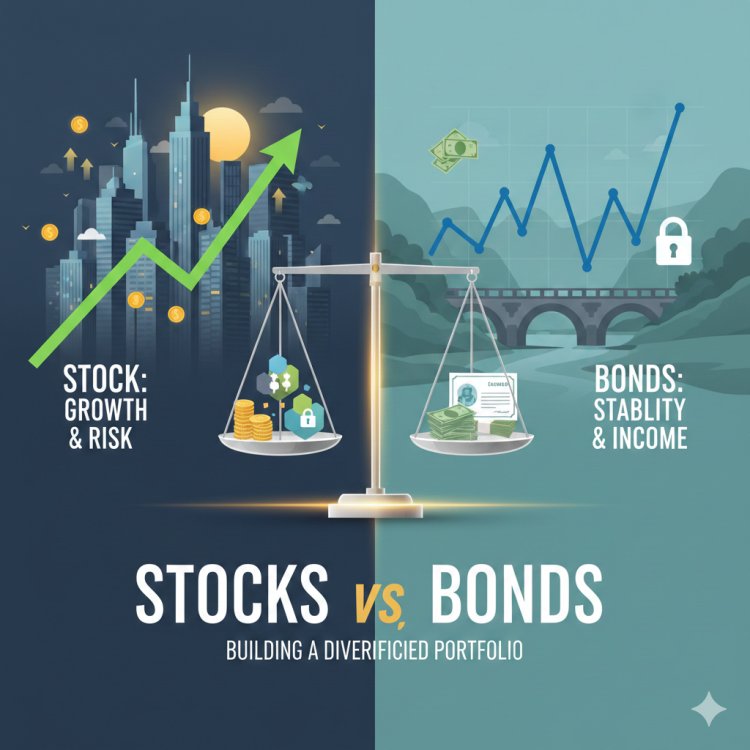
Stocks offer the potential for massive wealth creation. If you had invested in a successful tech giant twenty years ago, your return could be several thousand percent. However, you must have the stomach to watch your portfolio drop 20% or 30% in a single year during a recession.
-
Bonds offer a "cushion." They won't make you a millionaire overnight, but they provide the stability needed to protect your capital. They act as the "ballast" on a ship, keeping you upright when the stock market gets stormy.
The Impact of Inflation and Interest Rates
Understanding the environment is just as important as understanding the asset.
Inflation is the silent killer of purchasing power. Because stocks represent ownership in companies that can raise prices to match inflation, stocks are generally considered a good long-term hedge against rising costs. Bonds, however, can suffer during high inflation because the "fixed" interest they pay stays the same while the cost of living goes up.
Interest Rates have an inverse relationship with bond prices. When the central bank raises interest rates, new bonds are issued with higher yields. This makes existing bonds (with lower rates) less attractive, causing their market price to fall.
Building a Balanced Portfolio: Asset Allocation
You don't have to choose just one. In fact, most successful investors use a combination of both. This is known as Asset Allocation.
-
The Aggressive Strategy: Aimed at younger investors with a long time horizon. A portfolio might be 80% to 90% stocks and 10% to 20% bonds. The goal is maximum growth, with plenty of time to recover from market crashes.
-
The Conservative Strategy: Aimed at those nearing retirement. A portfolio might be 30% stocks and 70% bonds. The goal is to preserve wealth and generate a steady income to live on.
-
The Balanced Strategy: Often referred to as the "60/40 Portfolio" (60% stocks, 40% bonds). It seeks to capture market gains while significantly reducing the "bumps" in the road.
Conclusion: Which is Right for You?
The "better" investment depends entirely on your personal circumstances: your age, your financial goals, and your ability to sleep at night when the markets are red.
If you are looking for long-term wealth and can tolerate uncertainty, stocks are your primary engine. If you require predictable income and capital preservation, bonds are your best friend. Most professionals agree that a diversified mix of both—tailored to your specific life stage—is the most reliable path to financial success.
Investment is not a sprint; it is a marathon. By balancing the high-octane growth of stocks with the steady reliability of bonds, you can build a financial future that is both prosperous and secure.
What's Your Reaction?