Dollar-Cost Averaging: The "Lazy" Strategy That Outperforms Market Timing
Discover how Dollar-Cost Averaging (DCA) removes emotion from investing. Learn how this simple strategy builds long-term wealth by lowering risk and managing market volatility.
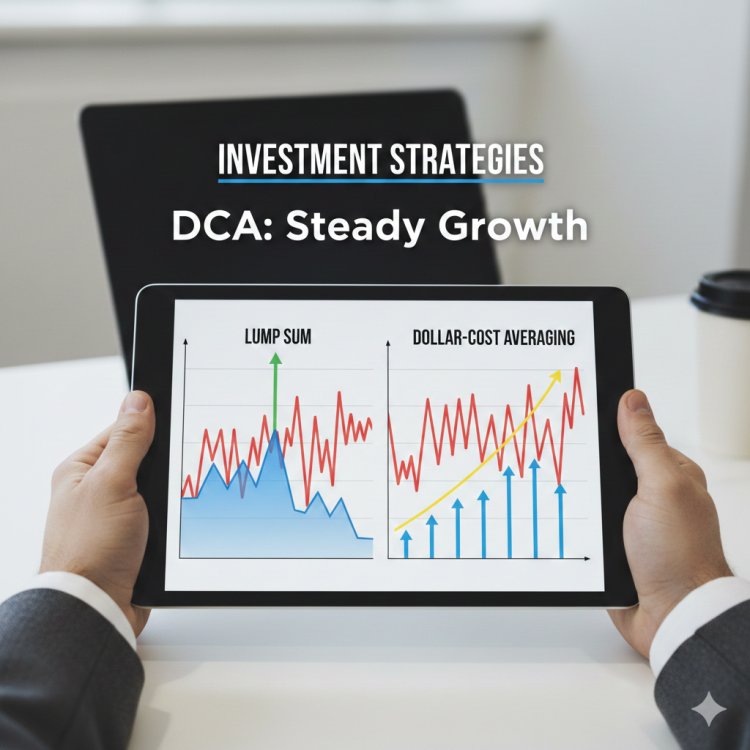
The world of investing often feels like a high-stakes poker game played in a language most people don't speak. Between "candle charts," "moving averages," and the constant noise of financial news cycles, the average person can feel paralyzed. Should you buy now? Should you wait for a "dip"? What if the market crashes tomorrow?
Enter Dollar-Cost Averaging (DCA). It is perhaps the most powerful, yet deceptively simple, strategy available to any investor. It doesn't require a PhD in economics or 12 monitors tracking live data. It only requires discipline.
What is Dollar-Cost Averaging?
At its core, Dollar-Cost Averaging is the practice of investing a fixed amount of money into a particular investment on a regular schedule, regardless of the share price.
Instead of trying to "time the market"—which involves guessing when prices are at their lowest—you buy consistently. When prices are high, your fixed investment buys fewer shares. When prices are low, your fixed investment buys more shares. Over time, this process tends to lower the average cost per share of your investment.
How It Works: A Practical Example
Imagine you decide to invest $500 every month into an Index Fund.
-
Month 1: The share price is $50. Your $500 buys 10 shares.
-
Month 2: The market dips, and the price drops to $40. Your $500 now buys 12.5 shares.
-
Month 3: The market recovers slightly to $45. Your $500 buys 11.1 shares.
In this scenario, you didn't panic when the price dropped. In fact, the drop worked in your favor because you "stacked" more shares at a discount. Your average cost per share over these three months is roughly $44.78, even though the starting price was $50.
The Psychology of Success
The biggest enemy of the investor is not the market; it is the mirror. Human beings are hardwired to buy when things are going well (greed) and sell when things look bleak (fear). This is the exact opposite of the "buy low, sell high" mantra.
DCA removes the emotional burden of decision-making. By automating your investments, you stop asking "Is today a good day to buy?" and start saying "Today is the day I invest." This consistency builds a "wealth-building habit" that is far more effective than sporadic, emotional bursts of activity.
The Math Behind the Strategy
Mathematically, DCA protects you against Sequence of Returns Risk. If you invest a large lump sum right before a market crash, it could take years just to break even. By spreading that investment out over several months or years, you ensure that some of your capital enters the market at lower valuations.
While a lump-sum investment can technically outperform DCA if the market goes up immediately and never looks back, very few people have the stomach to risk their entire life savings on a single day's market performance. DCA offers a smoother "ride" toward your financial goals.
Why Everyone Should Use DCA
-
Accessibility: You don't need $50,000 to start. You can start with $5 or $50.
-
Efficiency: It takes five minutes to set up an automatic transfer. After that, your wealth grows in the background of your life.
-
Risk Mitigation: It prevents you from the catastrophic mistake of putting all your money in at a market peak.
-
Discipline: It forces you to save and invest during bear markets when most people are too afraid to enter.
Conclusion: Time in the Market vs. Timing the Market
The most successful investors are rarely the ones who found the "next big stock" at the perfect time. They are the ones who stayed in the market the longest. Dollar-cost averaging is the bridge that gets you from where you are now to a position of financial security, one steady step at a time.
Regardless of your profession, age, or income level, the math remains the same: consistency creates compound interest, and compound interest creates freedom.
What's Your Reaction?