Consumer Traps: How Retailers Make You Spend More
Discover the hidden psychological tactics retailers use to influence your spending. From store layouts to "decoy pricing," learn how to spot consumer traps and save money today.
In an era of hyper-convenience, the act of "shopping" has evolved from a simple exchange of currency for goods into a highly engineered psychological experience. Whether you are walking through a fluorescent-lit supermarket or scrolling through a sleek e-commerce app, you are navigating a carefully constructed labyrinth designed with one singular goal: to separate you from your money.
Retailers spend billions of dollars annually researching human behavior. They employ neuroscientists, sociologists, and data analysts to map out exactly how our brains react to colors, sounds, smells, and price structures. This is not a conspiracy; it is the science of retail. However, for the global consumer, understanding these "traps" is the first step toward reclaiming financial autonomy.
1. The Layout Labyrinth: Why the Milk is in the Back
One of the oldest tricks in the retail playbook is the physical (or digital) layout of the store. Have you ever wondered why essential items—like bread, milk, or eggs—are always located at the furthest possible point from the entrance?
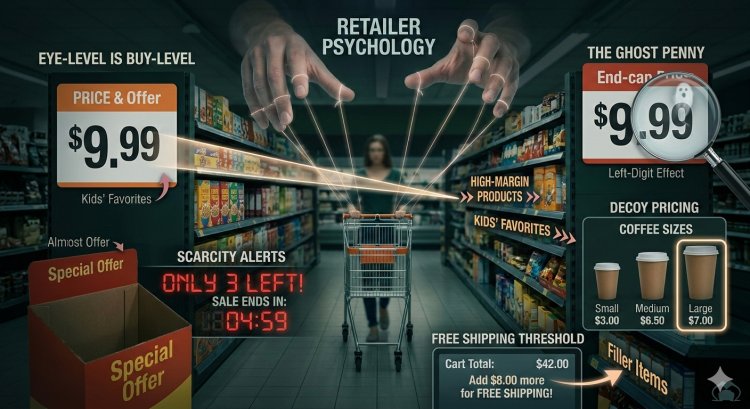
This is known as the Decompression Zone and Destination Item strategy. By placing essentials at the back, retailers force you to walk through the entire length of the store. Every aisle you pass is an opportunity for an unplanned purchase. You came for a gallon of milk, but you left with a bag of chips, a new candle, and a discounted pair of socks.
In the digital world, this translates to "infinite scroll" and complex navigation menus. E-commerce sites often bury the "search" bar or suggest dozens of "frequently bought together" items before you can reach your cart. The longer they keep you browsing, the higher the probability of your "basket size" increasing.
2. The Power of "Free" and the Shipping Trap
The word "free" triggers a chemical response in the human brain that overrides rational thought. Retailers utilize this through the "Free Shipping" threshold.
Consider this scenario: You have $45 worth of items in your cart. Shipping is $10. However, the site offers free shipping on orders over $50. Logically, it makes more sense to pay the $10 shipping than to spend an extra $15 on something you don’t need. Yet, the vast majority of consumers will find a $15 "filler" item to avoid the shipping fee. Retailers have successfully convinced you to spend $60 instead of $55, all while making you feel like you "won" a deal.
3. Price Anchoring and the Decoy Effect
How do you know if a $100 bottle of wine is a good deal? You don’t—unless there is a $200 bottle sitting right next to it.
Price Anchoring is the practice of placing a high-priced item next to the target item to make the latter seem like a bargain. When you see a premium television for $3,000, the $1,200 model suddenly feels affordable, even if your original budget was $800.
Similarly, the Decoy Effect is used in sizing. Imagine a movie theater popcorn:
-
Small: $5.00
-
Medium: $8.50
-
Large: $9.00
The Medium is the "decoy." Its price is set so close to the Large that it makes the Large seem like an incredible value. The retailer doesn't actually want you to buy the Medium; they want to nudge you toward the most expensive option.
4. The Illusion of Scarcity and Urgency
"Only 2 items left in stock!" "Sale ends in 04:59:52!"
These phrases are designed to trigger our evolutionary fear of missing out (FOMO). When we believe a resource is scarce, our "system 1" thinking—the fast, emotional, and intuitive part of the brain—takes over. We stop questioning if we need the item and start focusing on how to secure it before someone else does.
Digital retailers use "dark patterns" like countdown timers or notifications that say "15 people are looking at this item right now" to create a false sense of competition. In reality, the stock is often replenished daily, and the timer often resets the moment the page is refreshed.
5. Sensory Marketing: The Silent Salesman
Retail isn't just visual; it’s an assault on all five senses.
-
Smell: Bakeries at the front of grocery stores vent the smell of fresh bread to stimulate hunger, which leads to more food purchases.
-
Sound: Fast-paced music encourages shoppers to move quickly through a store (often used in fast-food outlets to increase turnover), while slow, classical music encourages lingering and higher spending in luxury boutiques.
-
Touch: Research shows that once a consumer touches a product, they develop a "psychological ownership" of it, making it much harder to put back on the shelf.
6. The "Charm" of 99 Cents
The "Left-Digit Effect" is perhaps the most ubiquitous trap in history. Our brains process numbers so quickly that we focus on the first digit we see. We perceive $19.99 as "under $20" rather than "effectively $20." This tiny distinction, repeated across thousands of items in a lifetime, leads to a significant accumulation of "ghost" expenses that we fail to account for in our mental budgeting.
7. Loyalty Programs: The Data Mine
While "points" and "rewards" seem like a gift to the customer, they serve two hidden purposes. First, they "gamify" spending, encouraging you to hit a certain tier or earn a "free" item that you've effectively pre-paid for through previous overspending. Second, they provide the retailer with invaluable data. They know what you buy, when you buy it, and what price point triggers a purchase. This allows them to send you personalized "deals" that are expertly timed to catch you when your willpower is lowest.
How to Protect Your Wallet
The goal of understanding these tactics isn't to stop shopping altogether, but to become a conscious consumer. Here are three quick rules to bypass the traps:
-
The 24-Hour Rule: For any non-essential purchase, wait 24 hours. The "urgency" and "scarcity" emotions will fade, leaving you with a rational choice.
-
Shop with a List (and a Full Stomach): This negates the sensory traps of the store layout and the smell of the bakery.
-
Calculate the "Hours of Work": Instead of looking at a price tag as $100, look at it as "6 hours of my life at work." This shifts the perspective from a "deal" to a trade-off.
By recognizing the invisible hand of retail psychology, you move from being a target to being a strategist. The next time you walk into a store, remember: everything you see is there for a reason. Make sure your reason for being there is the only one that matters.
What's Your Reaction?