ENTREPRENEURSHIP: THE COMPLETE GUIDE TO BUSINESS PLANNING, FUNDING, CASHFLOW, DIGITAL MODELS & SCALING
A complete guide to entrepreneurship covering business planning, funding, cashflow, digital business models, and scaling strategies for modern entrepreneurs.
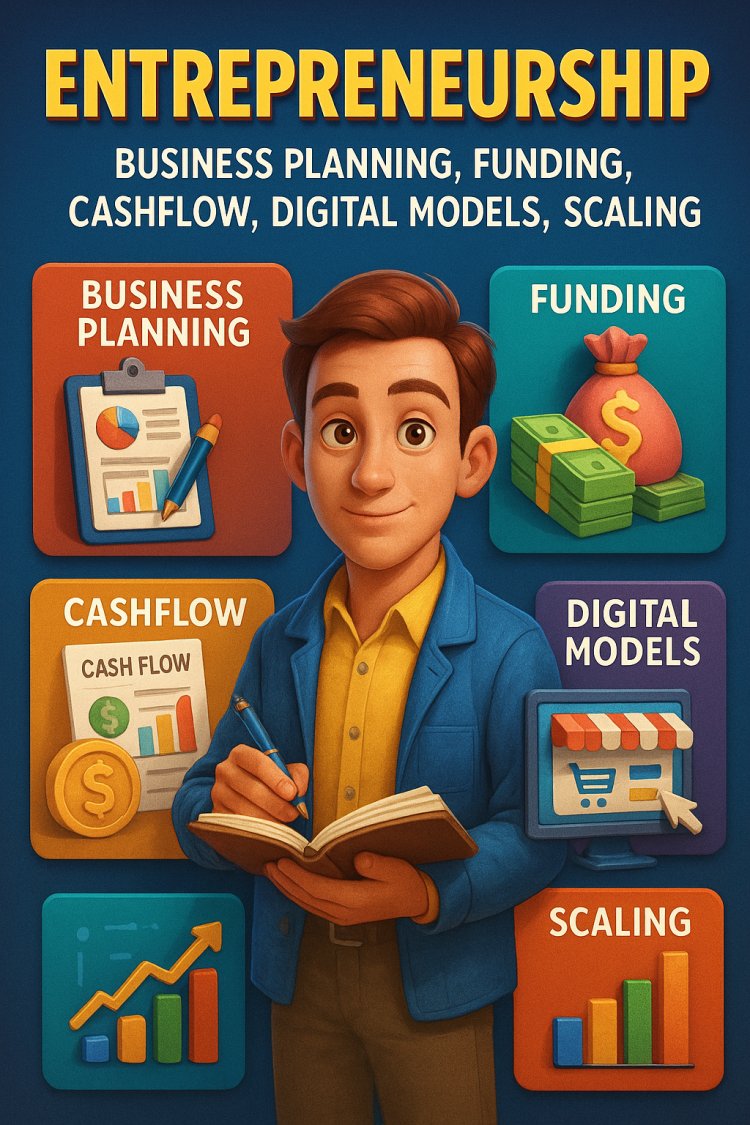
A Comprehensive Roadmap for New Founders, Career Professionals, and Digital Entrepreneurs
Entrepreneurship has become one of the most powerful pathways to wealth, economic transformation, and personal freedom. Whether you’re launching a small side hustle, building a digital empire, or scaling a fast-growth startup, the fundamentals remain the same: clear planning, strategic funding, disciplined cashflow management, smart digital business models, and intentional scaling systems.
This 5,000-word guide breaks down every critical stage — from idea development to growth execution — using practical steps, real-world examples, and modern strategies relevant in Africa and globally.
1. Understanding Entrepreneurship in the Modern Era
Today’s entrepreneur operates in a highly dynamic environment defined by technology, global competition, rapid innovation cycles, and shifting consumer behavior. Entrepreneurship is no longer just about starting a business; it is about solving problems at scale, leveraging tools, and designing systems that produce predictable cashflow.
Modern entrepreneurship sits at the intersection of:
-
Innovation — creating new value or improving existing solutions
-
Risk-taking — making informed bets backed by research and data
-
Resource management — time, money, technology, networks
-
Value delivery — customers pay you only when value is proven
-
Systems thinking — designing repeatable processes
-
Digital leverage — using tech to scale without equivalent cost increases
This new environment rewards founders who adopt a strategic mindset, remain adaptable, and use intelligent planning frameworks to drive execution.
PART I: BUSINESS PLANNING
2. Why Business Planning Matters More Than Ever
A business plan is not just a formal document for banks or investors; it is a strategic blueprint that clarifies:
-
What business you are building
-
Who it serves
-
How it will make money
-
What resources you need
-
How you will stay competitive
-
How you will measure success
A strong plan forces discipline, reduces risk, and accelerates growth because it provides direction and prevents emotional decision-making.
3. The 10 Components of a Winning Business Plan
1. Executive Summary
A concise overview capturing the business idea, target market, revenue model, and financial projections. It should be compelling enough for investors or partners to want to read more.
2. Problem Statement
Every successful company solves a painful problem. Clearly articulate the customer’s frustration, loss, inconvenience, or unmet need.
3. Solution Overview
Explain how your product or service solves the identified problem better, cheaper, or faster than existing alternatives.
4. Market Research
Include customer demographics, market size, customer segmentation, purchasing behavior, and competitive landscape.
5. Business Model
Define how the business will generate revenue. Will you rely on one stream or multiple?
6. Go-to-Market Strategy
Outline customer acquisition channels, pricing strategy, sales funnel, brand positioning, and marketing systems.
7. Operations Plan
Detail your day-to-day processes, staff roles, supply chain, vendors, and tools needed to deliver value consistently.
8. Technology Stack
Today, every business uses tech — e-commerce, CRM systems, POS, digital ads, inventory tools, or automation platforms.
9. Financial Plan
Include projected revenue, expenses, cashflow, break-even analysis, capital requirements, and profitability timelines.
10. Risk Assessment & Mitigation
Identify the biggest threats and how you will manage them: competition, operational risk, financial risk, or market shifts.
A business plan is a living document. It evolves as the business grows and as new data becomes available.
PART II: BUSINESS FUNDING
4. Understanding Startup Capital Needs
Before seeking funding, quantify exactly how much you need and what the money will accomplish. Categories include:
-
Startup capital
-
Working capital
-
Marketing budget
-
Production costs
-
Technology infrastructure
-
Payroll
-
Emergency buffer
Founders who calculate poorly either run out of cash early or raise more money than needed, diluting ownership unnecessarily.
5. Six Main Sources of Funding for Entrepreneurs
1. Personal Savings (Bootstrapping)
The most common form of financing for beginners. It proves commitment and reduces external control over your business.
2. Friends & Family
Flexible terms, but should be documented professionally to avoid relational tension.
3. Bank Loans
Best for established ventures with assets, predictable cashflow, or collateral.
4. Government Grants & Youth Funds
In Kenya, Nigeria, and across Africa, funds like Uwezo Fund, Youth Enterprise Development Fund, and C-YES offer grants or low-interest loans.
5. Angel Investors
High-net-worth individuals investing early in exchange for equity.
6. Venture Capital (VC)
Ideal for fast-scaling startups requiring significant funding and aiming for large markets.
6. How to Become Fundable
Investors look for:
-
A validated idea
-
Traction (customers, early sales, sign-ups)
-
Strong unit economics
-
Clear market opportunity
-
Founder credibility
-
Strong differentiation
-
A realistic financial model
-
Scalability
Your goal is to reduce investor risk and increase confidence in your execution.
PART III: CASHFLOW MANAGEMENT
7. Why Cashflow Is the Lifeblood of Business
Businesses do not die because they lack profits; they die because they run out of cash.
Cashflow determines:
-
Whether you can pay suppliers
-
Whether you can fulfill orders
-
Whether you can hire
-
Whether you can market
-
Whether you can scale
Healthy cashflow equals survival and sustainable growth.
8. Cashflow Planning: Key Principles
1. Always Maintain a Cashflow Forecast
Predict inflows and outflows for 3, 6, and 12 months.
2. Separate Business & Personal Accounts
Avoid mixing expenses to maintain clarity and financial discipline.
3. Negotiate Payment Terms
Request longer payment periods from suppliers and shorter payment periods from customers.
4. Build a War Chest
Keep a minimum of 3–6 months of operating expenses as a buffer.
5. Track Your Burn Rate
Understand how much money you spend monthly and when you will run out.
6. Build Multiple Revenue Streams
Diversify risk to stabilize income patterns.
PART IV: DIGITAL BUSINESS MODELS
9. The Rise of Digital Entrepreneurship
Digital transformation has unlocked new business opportunities that were impossible 10 years ago. Today, anyone with a smartphone, laptop, or Internet access can build:
-
E-commerce brands
-
Digital products (courses, eBooks)
-
SaaS platforms
-
Content businesses
-
Affiliate marketing funnels
-
Subscription communities
-
Print-on-demand brands
-
Consulting and coaching programs
Digital models scale faster, require lower overhead, and expand globally without physical limitations.
10. Top Digital Business Models for 2025 and Beyond
1. E-commerce & Dropshipping
Selling physical products without holding inventory using Shopify, WooCommerce, and Jumia stores.
2. Print-on-Demand
Create branded merchandise without upfront production costs.
3. Digital Courses & Webinars
Package your expertise into scalable knowledge products.
4. Freelancing & Virtual Services
Offer skills such as editing, design, marketing, social media management, or web development.
5. SaaS (Software as a Service)
Recurring revenue through software subscriptions.
6. Affiliate Marketing
Earn commissions by promoting digital or physical products.
7. Membership Sites
Monthly subscription communities with exclusive content.
PART V: SCALING
11. When to Scale a Business
Do not scale prematurely. Scale only when:
-
The business model is validated
-
Revenue is predictable
-
Margins are healthy
-
Customer demand is consistent
-
Systems are in place
-
The team can support growth
Scaling too early creates chaos; scaling too late allows competitors to catch up.
12. Systems Required for Effective Scaling
1. Marketing Systems
Automated funnels, ads, SEO, email marketing, and content pipelines.
2. Sales Systems
CRM, scripts, follow-up sequences, and trained sales reps.
3. Operational Systems
Standard Operating Procedures (SOPs), automation tools, and workflow mapping.
4. Financial Systems
Reporting dashboards, budgets, audits, cashflow forecasts.
5. Technology Systems
Cloud tools, automation software, AI assistants, and integrated databases.
13. Scaling Strategies for Modern Businesses
1. Geographic Expansion
Entering new towns, regions, or international markets.
2. Product Diversification
Adding complementary or premium products.
3. Digital Expansion
Using online platforms to reach larger audiences.
4. Partnerships & Collaborations
Joint ventures, influencer marketing, strategic alliances.
5. Franchise or Licensing Models
Allow others to run your model for a fee or percentage.
6. Talent Acquisition
Hiring the right people to take specialized roles and accelerate growth.
CONCLUSION
Entrepreneurship is not a one-time event; it is an evolving journey of experimentation, learning, and disciplined execution. With a strong business plan, strategic funding approach, controlled cashflow, digital leverage, and robust scaling systems, any founder can build a sustainable and fast-growing enterprise.
The opportunity today is larger than ever — but it rewards those who prepare intelligently and act consistently.
What's Your Reaction?