Entrepreneurship Fundamentals for Beginners.
Master the essentials of starting a business. From ideation and market research to scaling and financial management, learn the entrepreneurship fundamentals every beginner needs to succeed globally.
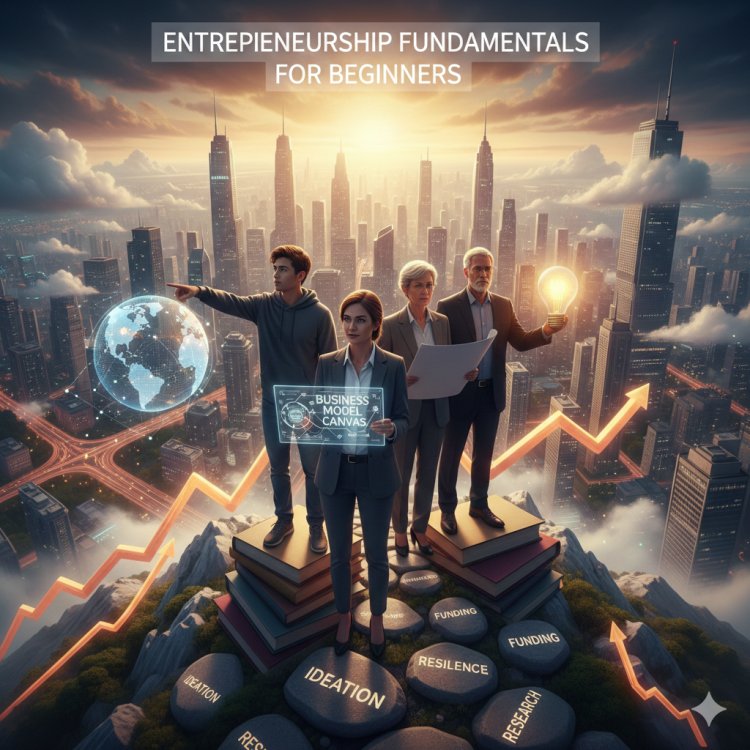
Introduction: The Call of the Modern Entrepreneur
In an era defined by rapid technological shifts and a globalized economy, the concept of a "job for life" has become a relic of the past. Today, the most secure path to financial independence and personal fulfillment is often the one you build yourself. Entrepreneurship is more than just starting a company; it is a mindset—a way of viewing the world through a lens of opportunity, problem-solving, and value creation.
Whether you are a student in Mumbai, a corporate professional in New York, or a retiree in London, the fundamentals of entrepreneurship remain universal. This guide serves as a comprehensive roadmap for anyone ready to transition from a dreamer to a doer.
Phase 1: Developing the Entrepreneurial Mindset
Before you register a domain or print a business card, you must cultivate the mental fortitude required for this journey.
-
Resilience over Comfort: Entrepreneurship is a marathon of hurdles. You will face rejection, failed launches, and financial stress. The ability to bounce back—resilience—is your most valuable asset.
-
The "Solution" Orientation: Most people see problems; entrepreneurs see market gaps. Every frustration you experience in daily life is a potential business opportunity waiting for a solution.
-
Risk Mitigation, Not Risk-Taking: Contrary to popular belief, successful entrepreneurs are not gamblers. They are experts at calculating risk and minimizing downside while maximizing upside.
Phase 2: Ideation and Market Validation
A great idea is worthless if nobody is willing to pay for it. The goal of this phase is to move from "I think people want this" to "I know people need this."
Identifying Your "Why"
Your business should sit at the intersection of your skills, your passions, and what the world is willing to pay for. This is often referred to as the Ikigai of business. If you lack passion, you will quit when things get hard. If you lack a market, you will go broke.
The Power of Market Research
-
Primary Research: Talk to potential customers. Use surveys, interviews, and focus groups. Ask about their "pain points."
-
Secondary Research: Analyze industry reports, competitor websites, and economic trends.
-
The MVP (Minimum Viable Product): Instead of building a perfect product, build the simplest version that solves the core problem. Test it. Gather feedback. Iterate.
Phase 3: Strategic Planning and Business Modeling
The days of 100-page business plans are largely over. In the modern world, agility is key.
The Business Model Canvas
Instead of a static document, use a dynamic framework. Focus on these nine building blocks:
-
Value Proposition: What unique value do you deliver?
-
Customer Segments: Who are you solving the problem for?
-
Channels: How do you reach them?
-
Customer Relationships: How do you keep them?
-
Revenue Streams: How exactly do you make money?
-
Key Activities: What must you do daily to succeed?
-
Key Resources: What assets do you need?
-
Key Partnerships: Who are your allies?
-
Cost Structure: What are your major expenses?
Phase 4: Financial Literacy and Funding
Money is the lifeblood of any venture. Understanding how it flows is non-negotiable.
Managing Cash Flow
Many profitable businesses fail because they run out of cash. Understanding the difference between "profit" (on paper) and "cash in bank" (liquidity) is the hallmark of a sophisticated entrepreneur.
Funding Options
-
Bootstrapping: Using your own savings and reinvesting initial profits. This gives you 100% control.
-
Debt Financing: Taking loans. This requires a clear plan for repayment.
-
Equity Financing: Selling a piece of your company to investors (Angels or VCs). This provides high capital but reduces your ownership.
-
Crowdfunding: Raising small amounts of money from a large number of people via platforms like Kickstarter or Indiegogo.
Phase 5: Building the Brand and Marketing
In a crowded global market, your brand is your promise to the customer.
The Core of Branding
Branding is not just a logo. It is the emotional resonance your company has with its audience. It includes your voice, your ethics, and your visual identity.
Modern Marketing Strategies
-
Content Marketing: Provide value through blogs, videos, and podcasts to build trust.
-
Social Media: Engage where your customers live. A B2B company might thrive on LinkedIn, while a fashion brand dominates Instagram and TikTok.
-
SEO (Search Engine Optimization): Ensure that when people search for a solution to their problem, your business appears on the first page of results.
Phase 6: Operations and Scaling
Once you have "Product-Market Fit," the challenge shifts from survival to growth.
Systems and Automation
To scale, the founder must eventually step out of the daily tasks. This requires creating Standard Operating Procedures (SOPs). If a task can be automated by software or delegated to a virtual assistant, it should be.
Hiring and Culture
Your first five hires will determine the culture of your company for years to face. Hire for attitude and "culture add" rather than just technical skills. A cohesive team with a shared vision can out-perform a group of disconnected geniuses every time.
Phase 7: Legal and Ethical Considerations
Protect your hard work by ensuring your foundation is solid.
-
Structure: Choose the right legal entity (LLC, Corporation, Sole Proprietorship) based on your country's laws to protect your personal assets.
-
Intellectual Property: Register your trademarks, copyrights, and patents early.
-
Ethics: In the long run, integrity is your most profitable strategy. Transparent pricing, honest marketing, and fair treatment of employees build a brand that lasts decades.
Conclusion: The Journey Begins Now
Entrepreneurship is not a destination; it is a continuous process of learning, adapting, and growing. The world needs your ideas, your energy, and your unique perspective. While the path is rarely straight, the rewards—both financial and personal—are unparalleled.
Start small. Think big. Act fast.
What's Your Reaction?