The Psychology of Spending: Why We Buy What We Buy (and How to Take Control)
Explore the hidden triggers behind your purchases. From emotional spending to neuromarketing secrets, learn the science of why we buy and how to master your money.
Introduction: The Invisible Hand on Your Wallet
Every day, we make hundreds of small decisions. Some are as trivial as choosing between a latte or a black coffee, while others are as significant as signing a mortgage. We like to believe that these choices are the result of rigorous logic and calculated utility. We tell ourselves we bought the new smartphone because our old one was slow, or we purchased a specific brand of detergent because it is objectively better at removing stains.
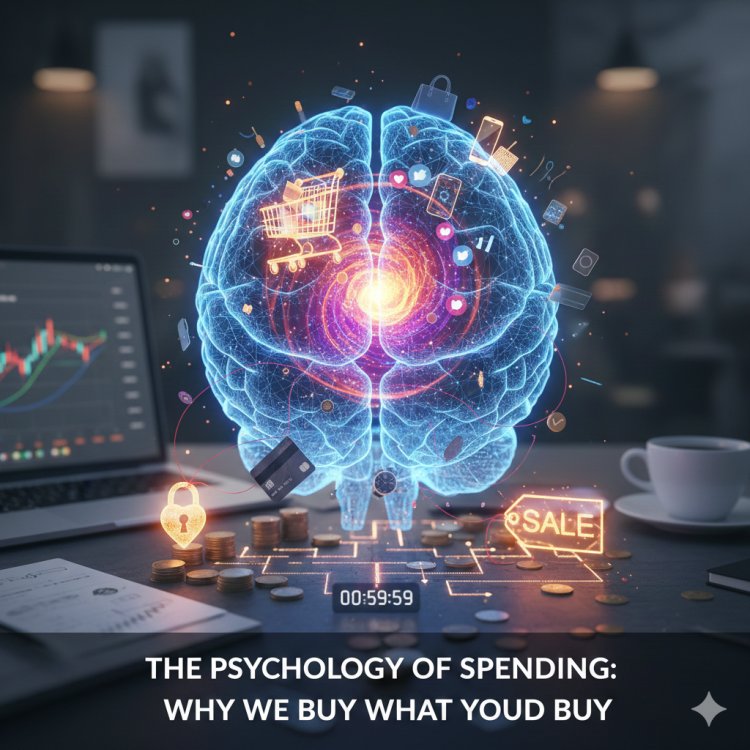
However, the reality is far more complex. Behind every "Add to Cart" click and every swiped credit card lies a sophisticated web of psychological triggers, evolutionary leftovers, and expertly crafted marketing cues. The psychology of spending is the study of why we part with our hard-earned money—often in ways that defy our own long-term interests.
1. The Evolutionary Roots of Consumption
To understand modern spending, we must first look at our ancestors. For the vast majority of human history, resources were scarce. Survival depended on the ability to gather and store calories, tools, and materials.
-
The Accumulation Instinct: In a world of scarcity, "more" equaled "survival." Today, even though we live in an age of abundance, our brains are still wired to accumulate. This manifests as a dopamine hit when we acquire something new.
-
Social Signaling: In tribal structures, status was vital for protection and mating. Today, we use "conspicuous consumption" to signal our status to the "tribe." We buy luxury cars or designer clothes not just for their function, but to communicate our place in the social hierarchy.
2. The Role of Emotions: Shopping as a Band-Aid
We are not thinking machines that feel; we are feeling machines that think. Emotional spending—often called "retail therapy"—is one of the primary drivers of unnecessary purchases.
-
The Dopamine Loop: When we see something we want, our brain releases dopamine, the neurotransmitter associated with reward and anticipation. Interestingly, the dopamine spike often happens before the purchase. The act of buying provides a temporary "high" that masks underlying stress, sadness, or boredom.
-
The Search for Control: When life feels chaotic, shopping provides a sense of agency. You may not be able to control your workload or the global economy, but you can control exactly which pair of shoes you bring home.
3. Cognitive Biases: How Our Brains Trick Us
Behavioral economists have identified several "short-circuits" in human reasoning that lead us to spend more than we intended.
The Anchoring Effect
This is why sales are so effective. If you see a jacket priced at $200, but it’s marked down to $100, your brain "anchors" to the original price. You don't see a $100 expense; you see a $100 "saving," even if the jacket is only worth $80.
The Scarcity Principle
Humans are terrified of missing out. Terms like "Limited Edition," "Only 2 left in stock," or "Flash Sale ends in 2 hours" trigger an urgent fear of loss. This bypasses the analytical part of our brain and forces us into an impulsive "buy now" mindset.
Social Proof
We are social creatures. If we see that a product has 5,000 five-star reviews or is being used by an influencer we admire, we feel a sense of safety. If everyone else is buying it, it must be good. This "herd mentality" is why brands invest so heavily in testimonials and celebrity endorsements.
4. The Architecture of Choice: Environments Designed for Spending
Whether you are walking through a physical mall or browsing an app, the environment is rarely neutral. It is "choice architecture" designed to maximize your output.
-
Supermarket Layouts: There is a reason the milk and eggs are at the very back of the store. You have to walk past aisles of snacks, sodas, and promotional displays just to get the essentials.
-
The "Endless Scroll": E-commerce sites use infinite scrolling to remove "stopping points." In a physical book, you know when the chapter ends. On a shopping app, there is no end, leading to mindless browsing and eventual purchasing.
-
Frictionless Payment: The further we get from physical cash, the less "pain" we feel when spending. Credit cards, "Buy Now, Pay Later" (BNPL) services, and one-click ordering remove the psychological friction of parting with money.
5. The Identity Factor: Buying Who We Want To Be
We don't just buy products; we buy identities. Every purchase is a vote for the person we want to become.
-
The "Aspirational Self": We buy gym equipment because we want to be "the fit person." We buy organic kale because we want to be "the healthy person." Often, the act of buying the item provides enough of a psychological reward that we never actually use the product for its intended purpose.
-
Brand Loyalty: Brands like Apple, Nike, or Tesla have moved beyond being companies—they are symbols of values. When a consumer buys these brands, they are reinforcing their own self-image as "innovative," "athletic," or "environmentally conscious."
6. The Impact of Digital Culture and Social Media
In the 21st century, the psychology of spending has been supercharged by the digital landscape.
-
The Comparison Trap: Historically, we compared ourselves to our neighbors. Now, we compare ourselves to the curated, filtered lives of billionaires and celebrities globally. This creates a constant sense of "relative deprivation," driving us to spend to keep up with an impossible standard.
-
Algorithmic Precision: Data analytics now allow companies to know what you want before you do. By tracking your search history and dwell time, algorithms can present the right product at the exact moment your willpower is lowest.
7. Breaking the Cycle: How to Reclaim Your Finances
Understanding the psychology of spending is the first step toward changing it. Here are strategies to move from impulsive to intentional spending:
-
The 48-Hour Rule: For any non-essential purchase, wait 48 hours. This allows the dopamine spike to subside and the rational prefrontal cortex to take back control.
-
Calculate "Life Hours": Instead of looking at a price tag in dollars, look at it in hours of your life. If you earn $25 an hour, is that $100 pair of jeans worth four hours of your labor?
-
Unsubscribe and Unfollow: Remove the triggers. If a certain influencer makes you feel inadequate, or a retail newsletter constantly tempts you with "deals," remove them from your digital environment.
-
Identify Your Triggers: Do you shop when you're tired? Lonely? Celebrating? Recognizing the emotional state that leads to spending allows you to find healthier outlets for those feelings.
Conclusion: Toward Mindful Consumption
Spending money is a necessary part of modern life, and there is no shame in enjoying the fruits of your labor. However, when our spending is driven by unconscious triggers and clever marketing, we lose our freedom.
By understanding the psychological forces at play—the dopamine loops, the cognitive biases, and the social pressures—we can transition from being passive consumers to conscious ones. We can start buying what we truly need and value, rather than what we are programmed to want.
What's Your Reaction?