Long-Term vs. Short-Term Investing: The Ultimate Guide to Building Lasting Wealth
Discover the critical differences between long-term and short-term investing. Learn which strategy fits your financial goals, risk tolerance, and professional lifestyle in this comprehensive 2026 wealth-building guide.
Introduction: The Great Financial Divide
The world of finance is often portrayed as a fast-paced, high-stakes environment where split-second decisions lead to overnight fortunes. Conversely, it is also depicted as a slow, methodical journey requiring decades of patience. Both of these depictions represent the two primary pillars of market participation: short-term and long-term investing.
Understanding the nuance between these two approaches is not merely a matter of academic interest; it is the fundamental requirement for anyone looking to secure their financial future. Whether you are a student just starting your career, a mid-level professional looking to optimize your tax strategy, or a retiree aiming to preserve capital, the strategy you choose will dictate your daily habits, your stress levels, and ultimately, your net worth.
Defining the Horizons
Before diving into the mechanics, we must define our terms.
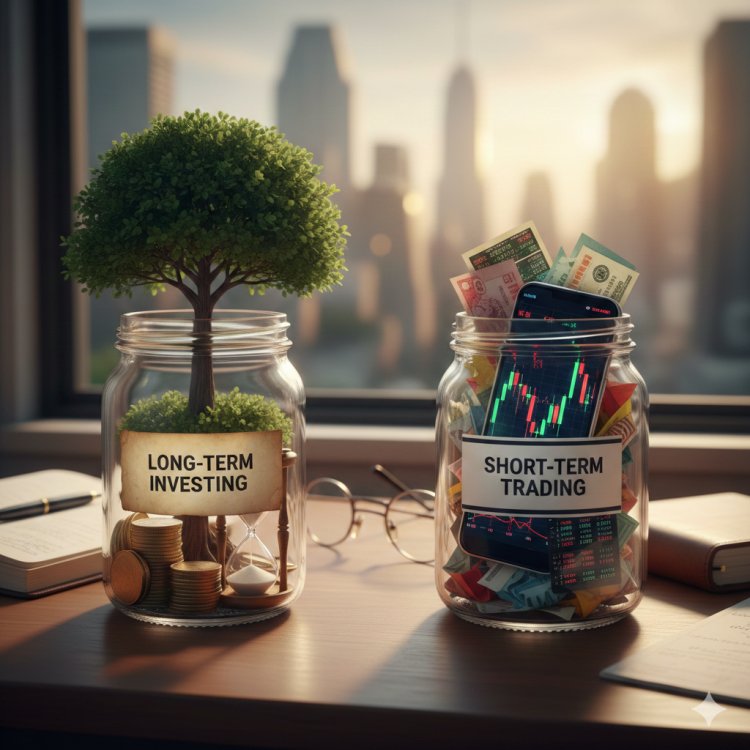
Short-term investing generally refers to any strategy where the holding period for an asset is less than one year. In many cases, this can be as short as a few minutes (scalping) or a few weeks (swing trading). The primary objective is to capitalize on market inefficiencies and price fluctuations.
Long-term investing is characterized by a "buy and hold" mentality, where assets are kept for five, ten, or even forty years. The goal here is not to beat the market on a Tuesday afternoon, but to participate in the long-term growth of the global economy and the power of compounding.
The Mechanics of Long-Term Investing
Long-term investing is built on the bedrock of fundamental analysis. When you invest for the long term, you are not just trading a ticker symbol; you are buying a piece of a business, a property, or an economy.
1. The Power of Compounding
Albert Einstein famously referred to compound interest as the eighth wonder of the world. In a long-term strategy, your earnings begin to earn their own earnings. This exponential growth is why starting early is more important than the amount of money you start with.
2. Risk Mitigation through Time
Market volatility is a mathematical certainty in the short term. However, historical data suggests that the longer you hold a diversified basket of stocks (such as an S&P 500 index fund), the lower your probability of a negative return becomes. Time acts as a buffer against the "noise" of political events and economic hiccups.
3. Tax Advantages
In many jurisdictions, holding an asset for longer than a year qualifies the investor for long-term capital gains tax rates, which are significantly lower than standard income tax rates. This allows more of your money to remain in the market working for you.
The Mechanics of Short-Term Investing
Short-term investing, or trading, is a different beast entirely. It requires a mastery of technical analysis—the study of price charts, volume, and patterns.
1. Exploiting Volatility
While the long-term investor fears a market crash, the short-term trader often welcomes it. Volatility creates "spreads" and price gaps that can be exploited for quick profit.
2. Liquidity and Flexibility
Short-term strategies keep your capital "liquid." If you need your cash next month for a down payment on a house, you cannot afford to have it tied up in a volatile stock that might be down 20% at that specific moment. Short-term vehicles like high-yield savings accounts or short-duration bonds provide safety and accessibility.
3. The Role of Leverage
Many short-term traders use margin or derivatives to amplify their positions. This can lead to massive gains on small price movements, but it also introduces the risk of total capital loss.
Psychological Considerations
Investing is 10% math and 90% temperament.
The long-term investor must battle boredom and FOMO (Fear Of Missing Out). Watching a "meme stock" skyrocket while your index fund grows by 8% can be agonizing. Success in the long term requires the discipline to do nothing when the world is panicking.
The short-term investor must battle stress and ego. The adrenaline of a winning trade can lead to overconfidence, while a losing streak can lead to "revenge trading"—trying to win back losses by taking even greater risks.
Asset Allocation Across Life Stages
A universal truth in finance is that your strategy should evolve as you do.
-
Early Career (Ages 20–35): This group should lean heavily toward long-term, high-growth equities. They have the greatest asset of all: time.
-
Mid-Career (Ages 36–55): A balanced approach is key. While still focusing on growth, professionals in this bracket should begin diversifying into real estate and more stable bonds to protect their accumulating wealth.
-
Late Career/Retirement (55+): The focus shifts to capital preservation and income generation. Short-term instruments become more important to ensure that living expenses are covered regardless of market conditions.
Common Pitfalls to Avoid
Regardless of your chosen path, certain traps can derail any investor:
-
Over-Trading: Even for short-term traders, excessive activity leads to high commission fees and "slippage," which eat into profits.
-
Lack of Diversification: Putting all your eggs in one basket (whether it’s a single stock or a single cryptocurrency) is gambling, not investing.
-
Ignoring Inflation: If your "safe" short-term investment returns 2% while inflation is at 4%, you are effectively losing money.
Conclusion: Finding Your Equilibrium
There is no "perfect" strategy, only the strategy that is perfect for you. Most successful investors actually use a "Core and Satellite" approach. They keep 80% of their wealth in long-term, diversified index funds (the Core) and use 20% for shorter-term, more speculative plays (the Satellite).
By balancing the patience of the long-term view with the agility of short-term opportunities, you can build a resilient portfolio that withstands any economic weather.
What's Your Reaction?