Good Debt vs. Bad Debt: The Ultimate Practical Guide to Building Wealth
Master your finances with our comprehensive guide on good debt vs. bad debt. Learn how to leverage loans for growth and avoid the traps of high-interest consumer credit.
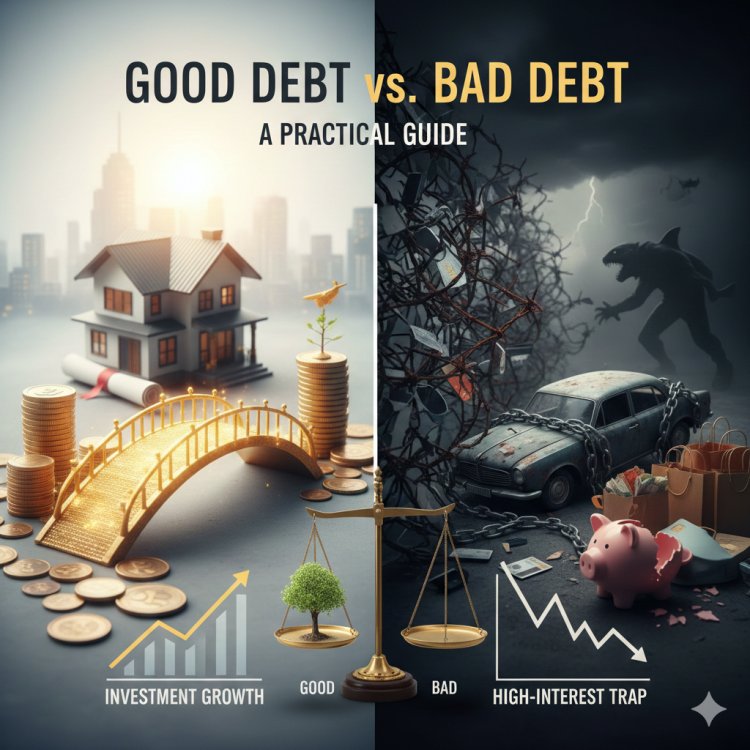
Understanding the distinction between good debt and bad debt is often the primary factor that separates those who achieve financial independence from those who remain trapped in a cycle of paycheck-to-paycheck living. Debt is a tool—much like a hammer. In the hands of a builder, it creates a structure; in the hands of the untrained, it can cause significant damage.
1. Defining the Core Concepts
At its simplest level, the difference between good and bad debt comes down to value over time.
-
Good Debt: This is an investment that will grow in value or generate long-term income. It typically carries a lower interest rate and has potential tax advantages.
-
Bad Debt: This involves borrowing money to purchase rapidly depreciating assets or for consumption. It usually carries high interest rates and provides no future financial return.
2. The Characteristics of Good Debt
Good debt is often described as "leverage." You are using someone else's money to acquire something that you could not afford upfront but which will eventually pay for itself or provide a profit.
Real Estate and Mortgages
A mortgage is the most common form of good debt. Real estate generally appreciates over time. Furthermore, if you own a home, you are building equity rather than paying rent to a landlord. For investors, mortgage debt allows for the purchase of rental properties where the tenant’s rent covers the debt service, creating passive income.
Education and Student Loans
While the conversation around student debt is complex, an investment in a high-demand degree or technical certification is statistically linked to higher lifetime earnings. This is a debt taken on to increase your "human capital."
Business Loans
Starting or expanding a business often requires capital. If the business generates a return on investment (ROI) that exceeds the interest rate of the loan, the debt is considered a powerful engine for wealth creation.
3. The Anatomy of Bad Debt
Bad debt is a drain on your future wealth. It takes money from your future self to pay for a lifestyle you cannot afford today.
High-Interest Credit Cards
Credit cards are the most common form of bad debt. When you carry a balance, you are often paying interest rates of 15% to 30%. There is almost no investment in the world that consistently returns 20%, meaning every dollar of credit card interest you pay is a direct hit to your net worth.
High-Depreciation Assets (Cars)
While many people need a car to get to work, taking out a large, high-interest loan for a luxury vehicle is bad debt. A car loses a significant portion of its value the moment it leaves the lot. If your car loan interest is high, you may quickly find yourself "underwater," owing more than the car is worth.
Payday Loans and Predatory Lending
These are the most dangerous forms of debt. They feature exorbitant interest rates and fees that make it nearly impossible for the borrower to escape the debt cycle.
4. The "Grey Area" of Debt
Not all debt fits perfectly into two boxes. Context matters.
-
Consolidation Loans: Taking out a new loan to pay off several smaller ones. This is "good" if it lowers your total interest rate, but "bad" if you continue to run up balances on the original cards.
-
Car Loans for Work: If a reliable vehicle is the only way to reach a high-paying job, a modest, low-interest car loan can be viewed as a necessary tool for income, though the asset itself depreciates.
5. Evaluating Debt: The ROI Framework
To decide if a debt is worth taking, ask yourself three questions:
-
What is the interest rate? If the rate is higher than what you could reasonably earn by investing that money elsewhere, it is likely bad debt.
-
Will this asset increase my net worth? Will it be worth more in five years, or will it be in a landfill?
-
Can I afford the monthly payments? Even "good" debt can become "bad" if it causes a cash flow crisis that leads to missed payments and a ruined credit score.
6. Strategies for Managing and Eliminating Debt
If you find yourself burdened by bad debt, the priority should be elimination.
-
The Debt Avalanche: Pay off the debt with the highest interest rate first. This saves the most money over time.
-
The Debt Snowball: Pay off the smallest balances first to build psychological momentum.
-
Refinancing: If you have good debt (like a mortgage), keep an eye on market rates. Refinancing to a lower rate can save tens of thousands of dollars over the life of the loan.
7. Global Perspectives on Debt
Across different cultures and professional backgrounds, the perception of debt varies. In some regions, any form of borrowing is seen as a moral failing. In others, aggressive leveraging is seen as the only path to success. However, the mathematical reality remains the same: if the cost of the money (interest) is lower than the value created by the money, you are winning. If the cost of the money is higher than the value created, you are losing.
Key Takeaway: Good debt builds a bridge to your future; bad debt builds a wall around your present. Use credit as a strategic tool, not a lifestyle supplement.
What's Your Reaction?