Income Streams 101: What They Are & Why You Need Them
Discover the fundamentals of building multiple income streams. Learn how to diversify your earnings, reduce financial risk, and build long-term wealth in today's global economy.
Introduction: The Shift in Global Economics
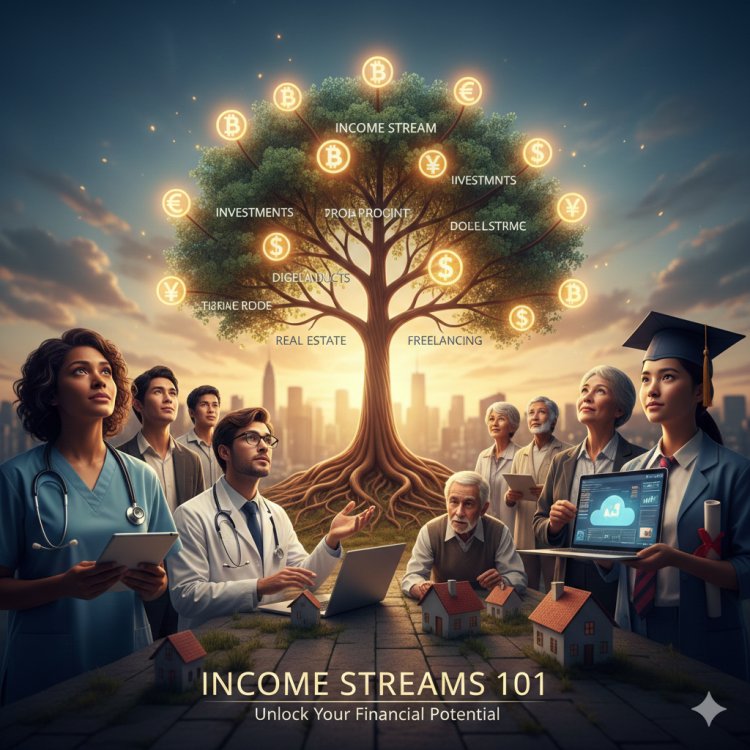
The traditional concept of a "job for life" has undergone a radical transformation. In the mid-20th century, the standard career path involved finding a single employer, climbing a linear corporate ladder, and retiring with a guaranteed pension. Today, that model has largely been replaced by a dynamic, often volatile, global economy. Whether you are a student in Mumbai, a designer in New York, or a healthcare professional in Berlin, the need for financial resilience is a universal constant.
An income stream is simply a specific source of money coming into your possession. While most people are familiar with the "active" stream—trading hours for a paycheck—the most successful individuals across all professions utilize a "multi-stream" approach. This guide explores the architecture of modern earnings and why diversifying your "revenue portfolio" is no longer a luxury, but a necessity for survival and prosperity.
Defining the Core Types of Income
To understand why you need multiple streams, you must first understand the different flavors of income. Not all dollars are created equal; some require your physical presence, while others work for you while you sleep.
1. Active Income (Earned Income) This is the most common form of income. It includes wages, salaries, tips, and commissions. The defining characteristic of active income is the direct exchange of time for money. If you stop working, the money stops flowing. While it is the primary starting point for almost everyone, relying solely on active income creates a "single point of failure" in your financial life.
2. Passive Income Passive income is money earned from enterprises in which the individual is not actively involved on a daily basis. Examples include rental income, limited partnerships, or automated businesses. It often requires a significant upfront investment of either time or capital, but once established, it requires minimal effort to maintain.
3. Portfolio Income This is income derived from investments, such as dividends, interest, and capital gains. For many professionals, portfolio income is the end goal of a long-term retirement strategy. It allows your accumulated wealth to generate its own momentum.
The Psychology of Financial Fragility
Why do so many people stick to a single source of income? The answer often lies in a false sense of security. Having one high-paying job feels stable until a company-wide layoff or an industry shift occurs. This is known as financial fragility.
When you have only one stream of income, you are essentially a "price taker" in the labor market. You have less leverage to negotiate and higher stress regarding job performance. By contrast, having three or four streams of income—even if some are small—changes your psychological relationship with money. It provides a "safety net" that allows for more courageous career moves and better mental health.
The Power of Diversification
In the world of investing, diversification is the only "free lunch." The same principle applies to your personal earnings. Diversification protects you against:
-
Sector-specific downturns: If you work in tech and the tech market dips, having a rental property or a side consultancy in a different field keeps you afloat.
-
Geopolitical instability: For a global audience, having digital income streams that are not tied to a local currency can be a hedge against inflation and local economic crises.
-
Life changes: Health issues or family responsibilities might temporarily prevent active work. Passive streams ensure that your lifestyle is maintained during these periods.
Step-by-Step: How to Build Your Second Stream
Transitioning from one stream to two does not require quitting your job. It requires a shift in how you view your "off-hours."
Assess Your Current Assets Do you have unused space? Do you have a specialized skill that others find difficult? Do you have liquid savings sitting in a low-interest account? Your first "side" stream should ideally leverage what you already have.
The "Scale" Factor When choosing a new income stream, consider its scalability. If you start tutoring, you are still trading time for money. However, if you record a series of educational videos and sell them as a course, you have created a scalable asset. The goal is to move gradually from high-effort/low-scale activities to low-effort/high-scale assets.
Common Barriers to Entry
Many professionals hesitate to start because of perceived complexity. Common myths include:
-
"I need a lot of money to start." Many digital streams require near-zero capital.
-
"I don't have time." Building a stream can be done in as little as five hours a week if focused on high-impact tasks.
-
"The market is saturated." There is always room for high-quality, authentic perspectives in any niche.
Expanded Discussion: The Professional's Edge
For professionals in fields like law, medicine, engineering, or education, income streams often take the form of "knowledge products." A senior engineer might write a technical manual, while a teacher might create a specialized curriculum for a global marketplace. This is a form of "recycled labor"—doing the work once and getting paid for it repeatedly.
Long-Term Wealth and the Compound Effect
The real magic of multiple income streams is found in the compound effect. When your secondary streams cover your basic living expenses, your primary salary can be redirected entirely into investments. This creates an exponential growth curve that can lead to early retirement or the ability to pursue "passion projects" without the pressure of monetization.
Conclusion: The New Standard
In a world of rapid technological change and shifting employment norms, the single-income household is becoming a relic of the past. By understanding the various types of income and systematically building new avenues for revenue, you insulate yourself against the unknown.
Building income streams is not about greed; it is about autonomy. It is the ability to say "yes" to opportunities you love and "no" to situations that no longer serve you. Start small, stay consistent, and view every new stream as a brick in the wall of your financial fortress.
What's Your Reaction?