How to Diversify Income as a Beginner: The Ultimate Guide to Financial Resilience
Learn how to diversify your income as a beginner with this comprehensive guide. Explore passive income, side hustles, and investment strategies to build long-term wealth.

In an era of rapid economic shifts, the concept of a "job for life" has largely vanished. For the modern professional, whether you are a recent graduate, a mid-career manager, or someone approaching retirement, relying on a single source of income is no longer just a risk—it is a strategic vulnerability.
Income diversification is the process of creating multiple channels through which money flows into your bank account. It is the financial equivalent of not putting all your eggs in one basket. This guide will walk you through the philosophy, the practical steps, and the long-term habits required to build a multi-stream income portfolio from scratch.
Phase 1: The Mindset of Multi-Stream Earning
Before you pick a side hustle or buy a stock, you must shift your perspective on how money is earned. Most people are taught to trade time for money. While this is a foundational starting point, true diversification requires moving toward trading value, assets, or systems for money.
1. The Three Tiers of Income
-
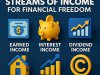
Active Income: Your primary salary or hourly wages.
-
Linear Income: Side projects where you still trade time for money (e.g., freelancing).
-
Passive Income: Systems that earn money while you sleep (e.g., dividends, digital products).
2. Overcoming the "Expert" Myth Many beginners stall because they feel they aren't "expert" enough to charge for a service. In reality, you only need to be two steps ahead of your target audience to provide value.
Phase 2: Low-Barrier Entry Points for Beginners
For those just starting, the goal is to generate "proof of concept"—earning your first dollar outside of your main paycheck.
Service-Based Freelancing If you have a laptop and a skill (writing, coding, graphic design, data entry, or translation), you have a marketable asset. Platforms like Upwork or Fiverr allow you to test the waters. The key here is to productize your service. Instead of saying "I am a writer," say "I provide 500-word SEO-optimized blog posts for tech startups."
The Sharing Economy Do you have underutilized assets? Renting out a spare room, a car, or even high-end camera equipment can provide immediate cash flow with minimal extra labor. This is often the easiest "bridge" to diversification because it utilizes what you already own.
Phase 3: Building Digital Assets
The digital economy offers the highest scalability. Unlike physical products, digital products can be created once and sold an infinite number of times.
Educational Content If you have mastered a specific professional task—be it Excel macros, project management, or even sourdough baking—you can package that knowledge.
-
E-books: Low production cost, high distribution.
-
Online Courses: Higher price point, builds authority.
-
Templates: People pay for convenience. Selling a "Business Budget Template" saves someone five hours of work.
Affiliate Marketing and Content By building an audience around a niche (via a blog, a newsletter, or social media), you can earn commissions by recommending products you trust. This requires patience but offers significant long-term passive potential.
Phase 4: Investment and Capital-Based Income
Once your side hustles begin to generate a surplus, that money should be diverted into assets that grow independently of your labor.
The Power of Compound Interest $1,000 invested at a 7% annual return doubles roughly every 10 years. For a beginner, the simplest entry point is a low-cost Index Fund or Exchange-Traded Fund (ETF). This allows you to own a tiny piece of hundreds of companies, diversifying your risk automatically.
Dividend Investing Some companies pay out a portion of their profits to shareholders. By reinvesting these dividends, you create a "snowball effect" where your money creates more money, which then creates even more money.
Phase 5: Managing the Logistics
Diversification can lead to chaos if not managed correctly. To succeed, you must treat your side streams like a business.
1. Time Management Avoid burnout by dedicating specific "deep work" blocks to your secondary income streams. Even five hours a week can yield significant results over a year.
2. Tax and Legal Structures As your income grows, consult with a professional regarding business registration and tax obligations. Keeping your personal and business finances separate from day one is a hallmark of a professional.
3. Risk Assessment Never invest money you cannot afford to lose. Your primary income should cover your "Needs" (housing, food, insurance), while your secondary streams should be used for "Wants," debt reduction, and further investment.
Phase 6: Scaling and Automation
The final stage of diversification is removing yourself from the daily operations.
If your freelancing business is booming, consider hiring a virtual assistant to handle administrative tasks. If your digital products are selling, use automated email marketing sequences to nurture leads. The goal is to transform your active efforts into autonomous systems.
Conclusion
Diversifying your income is not a get-rich-quick scheme; it is a long-term strategy for freedom. It provides a cushion against layoffs, a fund for your passions, and a path toward a work-life balance defined by choice rather than necessity. Start small, stay consistent, and watch as your financial landscape transforms from a single narrow path into a broad, resilient network of opportunities.
What's Your Reaction?