How to Monitor & Rebalance Your Investments: The Ultimate Guide to Long-Term Wealth
Learn the essential strategies for monitoring and rebalancing your investment portfolio. Discover how to maintain your risk tolerance and maximize returns in any market.
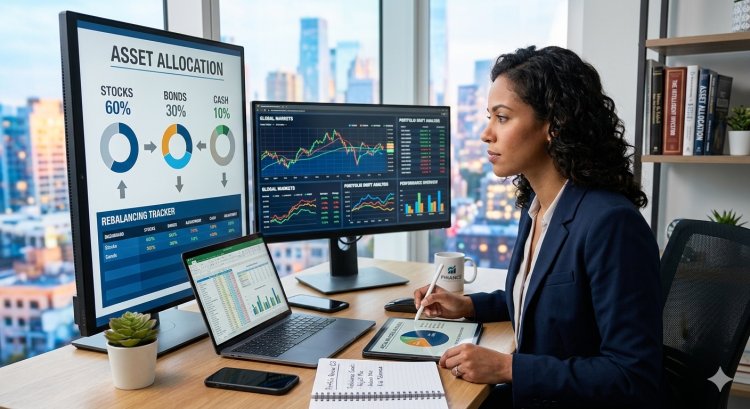
Investing is often marketed as a "set it and forget it" activity. While passive investing through index funds and ETFs is a highly effective strategy, the "forget it" part is a misconception. To build sustainable wealth, an investor must act as the pilot of their financial aircraft. You do not need to micro-manage every movement, but you must monitor the gauges and occasionally adjust the flight path.
Portfolio monitoring and rebalancing are the twin pillars of risk management. Without them, even the most diversified portfolio can transform into a concentrated, high-risk gamble over time.
Understanding Portfolio Drift
Imagine you start with a balanced portfolio of 60% stocks and 40% bonds. During a massive bull market, your stocks might grow by 20%, while your bonds remain stagnant. Suddenly, your portfolio is 70% stocks and 30% bonds. This is known as portfolio drift.
While it might feel good to see your stock value rising, your risk profile has changed. You are now more exposed to market crashes than you originally intended. Rebalancing is the process of bringing those percentages back to your original target.
The Psychology of the Investor
The hardest part of rebalancing is the emotional toll. To rebalance, you often have to sell your "winners" (the assets that are doing well) and buy more of your "losers" (the assets that have underperformed). This goes against human intuition. However, this is the literal application of the oldest rule in investing: Buy low, sell high.
Step 1: Establishing Your Target Asset Allocation
Before you can monitor or rebalance, you must have a baseline. Your asset allocation should be based on three factors:
-
Time Horizon: When do you need the money?
-
Risk Tolerance: How much of a market drop can you stomach without panic-selling?
-
Financial Goals: Are you saving for retirement, a home, or education?
Common Allocation Models
-
Aggressive: 90% Stocks / 10% Bonds (Best for young professionals with 30+ years to retirement).
-
Moderate: 60% Stocks / 40% Bonds (The classic "balanced" approach).
-
Conservative: 30% Stocks / 70% Bonds (Best for those nearing or in retirement).
Step 2: How to Monitor Your Portfolio
Monitoring does not mean checking your brokerage app every hour. In fact, over-monitoring often leads to emotional trading.
What to Look For
-
Performance vs. Benchmarks: If your "Total Stock Market Fund" is up 8% but the S&P 500 is up 12%, you need to investigate why.
-
Expense Ratios: Are the fees on your funds creeping up or are there cheaper alternatives now available?
-
Tax Efficiency: Are you holding high-dividend assets in taxable accounts instead of tax-advantaged ones like an IRA or 401k?
-
Asset Concentration: Has one single company stock grown so much that it now makes up 20% of your net worth?
Frequency of Monitoring
For most individual investors, a quarterly check-in is the "sweet spot." It is frequent enough to catch major market shifts but infrequent enough to prevent knee-jerk reactions to daily volatility.
Step 3: When to Rebalance
There are two primary strategies for deciding when to pull the trigger on a rebalance.
The Calendar Method
You choose a specific date (e.g., the first Monday of January or your birthday) to reset your portfolio. This is simple and requires the least amount of math.
The Percentage (Threshold) Method
You rebalance only when an asset class drifts by a certain percentage—usually 5%. Using our 60/40 example, if stocks hit 65%, you rebalance. This method is more responsive to market conditions but requires more frequent monitoring.
Step 4: The Mechanics of Rebalancing
There are three ways to actually move the money:
-
Selling and Buying: The traditional way. You sell the over-performing asset and use the cash to buy the under-performing one. Note: This may trigger capital gains taxes in taxable accounts.
-
Directing New Contributions: If you are still in the "accumulation phase" (adding money every month), simply use your new cash to buy the under-weighted assets until the balance is restored. This avoids selling and triggering taxes.
-
Dividend Reinvestment: Instead of automatically reinvesting dividends back into the fund that paid them, take them as cash and manually buy the assets that are lagging.
The Global Perspective: Currency and Inflation
For a global audience, rebalancing also involves considering currency risk. If you are an investor in Europe holding US-denominated stocks, a shift in the EUR/USD exchange rate can affect your portfolio value just as much as the stock price itself. Diversifying across different geographic regions (US, Emerging Markets, Europe) provides a hedge against local economic downturns.
Conclusion: The Long Game
Monitoring and rebalancing are not about "beating the market." They are about staying in the market. By controlling risk, you prevent the catastrophic losses that lead investors to quit. Wealth is built through discipline, patience, and the steady hand of a well-monitored portfolio.
What's Your Reaction?