Investment Mistakes to Avoid: The Definitive Guide to Protecting Your Wealth
Master the art of wealth preservation. Learn the most common investment mistakes to avoid, from emotional trading to lack of diversification, and build a resilient portfolio.
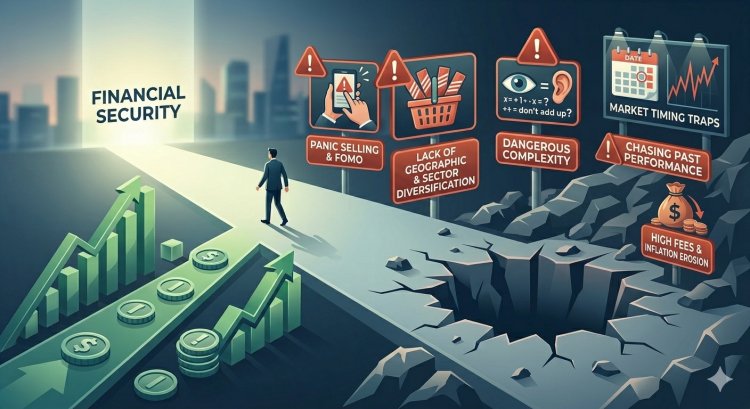
Introduction: The Psychology of Wealth
Investing is often described as a cold, calculated science governed by numbers, charts, and historical data. However, the reality of the financial markets is far more human. Successful investing is less about being the smartest person in the room and more about being the most disciplined. For global professionals across all sectors—from medicine to engineering to the arts—understanding how to navigate the pitfalls of the financial landscape is the difference between a secure retirement and a perpetual struggle for liquidity.
The following analysis explores the critical errors that derail even the most well-intentioned investors. By recognizing these patterns, you can pivot from reactive decision-making to a proactive, long-term strategy.
1. The Perils of Emotional Decision-Making
The most significant threat to your portfolio isn't a market crash; it is the person looking back at you in the mirror. Behavioral finance tells us that humans are biologically wired to fear loss more than they value gains.
-
Panic Selling: When the market dips, the instinctual "fight or flight" response kicks in. Investors often sell at the bottom, locking in losses, only to miss the inevitable recovery.
-
FOMO (Fear Of Missing Out): Conversely, when an asset class—be it AI stocks or digital currencies—skyrockets, investors rush in at the peak, driven by greed and social proof.
-
Confirmation Bias: We tend to seek out news that supports our current investments and ignore warning signs. This leads to holding onto "sinking ships" far longer than is mathematically sound.
2. Failure to Understand Diversification
A common misconception is that owning ten different tech stocks constitutes a diversified portfolio. True diversification requires a lack of correlation between assets.
-
Sector Concentration: If your entire net worth is tied to the technology sector, a specific regulatory change or a shift in interest rates can wipe out decades of growth.
-
Geographic Risk: Many investors suffer from "home country bias," investing only in their local markets. A global professional must look toward international equities and emerging markets to hedge against domestic economic downturns.
-
Asset Class Variance: A robust portfolio balances equities with fixed income, real estate, and perhaps commodities. This ensures that when one "engine" of the economy stalls, another provides stability.
3. The Hidden Erosion: Fees and Inflation
Many investors focus solely on gross returns, ignoring the silent killers of wealth: management fees and the decreasing purchasing power of currency.
-
High Expense Ratios: A 1% difference in management fees might seem negligible, but over 30 years, it can result in hundreds of thousands of dollars in lost compounding.
-
Ignoring Inflation: Keeping too much capital in a standard savings account is a guaranteed way to lose money in real terms. If inflation is at 3% and your bank pays 0.5%, your "safe" money is actually shrinking.
4. Market Timing vs. Time in the Market
The attempt to "time" the bottom of a crash or the peak of a bubble is a fool’s errand. Even professional fund managers rarely outperform the broader market consistently over decades.
-
Missing the Best Days: Data shows that missing just the ten best performing days in a decade can cut your total returns in half. Since those "best days" often occur immediately after the "worst days," staying invested is the only way to capture them.
-
The Cost of Hesitation: Waiting for the "perfect moment" to enter the market often leads to "analysis paralysis," where capital sits on the sidelines while the market trends upward.
5. Lack of a Clear Investment Policy Statement (IPS)
Without a roadmap, any road will take you nowhere. An Investment Policy Statement is a written document that outlines your goals, risk tolerance, and liquidity needs.
-
Age-Appropriate Risk: A professional in their 20s should have a drastically different risk profile than someone approaching retirement. Failing to adjust this "glide path" can lead to catastrophic losses right when the capital is needed most.
-
Lifestyle Creep: As professionals earn more, they often increase their spending rather than their investing. This delays the point of financial independence indefinitely.
6. The Danger of Complexity
Wall Street thrives on selling complex products—structured notes, hedge funds, and private equity—that often benefit the provider more than the investor.
-
The "Black Box" Problem: If you cannot explain how an investment generates cash flow in two sentences, you should not own it. Complexity often hides high fees and opaque risks.
-
Over-Trading: The advent of zero-commission trading apps has turned many long-term investors into accidental day traders. Frequent trading increases tax liabilities and decreases the likelihood of catching long-term growth trends.
7. Neglecting the Role of Taxes
Tax drag is one of the most significant impediments to wealth. Professional investors utilize strategies to keep more of what they earn.
-
Tax-Advantaged Accounts: Failing to maximize contributions to retirement schemes (like 401ks, IRAs, or national pension equivalents) is leaving free money on the table.
-
Tax-Loss Harvesting: This involves selling losing positions to offset capital gains, a strategy that can significantly lower your annual tax bill when managed correctly.
8. Misunderstanding Risk vs. Volatility
Volatility is the price of admission for market gains. Risk, however, is the permanent loss of capital.
-
Short-Term Noise: Price fluctuations over a week or a month are noise. Investors who confuse this with actual risk often make the mistake of exiting great companies just because the price moved downward temporarily.
-
Leverage: Using borrowed money (margin) to invest amplifies gains but also amplifies losses. For the average professional, margin trading introduces a level of risk that can lead to total liquidation.
9. Lack of an Emergency Fund
Investing money that you might need in the next six to twelve months is a recipe for disaster. If a medical emergency or job loss occurs during a market downturn, you may be forced to sell your investments at a loss. A liquid emergency fund is the "moat" that protects your investment "castle."
10. Chasing Past Performance
Just because a fund returned 40% last year does not mean it will do so this year. In fact, mean reversion suggests that the "hottest" funds today are often the worst performers tomorrow. Invest based on forward-looking fundamentals, not rear-view mirror hype.
Conclusion: The Path Forward
Avoiding these mistakes requires more than just financial knowledge; it requires a temperament of steel and a commitment to lifelong learning. The global economy is a complex system, but your approach to it should be simple, disciplined, and focused on the long term. By minimizing fees, controlling your emotions, and maintaining a diversified outlook, you place yourself in the top tier of global investors.
Wealth is not built overnight, but it can be lost in a single afternoon of poor decision-making. Protect your future by respecting the math and mastering your mind.
What's Your Reaction?