Mastery Over Money: What Is Debt & How It Works in Today’s Economy
Decode the world of debt with this comprehensive guide. Learn how debt works, the difference between good and bad debt, and strategies to manage your financial future effectively.
The Foundations of Debt
Debt is a fundamental pillar of the global financial system. At its simplest level, debt is an obligation that requires one party, the debtor, to pay money or another agreed-upon value to another party, the creditor. Debt is a deferred payment, or series of payments, which differentiates it from an immediate purchase.
In modern society, debt is often viewed through a lens of stress or burden, but it is also a powerful tool for growth. Without debt, most individuals would be unable to purchase homes, many students would be unable to afford higher education, and businesses would struggle to scale their operations. To understand how debt works is to understand the mechanics of the modern world.
The Components of Debt
Every debt agreement generally consists of three primary components:
-
The Principal: This is the original sum of money borrowed.
-
The Interest: This is the cost of borrowing the money, usually expressed as a percentage of the principal over a specific period.
-
The Term: The duration over which the debt must be repaid.
When you take out a loan, you are essentially "buying" money today using your future income. The interest you pay is the price of that convenience and the compensation for the lender’s risk.
How Debt Functions: The Mechanics of Borrowing
The process of debt begins with a credit assessment. Lenders—whether they are banks, credit unions, or private entities—need to determine the likelihood that a borrower will repay the loan. They look at credit scores, income levels, and existing debt-to-income ratios.
Interest Rates and APR
Interest is the engine of the debt industry. It can be categorized into two main types:
-
Fixed Interest: The rate remains the same throughout the life of the loan. This provides stability for the borrower’s budget.
-
Variable Interest: The rate fluctuates based on market benchmarks. While these may start lower, they carry the risk of increasing over time.
The Annual Percentage Rate (APR) is a broader measure of the cost of borrowing, as it includes both the interest rate and any fees or costs associated with the loan.
The Role of Collateral
Debt is further divided into secured and unsecured categories.
-
Secured Debt: Backed by an asset, such as a house (mortgage) or a car (auto loan). If the borrower defaults, the lender can seize the asset.
-
Unsecured Debt: Not backed by collateral. Examples include credit cards and personal loans. Because these are riskier for lenders, they typically carry higher interest rates.
Types of Debt: From Personal to Global
Consumer Debt
This is the debt held by individuals to fund daily life or major purchases. Credit cards are the most common form, often utilizing "revolving credit," where the borrower can spend up to a certain limit, pay it back, and spend again.
Mortgages
A mortgage is a loan specifically for real estate. Because homes are expensive, these loans typically have long terms (15 to 30 years). They are secured by the property itself.
Corporate and Sovereign Debt
Businesses issue debt (often in the form of bonds) to fund expansion or research. Similarly, governments issue sovereign debt to fund public services, infrastructure, and social programs when tax revenue is insufficient.
The Psychology and Strategy of Debt
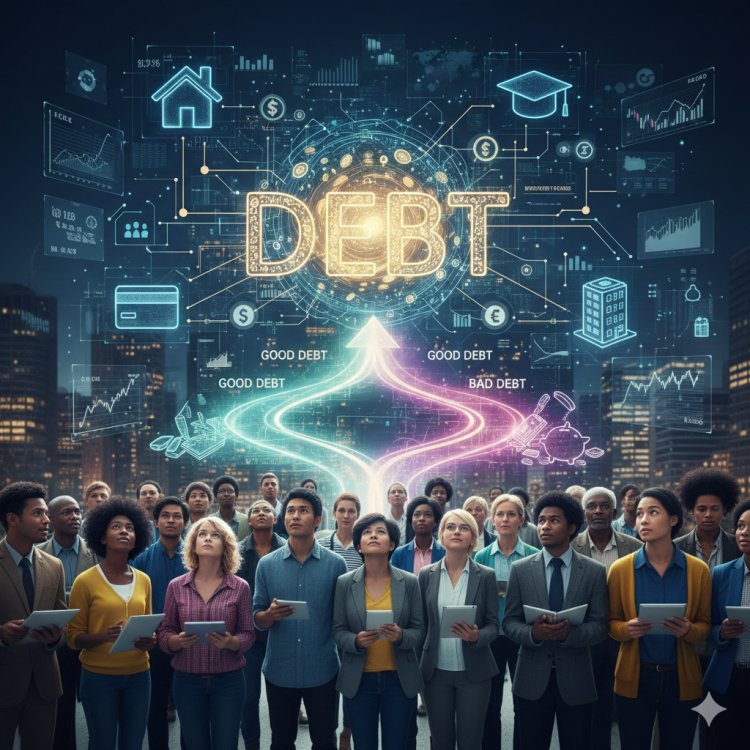
Understanding debt requires a distinction between Good Debt and Bad Debt.
-
Good Debt is an investment that will grow in value or generate long-term income. A student loan that increases earning potential or a mortgage on a home that appreciates are classic examples.
-
Bad Debt involves borrowing for assets that depreciate quickly or for purely consumptive purposes, like high-interest credit card debt for luxury items.
The Power of Leverage
In the professional world, debt is often referred to as "leverage." By using borrowed capital, a business can see a higher return on equity than it could by using only its own cash. However, leverage is a double-edged sword; while it magnifies gains, it also magnifies losses.
Managing and Eliminating Debt
For many, the goal is to become debt-free. Two popular strategies for debt repayment are:
-
The Debt Snowball: Paying off the smallest balances first to build psychological momentum.
-
The Debt Avalanche: Paying off debts with the highest interest rates first to minimize the total cost of borrowing over time.
Effective debt management requires a strict budget and an understanding of one's cash flow. It is about ensuring that debt serves your goals rather than dictating your life.
Conclusion
Debt is neither inherently good nor evil; it is a financial tool. When used responsibly, it facilitates homeownership, education, and innovation. When misunderstood or mismanaged, it can lead to cycles of financial hardship. By mastering the concepts of interest, principal, and leverage, individuals and professionals alike can navigate the economy with confidence and clarity.
What's Your Reaction?