Inflation Explained: Why Prices Rise
Inflation affects everyone. Learn what inflation is, why prices rise, its causes, effects, and how individuals and businesses can adapt in a changing global economy.
Introduction
Inflation is a word that appears frequently in news headlines, economic reports, and everyday conversations, yet many people struggle to fully understand what it means and why it matters. From the rising cost of groceries and fuel to increased rent and healthcare expenses, inflation directly affects how far money can go. Regardless of age, profession, or location, inflation influences financial decisions, business operations, and government policies worldwide.
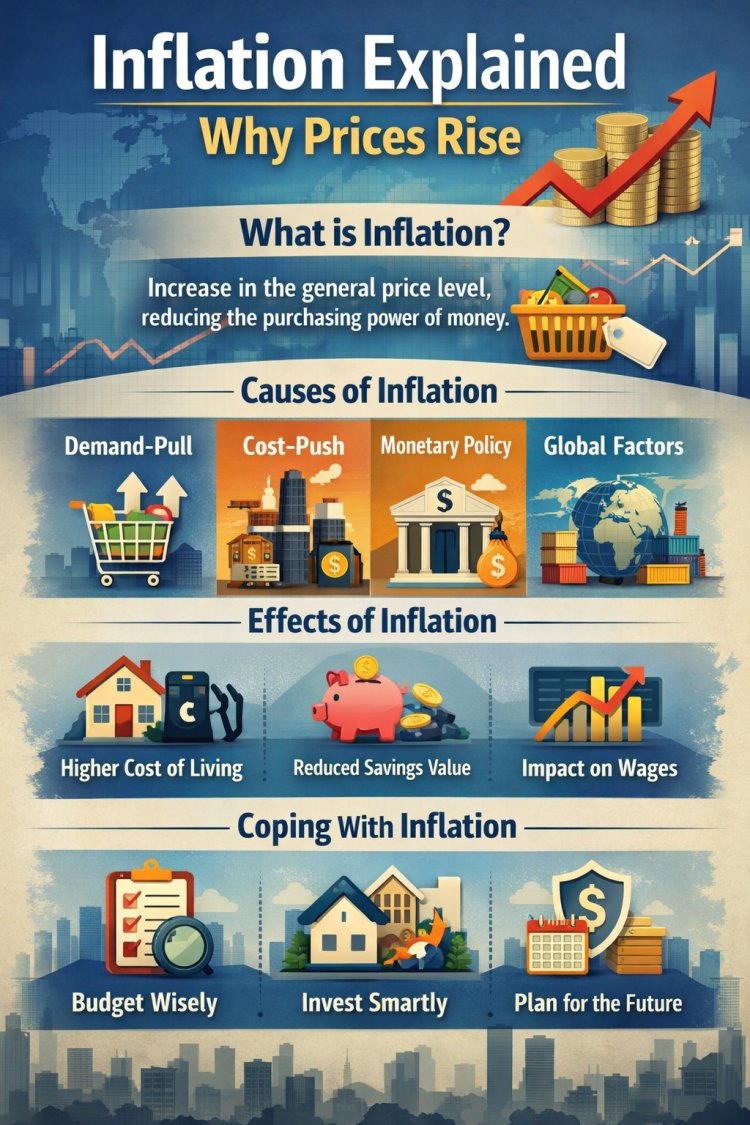
At its core, inflation refers to the general increase in prices over time, which leads to a decline in the purchasing power of money. When inflation rises, each unit of currency buys fewer goods and services than before. While moderate inflation is considered a normal part of a growing economy, high or unpredictable inflation can create economic instability and financial hardship.
This article explains inflation in clear and practical terms, explores why prices rise, examines its causes and effects, and highlights how individuals, businesses, and governments respond to inflation in a global economy.
What Is Inflation?
Inflation is the sustained increase in the general price level of goods and services in an economy over a period of time. It is not about the price of a single product increasing, but rather a broad rise across many sectors such as food, housing, transportation, education, and healthcare.
Inflation is commonly measured using price indices such as the Consumer Price Index (CPI) or the Producer Price Index (PPI). These indices track changes in the prices of a selected basket of goods and services over time, offering a snapshot of how living costs evolve.
When inflation occurs, the value of money decreases. For example, if inflation is 5 percent annually, something that costs 100 units of currency today would cost approximately 105 units next year.
Why Do Prices Rise?
Prices rise due to a combination of economic forces rather than a single cause. These forces interact in complex ways, influencing how businesses set prices and how consumers spend their money.
Broadly, the reasons prices rise can be grouped into demand-side factors, supply-side factors, monetary influences, and external or structural factors.
Demand-Pull Inflation
Demand-pull inflation occurs when the demand for goods and services exceeds their supply. When consumers, businesses, or governments spend more money than the economy can produce, prices rise as sellers respond to increased demand.
Several factors can drive demand-pull inflation:
-
Rising household incomes
-
Increased government spending
-
Expansion of credit and loans
-
Strong consumer confidence
For example, during periods of rapid economic growth, employment levels rise and people have more disposable income. As more people compete for the same goods and services, businesses raise prices to balance demand with available supply.
Cost-Push Inflation
Cost-push inflation occurs when the cost of producing goods and services increases, forcing businesses to raise prices to maintain profitability. These rising costs can come from several sources, including:
-
Higher wages
-
Increased raw material costs
-
Rising energy and fuel prices
-
Supply chain disruptions
If transportation costs increase due to higher fuel prices, businesses often pass these costs to consumers in the form of higher prices. Similarly, when wages rise significantly without a matching increase in productivity, businesses may increase prices to cover labor expenses.
The Role of Money Supply
Money supply plays a critical role in inflation. When too much money circulates in an economy relative to the production of goods and services, inflation can result. This concept is often summarized by the idea that more money chasing the same amount of goods leads to higher prices.
Central banks influence money supply through monetary policy tools such as:
-
Interest rates
-
Open market operations
-
Reserve requirements
Low interest rates encourage borrowing and spending, which can stimulate economic growth but may also increase inflation if spending grows too rapidly. Conversely, higher interest rates tend to reduce spending and help control inflation.
Imported Inflation and Global Factors
In an interconnected global economy, inflation is not limited by national borders. Imported inflation occurs when the cost of imported goods and services rises due to factors such as:
-
Currency depreciation
-
Global supply shortages
-
Rising international commodity prices
For example, if a country relies heavily on imported fuel or food, a global increase in oil or grain prices can lead to higher domestic inflation. Exchange rate fluctuations also play a role, as a weaker currency makes imports more expensive.
Structural and Long-Term Factors
Some inflationary pressures develop gradually due to structural changes in the economy. These include:
-
Population growth
-
Urbanization
-
Technological shifts
-
Changes in consumption patterns
For instance, rapid urbanization can increase demand for housing, transportation, and utilities, driving prices upward. Similarly, aging populations may increase demand for healthcare services, contributing to higher medical costs.
Types of Inflation
Inflation can take different forms depending on its severity and pace.
Moderate Inflation
A low and stable inflation rate is generally considered healthy for economic growth. It encourages spending and investment while allowing wages and profits to grow gradually.
High Inflation
High inflation occurs when prices rise rapidly, reducing purchasing power and increasing uncertainty. It can distort financial planning and discourage long-term investment.
Hyperinflation
Hyperinflation is an extreme and rare form of inflation characterized by runaway price increases and a collapse in confidence in the currency. It often results from severe economic mismanagement or political instability.
Effects of Inflation on Individuals
Inflation affects individuals differently depending on income levels, spending habits, and financial planning.
Key impacts include:
-
Reduced purchasing power
-
Increased cost of living
-
Pressure on household budgets
-
Decline in real savings value
People with fixed incomes may struggle more during periods of inflation, as their income does not adjust quickly to rising prices. Savers may also be affected if inflation exceeds the interest earned on savings.
Effects of Inflation on Businesses
Businesses face both challenges and opportunities during inflationary periods.
Challenges include:
-
Rising production costs
-
Uncertainty in pricing strategies
-
Reduced consumer spending power
However, businesses with strong pricing power or efficient cost management may adapt better. Inflation can also increase nominal revenues, though profits depend on controlling expenses.
Effects of Inflation on Governments
Governments are deeply involved in managing inflation because of its impact on economic stability and public welfare.
Inflation influences:
-
Tax revenues
-
Public spending
-
Debt repayment
-
Social programs
Moderate inflation can reduce the real value of public debt, but high inflation can undermine trust in government institutions and weaken economic performance.
How Inflation Is Controlled
Central banks play a key role in controlling inflation through monetary policy. Common tools include:
-
Raising interest rates to reduce borrowing and spending
-
Reducing money supply
-
Communicating inflation targets to manage expectations
Governments may also use fiscal policies, such as adjusting taxes or reducing public spending, to influence inflation.
Inflation and Wages
Wages and inflation are closely linked. Ideally, wages should increase at a pace that matches productivity growth and inflation. If wages lag behind inflation, real income declines. If wages rise too quickly, they may contribute to further inflation.
Inflation and Investments
Inflation affects investment returns by reducing real gains. Investors often seek assets that can keep pace with or outperform inflation, such as equities, real estate, or inflation-linked bonds.
Understanding inflation is essential for making informed investment decisions and protecting long-term wealth.
Inflation in a Global Context
Inflation is a global phenomenon influenced by international trade, capital flows, and geopolitical events. Economic shocks in one region can ripple across the world, affecting prices elsewhere.
Global cooperation, sound economic policies, and strong institutions are essential for managing inflation in an interconnected world.
Why Understanding Inflation Matters
Inflation is not just an abstract economic concept. It affects everyday life, from the price of food and fuel to education and retirement planning. Understanding why prices rise empowers individuals to make informed financial choices and helps businesses and policymakers plan more effectively.
Conclusion
Inflation is a complex but essential concept in understanding how economies function. Prices rise due to a mix of demand pressures, production costs, money supply dynamics, and global influences. While moderate inflation is a normal feature of economic growth, uncontrolled inflation can undermine financial stability and living standards.
By understanding inflation, its causes, and its effects, individuals and organizations can better navigate economic changes, protect their purchasing power, and plan for the future with confidence.
What's Your Reaction?