Master Your Finances: The Ultimate Monthly Money Review Template for Lasting Wealth
Take control of your financial future with our comprehensive Monthly Money Review Template. Learn how to track spending, increase savings, and achieve your goals with this easy-to-use professional framework for all ages.
Introduction: Why a Monthly Money Review is Your Superpower
In an era of instant transactions, digital subscriptions, and global economic shifts, maintaining a clear picture of your financial health is no longer a luxury—it is a necessity. Regardless of your profession, age, or location, the way you manage your resources dictates the quality of your future. The "Monthly Money Review Template" is more than just a document; it is a ritual of empowerment. It allows you to transition from being a passive observer of your bank account to an active architect of your wealth.
Most people fail to reach their financial goals not because they don't earn enough, but because they lack visibility. A monthly review provides that visibility, acting as a diagnostic tool for your habits and a roadmap for your aspirations.
The Philosophy of the Monthly Review
The goal of this review is not to induce guilt over a morning latte or a weekend dinner. Instead, it is designed to align your spending with your values. If you value travel but spend all your excess income on unused streaming services, there is a misalignment. The monthly review identifies these gaps and gives you the permission to spend on what truly matters by eliminating what does not.
Section 1: The Pre-Review Checklist
Before diving into the numbers, you must gather your data. Attempting to do a money review from memory is a recipe for inaccuracy.
-
Bank Statements: Access all checking and savings accounts.
-
Credit Card Portals: Download activity for the previous month.
-
Investment Portfolios: Check balances for retirement accounts, brokerage accounts, and any digital assets.
-
Debt Balances: Note the remaining totals on loans, mortgages, or credit cards.
-
Physical Receipts: If you use cash, ensure these are accounted for.
Section 2: The Core Components of the Template
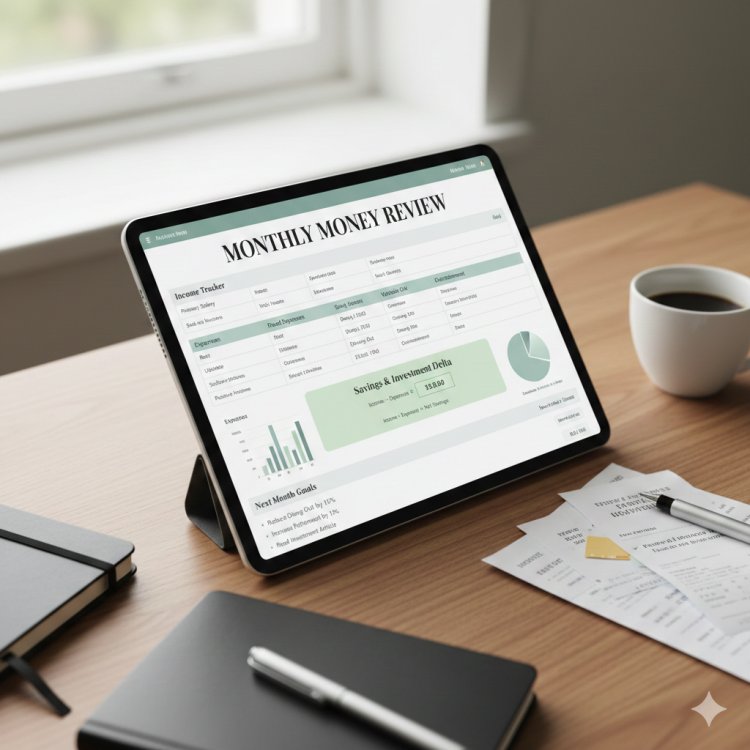
Part A: The Income Tracker
List every source of inflow. In a modern economy, income is often fragmented.
-
Primary Salary: Your main take-home pay after taxes.
-
Side Hustles: Freelance work, consulting, or gig economy earnings.
-
Passive Income: Dividends, interest, or rental income.
-
One-time Inflows: Gifts, tax refunds, or sold items.
Part B: Fixed vs. Variable Expenses
Fixed Expenses are the "non-negotiables." These are usually consistent every month:
-
Housing (Rent/Mortgage)
-
Utilities (Electricity, Water, Internet)
-
Insurance Premiums
-
Subscription Services
-
Minimum Debt Payments
Variable Expenses are where the most "leakage" occurs. These fluctuate based on behavior:
-
Groceries and Dining Out
-
Entertainment and Hobbies
-
Transportation/Fuel
-
Personal Care and Shopping
Part C: The Savings and Investment Delta
This is the most critical metric: Income minus Expenses. If this number is positive, you are building wealth. If it is negative, you are eroding it.
Section 3: Analyzing the Data
Once the data is entered into your template, ask yourself these diagnostic questions:
-
What was the biggest surprise this month? (Unexpected repairs, forgotten subscriptions).
-
Did I meet my savings goal? If not, identify the specific category that overextended.
-
Are my fixed costs under 50 percent of my income? This is a standard benchmark for financial stability.
-
What can be automated? If you forgot to pay a bill or save, set up a system to handle it next month.
Section 4: Setting Goals for the Next Month
A review looks backward, but its purpose is to move you forward. Based on your findings, set three specific targets for the upcoming thirty days:
-
The Reduction Goal: "I will reduce dining out by 15 percent."
-
The Growth Goal: "I will increase my retirement contribution by 1 percent."
-
The Educational Goal: "I will read one article on tax-efficient investing."
Section 5: Overcoming Psychological Barriers
Money is deeply emotional. Many avoid these reviews because of "financial anxiety." To overcome this, treat the review as a professional task. You are the CEO of "You, Inc." A CEO does not ignore the balance sheet because it looks bad; they study it to make it better.
For younger professionals, this is about building the "muscle memory" of management. For mid-career professionals, it is about optimizing for retirement. For those in later stages of life, it is about wealth preservation and legacy.
Conclusion: Consistency is the Only Secret
There is no "magic" investment that replaces the need for disciplined tracking. The Monthly Money Review Template is your primary tool for navigating the complexities of the modern financial landscape. By dedicating just sixty minutes at the end of every month to this process, you ensure that your hard-earned money is working just as hard for you.
Financial freedom is not a destination you reach by accident; it is a series of intentional turns made one month at a time. Start your review today, and watch your future self thank you.
What's Your Reaction?